
Nutrition & Supplements
Carbohydrates for Strength Athletes: Fuel the Lift, Not the Hype
A science-backed strength athlete guide to simple and complex carbohydrates, glycogen, timing, strongman competition fueling, and how much carbs really matter.

The practical take.
- What it may help with
- Fuel demanding training with carbohydrate foods you enjoy and tolerate. A short, well-fed session and an all-day competition have different needs.
- What the evidence supports
- Research findings depend on the outcome and context. More training volume, same-day repetitions and long-term muscle growth are different questions.
- Joel’s approach
- Build normal meals, use convenient foods when timing is tight, and adjust intake to actual training, calories and digestion rather than a universal formula.
Read full guide & sources
Which carbs should you eat, when should you eat them, and does the type actually change your performance?
If I had a dollar for every argument I've heard about carbs, I'd have enough to buy another gym's worth of plates. One guy swears white rice is the secret to getting huge. Another says sugar is poison. Somebody else thinks the only thing separating him from a world-record deadlift is a $60 tub of designer carbohydrate powder.
Here's where I land: carbs are fuel. The smartest choice depends on what you're doing with that fuel. A heavy single, a two-hour leg session, and an all-day strongman contest aren't the same job.
I dug into the human research, including the newer 2025 and 2026 studies. Let's sort out the science without turning breakfast into a chemistry exam.
First, what kinds of carbs are we talking about?
There are three broad groups worth understanding:
- Sugars: glucose, fructose and galactose, plus combinations like sucrose (table sugar) and lactose (milk sugar). You'll find them in fruit, milk, honey, sports drinks, and plenty of packaged foods.
- Starches: long chains of glucose found in rice, potatoes, oats, pasta, bread and grains. They're complex chemically, but some cooked and processed starches digest relatively quickly.
- Fiber and resistant starch: carbohydrate that isn't fully broken down by your own small-intestine enzymes. Some is fermented by gut bacteria; some passes through. Great for digestive health, but a giant fiber bomb before deadlifts can be a bad time.
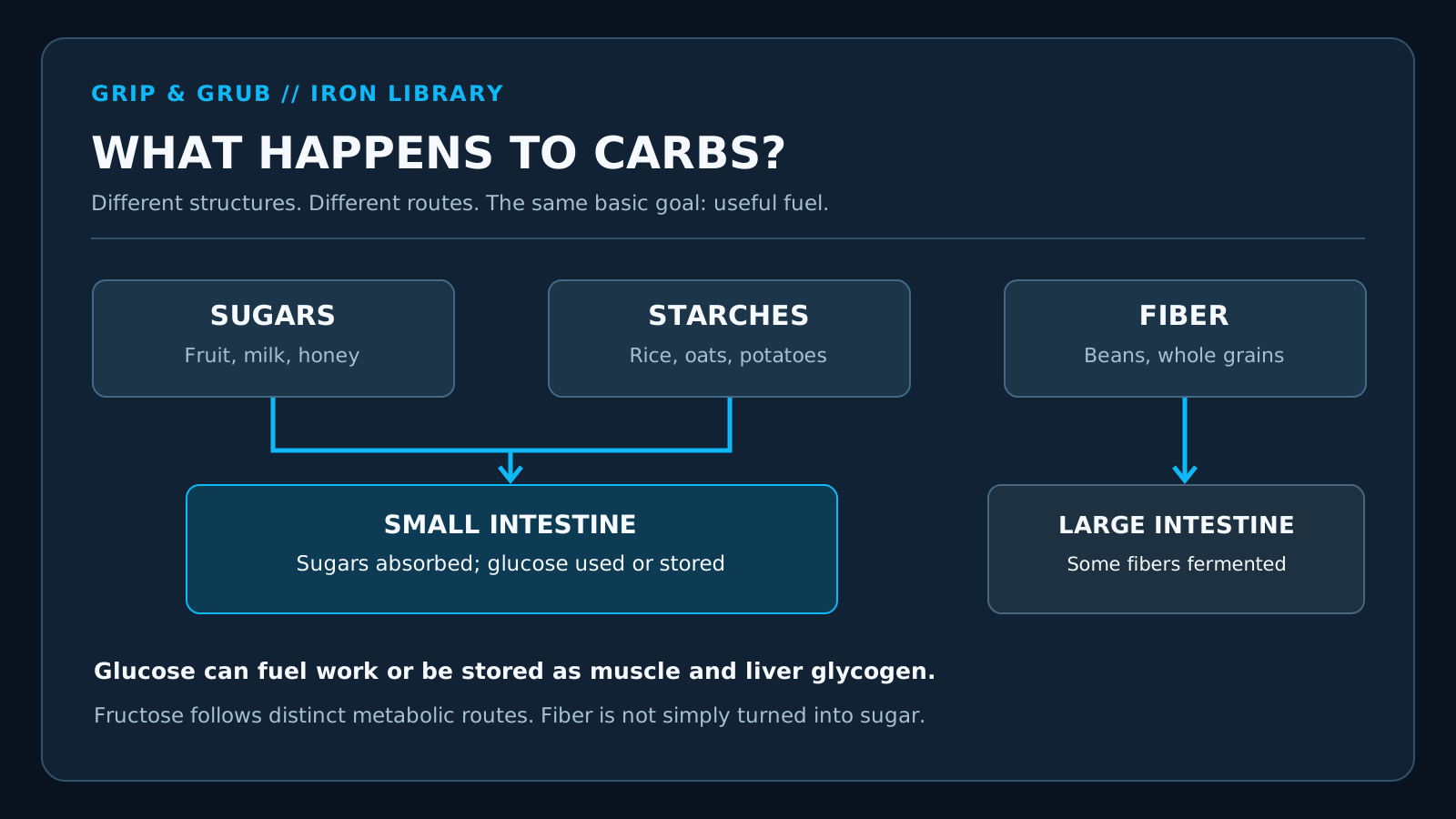
Your body can use absorbed glucose for immediate energy or store it as glycogen in muscle and liver. That's stored carbohydrate you can tap into during demanding training. Fructose is processed through different pathways, especially in the intestine and liver. Fiber is a different story altogether.
Bro-science translation: Muscle glycogen is your fuel tank. You don't have to top it off with a gallon of sugar every time you train, but you also shouldn't ignore the gauge during hard training.
Fast carbs vs. slow carbs: does it really matter?
Yes—but not the way most supplement labels make it sound.
Easy-to-digest, lower-fiber options like rice, toast, ripe bananas, rice cakes, pretzels, or a sports drink can be convenient close to exercise or between competition events.
Higher-fiber options like oats, lentils, beans, fruit, and intact whole grains are excellent everyday foods. They're usually more filling, but can be harder to tolerate immediately before a brutal session.
Potatoes, rice, and pasta can fit both roles. Portions, ripeness, processing, cooking, added fat and the rest of your meal all change how your body handles them.
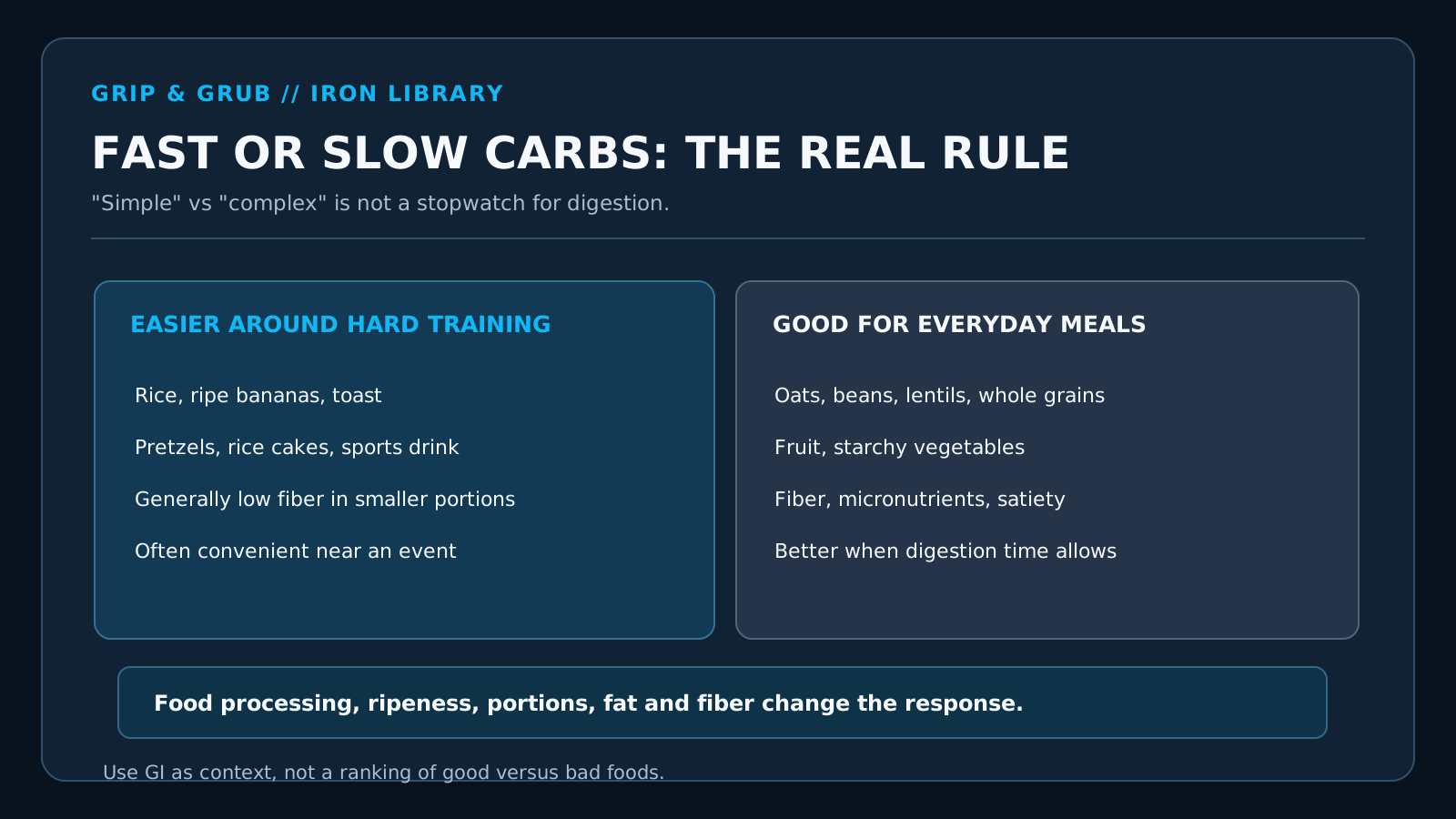
And about glycemic index: it measures a standardized blood-glucose response, not an automatic ranking of athletic performance. A high-GI food isn't necessarily the best pre-workout food, and a low-GI food isn't necessarily the best for recovery. How much you eat and whether your stomach handles it matter more.
What actually improves strength and muscle growth?
This is where the research gets interesting.
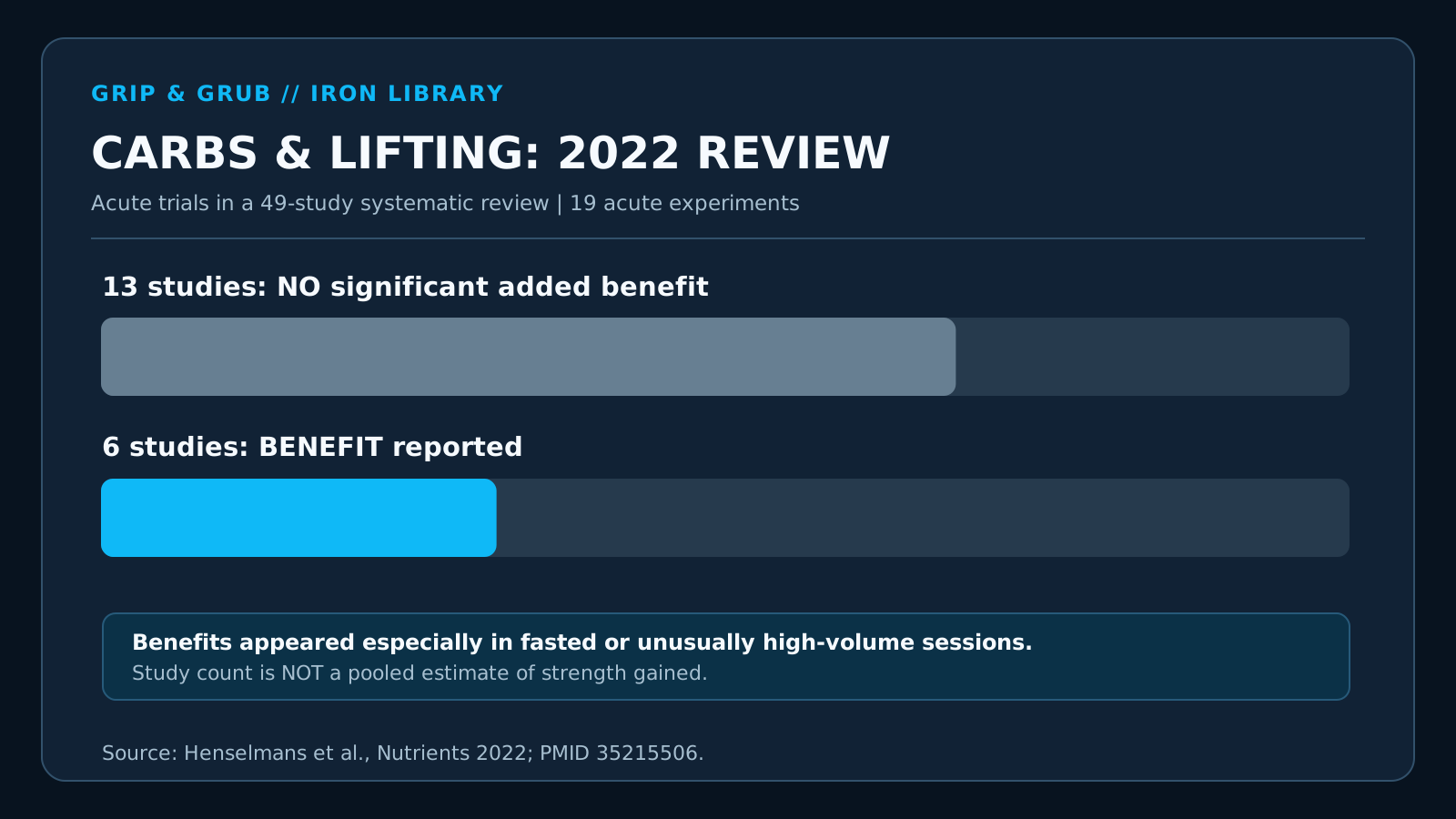
A 2022 review of 49 studies found that, among 19 acute experiments, 13 showed no added performance benefit from more carbs and six did. Positive results were more common when people trained fasted or performed unusually high volumes.
A separate 2022 meta-analysis did find a pooled benefit for total resistance-training volume from acute carbohydrate feeding. That's worth knowing if you're doing a pile of hard sets.
But a 2025 randomized trial put 16 trained adults through about 90 minutes of lifting after high-carb, low-carb, or placebo breakfasts. It found no significant difference in the repetitions completed.
And in 2026, a meta-analysis of 11 trials found no statistically significant independent muscle-growth advantage from higher carbohydrate intake when protein was comparable. The evidence certainty was low, so this isn't a final verdict on every scenario.
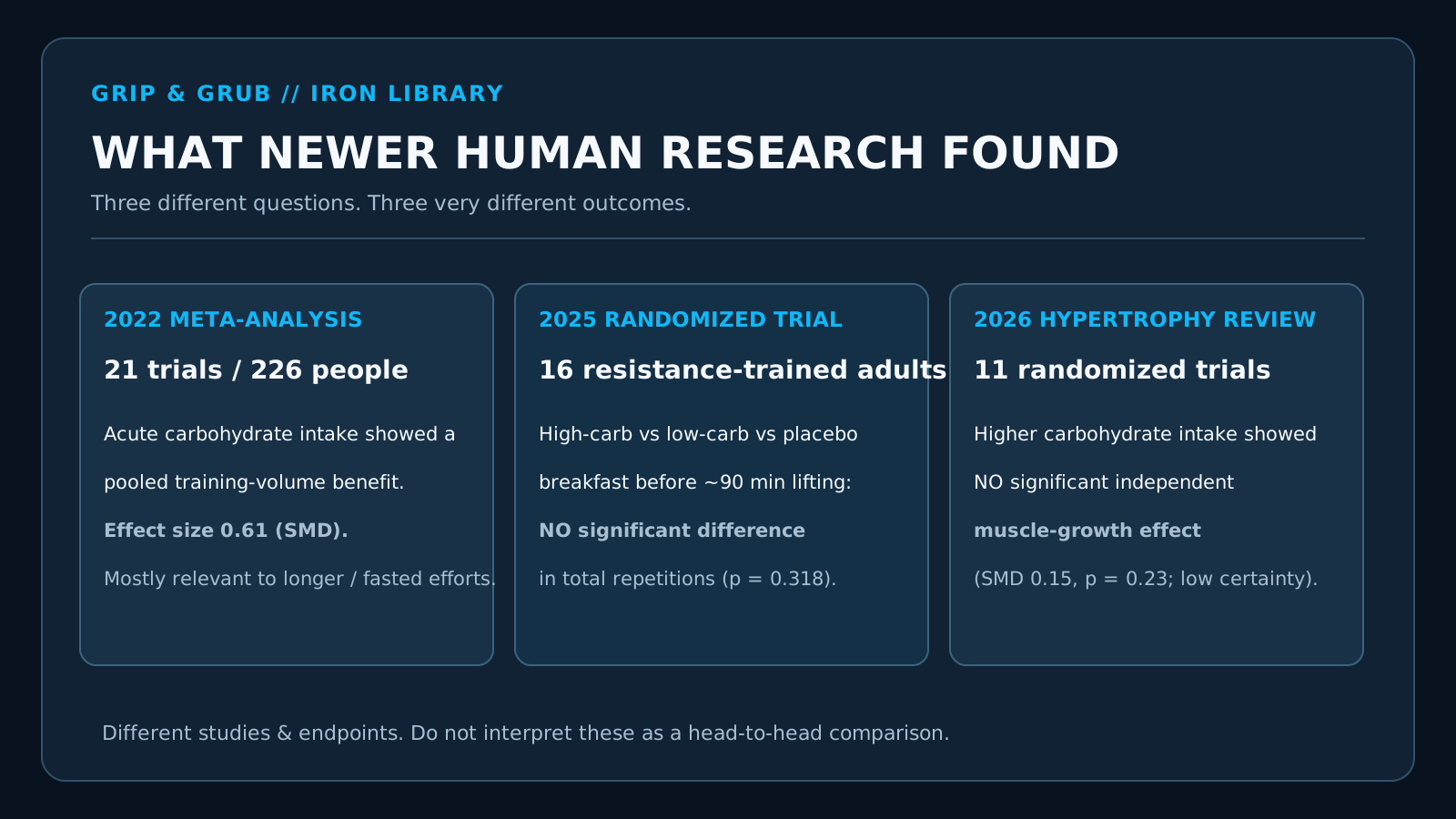
My translation: Carbs can help you do the work, especially when you're under-fueled. But just shoveling down more rice doesn't guarantee more muscle or another 50 pounds on the squat bar.
When should a strength athlete eat carbs?
Here's my practical approach. No magic 30-minute window. No pretending every lifter needs to carry a gallon jug of sugar water.
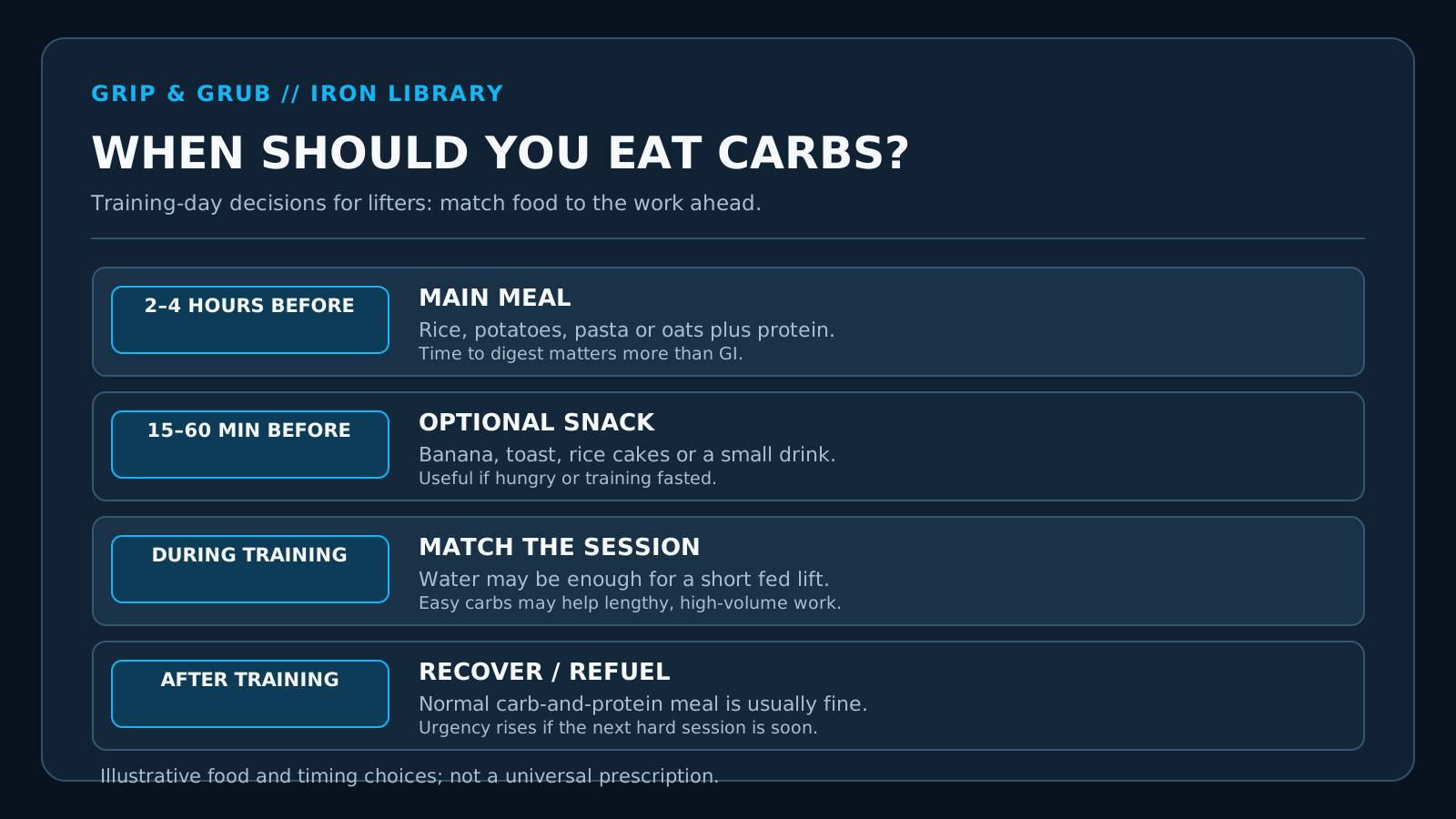
Two to four hours before training
Eat a normal meal with carbs and protein: chicken and rice, beef and potatoes, eggs and toast, or oatmeal and Greek yogurt. Choose something that digests well for you. You're trying to be fueled, not feel like you swallowed a brick.
Fifteen to sixty minutes before
If you're hungry, trained fasted, or have a demanding workout ahead, a small, easy carb snack can make sense: a banana, toast with jam, rice cakes, or a little sports drink. If you already ate a substantial meal, you may not need anything else.
During training
For a regular 45–75-minute lifting session after eating, water is often enough. For a very long, high-volume session, experimenting with easily digested carbs may help preserve training quality. A small drink or snack is often more practical than a heavy meal. Endurance guidelines of 30–60 grams an hour are not an automatic prescription for a weight-room session.
After training
Have a regular meal with carbs and protein. Rice, potatoes, pasta, fruit, and oats all work. If your next hard workout is tomorrow, your overall daily intake usually matters much more than racing the clock.
When athletes need to restore glycogen after serious depletion with fewer than about four hours until another hard effort, research supports more aggressive carbohydrate intake under a structured fueling plan. That specialized situation is different from a typical evening lifting session.

What about strongman competitions?
This is where I think carb planning can make a real practical difference.
A five-second max log press is not the same as a two-minute loading medley. And an all-day competition isn't six straight hours of continuous exercise—you spend plenty of time waiting for your turn.
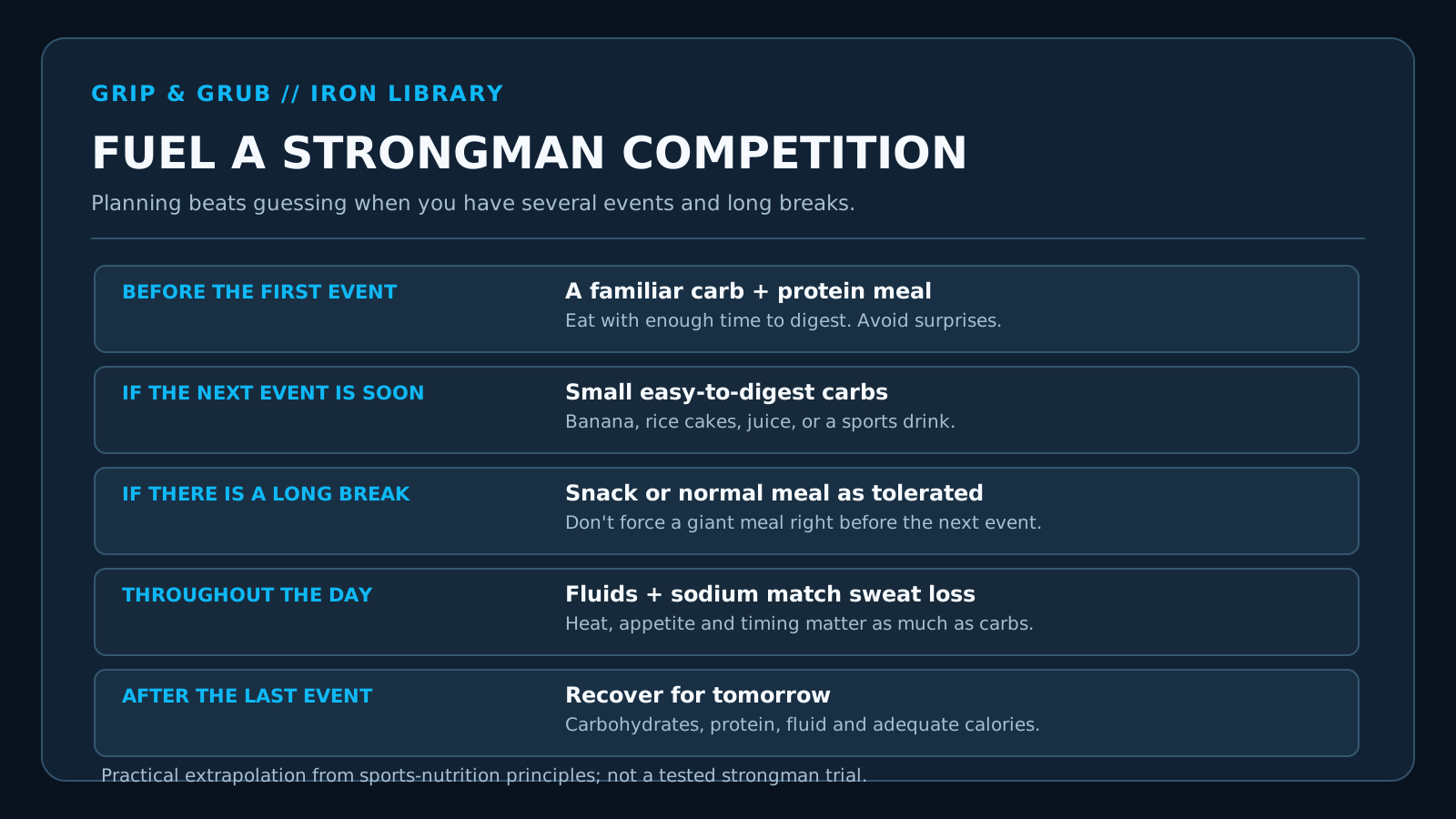
My approach would be a familiar meal a few hours before, then small portable carbs between events as needed: bananas, bagels, rice cakes, pretzels, juice or a sports drink. Stay on top of fluids and sodium if it's hot and you're sweating heavily.
I wouldn't pound a giant cheeseburger five minutes before an Atlas-stone series and call it performance nutrition. You want fuel you can use—not a meal that fights back.
How many carbs do you actually need each day?
There's no magic number for every strength athlete. Broad sports-nutrition guidance often uses around 3–5 grams per kilogram of body weight daily for general training, with some higher-volume strength programs discussed around 4–7 g/kg/day. These are planning ranges, not requirements proven optimal for every powerlifter.
For bigger athletes, using total body weight mechanically can produce absurdly high calorie targets. Look at total calories, training volume, body composition, activity, and actual performance instead.
When bulking, carbs can make fueling productive sessions easier. When cutting, they can be adjusted to fit calories while keeping protein high and placing useful carbs around the hardest training. Cutting carbs may also lower glycogen-associated water weight, which isn't the same thing as losing body fat.
Carb powders: do you need the expensive stuff?
Dextrose, maltodextrin, highly branched cyclic dextrin, and waxy maize are ways to deliver carbohydrates. Some mix or digest differently, but there isn't convincing evidence that a fancy name on a powder builds more muscle than ordinary carbs when intake and training are matched.
A glucose-fructose blend has a real use case in prolonged endurance exercise at very high carb intakes, because those sugars use different intestinal transporters. That doesn't mean you need 90 grams an hour to survive bench day.
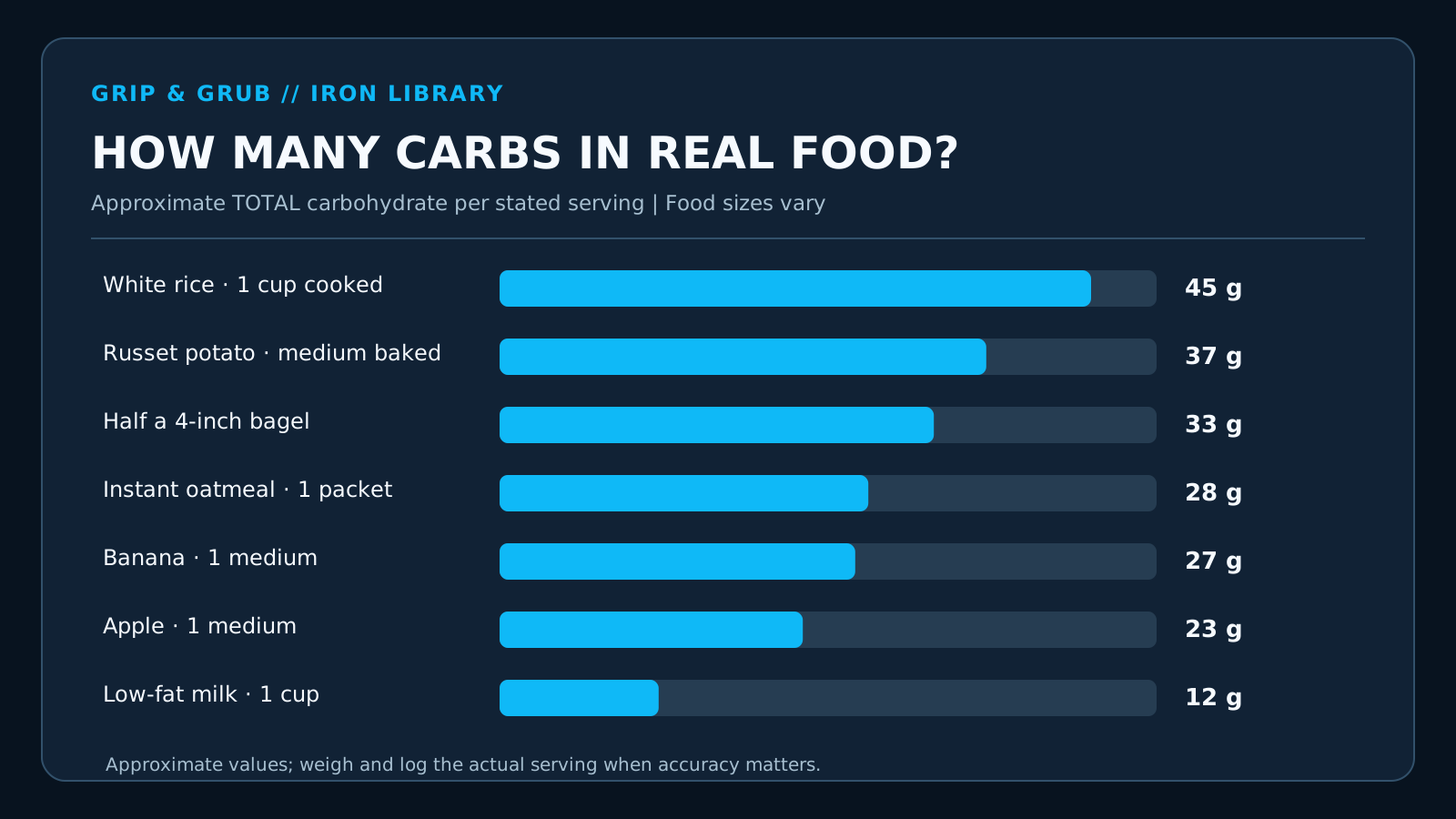
If a banana and a bagel are doing the job, there's no trophy for making your intra-workout drink more expensive.
My athlete action plan
- Start with your training. Short heavy sessions and all-day strongman contests need different fueling strategies.
- Eat most of your carbs in normal meals. Rice, potatoes, fruit, oats, pasta, beans and bread can all fit.
- Get practical near training. Choose familiar, lower-fiber foods when you don't have much digestion time.
- Use intra-workout carbs when the work justifies them. Don't assume everyone needs them.
- Think ahead to the next session. Rapid glycogen replenishment matters most when recovery time is short.
- Track the basics. Energy, training performance, appetite, digestion and your overall calorie goal beat chasing glucose spikes.
My Take
Carbs aren't the enemy. And they're not a secret anabolic drug either.
White rice isn't magic. Potatoes aren't too slow. A banana isn't somehow ruining your cut. Your body is pretty good at using different carbohydrates when you give it enough total food and a reason to work.
If you're training hard and struggling to get through the back half of a session, take a look at your fueling. If you're already well fed and pulling heavy singles, an expensive carb powder probably isn't moving the needle.
Fuel the work you're actually doing—not the workout the supplement label wants you to believe you're doing.
Train hard. Recover harder. Let the science do the talking.
— Joel
Research & References
- Henselmans et al. (2022). Carbohydrate intake and strength/resistance-training performance, 49-study systematic review. PubMed
- King et al. (2022). Acute carbohydrate feeding and resistance-exercise volume, 21-study meta-analysis. PubMed
- King et al. (2025). High- versus low-carbohydrate pre-exercise meals and lifting repetitions. PubMed
- Henselmans et al. (2026). Carbohydrate intake and muscle hypertrophy, 11-study meta-analysis. PubMed
- ISSN (2017). Position stand on nutrient timing and rapid glycogen restoration. Full text
- Murray & Rosenbloom (2018). Fundamentals of glycogen metabolism for coaches and athletes. Full text
- University of Florida IFAS / USDA-derived food data. Carbohydrate content of common foods. Food table
- CDC. Carbohydrate-choice serving-size guide. Carb choices
- Strength & conditioning nutrition review (2026). Context-specific daily carbohydrate ranges for strength athletes. Full text
Educational information, not individualized medical advice. Specific dietary needs vary with health conditions, training, energy requirements and medications.