
THE IRON LIBRARY / NUTRITION & SUPPLEMENTS
Recover
from the lift.
Eat for the next strong day.
Build a meal with protein, carbs and foods you enjoy. Repair, refuel, and get ready to do it again.
Build your recovery meal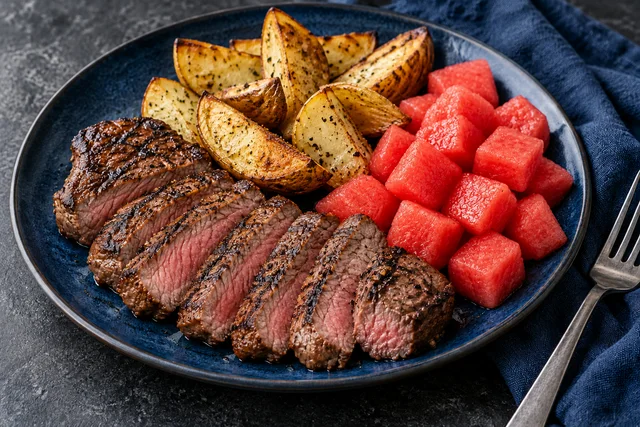
The practical take.
- What it may help with
- Use normal food, protein, carbohydrate and fluids to prepare for the next session.
- What the evidence supports
- Your daily intake and time until the next demanding bout shape the recovery plan.
- Joel’s approach
- Adjust the example meal and choose the timing situation that matches your day.
01 / THE INTERACTIVE MEAL LAB
What’s on your plate?
YOUR BODY SIZE. A STARTING POINT.
Make the numbers useful.
Plan across the day. One meal is part of the bigger picture.
Daily range: 1.6–2.2 g/kg/day.
180 lb is an example. Tool range: 35–250 kg (about 77.17–551.16 lb), not a recommended weight range. Your weight is not saved or sent.
Spread protein across your usual meals. The upper end is not a requirement.
0.4 g/kg per meal. A planning guide, not a minimum or an absorption ceiling.
0–250 g scale. Carbs at 0.5–1.0 g/kg are Joel’s planning example, not an established post-workout requirement. Fat is flexible.
How to use these numbers + sources
The same baseline is used for men and women. Body composition, age, goals and health can change planning; scaling actual weight is less useful at high body-fat levels. These are educational examples for adults.
Daily ranges: ISSN protein position stand and Schoenfeld & Aragon’s per-meal review. The frameworks overlap; neither is an exact threshold for everyone.
Special case: another demanding bout in a few hours. After glycogen-depleting exercise, ISSN nutrient timing guidance describes 1.2 g/kg/hour carbohydrate in early recovery (98 g/hour at the weight entered). This specialized hourly strategy is separate from an ordinary meal.
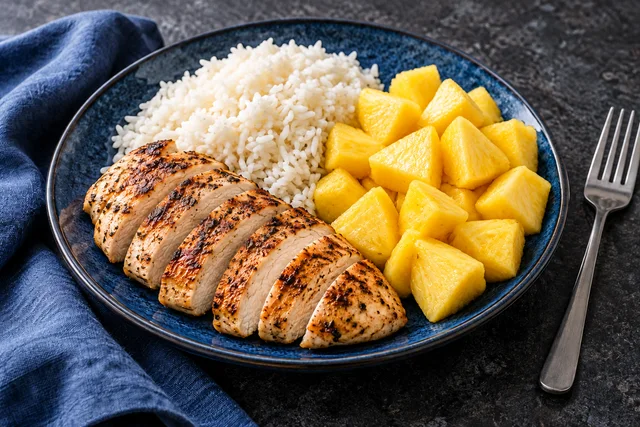
Meal-prep friendly. Adjust the portion to your training, appetite and the rest of your day.
REAL FOOD. ADJUSTABLE PORTIONS.
Chicken, rice + pineapple
- 5 ozcooked chicken breast
- 1.5 cupscooked white rice
- 1 cuppineapple chunks
Estimated grams, not performance gains. Shaded ends show the estimate range. Fat and calories are not calculated. Brands and preparation vary; added oils, sauces and toppings are excluded. Adjust amounts to your needs.
Compare the three meals
All three meals at their original 1× portions. Shaded ends show the estimate range. These compare food amounts, not recovery quality or strength gains.
Make a quick meal-prep checklist
Check off what you have ready. This checklist stays in this page only.
0 of 3 ingredients ready
02 / MAKE THE TIMING FIT
What comes next?
Your next normal meal can do the job.
Include protein, a carbohydrate portion that fits the work, and fluids. With ample recovery time, the day’s total intake matters more than racing the clock.
03 / THE COACH’S TAKE
Food first.
Details when you need them.
I would rather see an athlete consistently eat enough than obsess over the minute they finish a shake. Build a routine you can repeat.
JOEL DIRCKS / GRIP & GRUBDo I have to eat immediately?
If you ate protein before training and a meal is coming, you have flexibility. If you trained fasted or have gone hours without food, eat reasonably soon. The value of your workout does not disappear because you missed a narrow “anabolic window.”
Are recovery targets different for women?
The calculator uses the same body-size baseline for men and women. Female athletes should prioritize enough energy and protein around training. Age and menopause can affect planning, but current evidence does not establish a universal female-only 45-minute deadline.
Is protein above 30 g wasted?
No. Larger servings are not automatically wasted. A study of 100 g milk protein found a prolonged acute response, but it did not prove that every athlete needs 100 g after training or that one huge serving produces more long-term muscle growth.
Do I need sugar, a shake or a special recovery product?
No. Carbs replenish fuel; they are not required to make an adequate protein serving work. A shake is convenient when a meal is difficult. Chicken, eggs, dairy, fish, lean meat, soy and well-planned plant proteins can all fit. Dinner can be your recovery meal.
Research, sources & nutrition notes 17 references
The recommendations above synthesize peer-reviewed research, professional guidance, and the expert discussions credited below. Podcast commentary is distinguished from experimental evidence; practical meal examples are the author's application of that evidence.
1. Kerksick, C. M., et al. (2017). International Society of Sports Nutrition Position Stand: Nutrient Timing. Journal of the International Society of Sports Nutrition, 14, 33. Guidance on glycogen restoration, recovery intervals, and nutrient timing.
2. Jäger, R., et al. (2017). International Society of Sports Nutrition Position Stand: Protein and Exercise. Journal of the International Society of Sports Nutrition, 14, 20. Protein amount, quality, and distribution.
3. Morton, R. W., et al. (2018). A systematic review, meta-analysis and meta-regression of the effect of protein supplementation on resistance training-induced gains in muscle mass and strength in healthy adults. British Journal of Sports Medicine, 52, 376–384. Daily protein and long-term resistance-training adaptations.
4. Huberman Lab (July 7, 2025). How to Lose Fat & Gain Muscle With Nutrition | Alan Aragon. Relevant chapters: 00:02:17, protein amounts; 00:09:16, fasted training and the anabolic window; 00:15:53, daily protein and timing.
5. Staples, A. W., et al. (2011). Carbohydrate does not augment exercise-induced protein accretion versus protein alone. Medicine & Science in Sports & Exercise, 43, 1154–1161. Small acute study comparing whey with whey plus carbohydrate.
6. Huberman Lab (February 22, 2023). Dr. Andy Galpin: Optimal Nutrition & Supplementation for Fitness. Nutrition, carbohydrate availability, hydration, and recovery; the 02:43:39 chapter includes carbohydrate loading and the anabolic window.
7. Casuso, R. A., & Goossens, L. (2025). Does Protein Ingestion Timing Affect Exercise-Induced Adaptations? A Systematic Review with Meta-Analysis. Nutrients, 17, 2070. Direct comparisons of pre- versus post-exercise protein; five eligible studies.
8. Huberman Lab (August 12, 2024). Dr. Layne Norton: Tools for Nutrition & Fitness. Relevant chapters: 00:46:05, protein and fasting; 00:54:52, total protein and distribution; 01:10:30, carbohydrate timing.
9. FoundMyFitness, hosted by Rhonda Patrick (July 30, 2024). Dr. Luc van Loon: Optimizing Protein Intake & Distribution for Muscle Growth. Relevant chapters: 00:29:20, distribution; 00:33:05, large protein doses; 00:47:07, pre- versus post-training; 00:51:55, food versus supplements. Also reviewed: How Protein Dose and Timing Shape Muscle Protein Synthesis.
10. Trommelen, J., et al. (2023). The anabolic response to protein ingestion during recovery from exercise has no upper limit in magnitude and duration in vivo in humans. Cell Reports Medicine, 4, 101324. Acute 0-, 25-, and 100-gram protein comparison; the title should not be interpreted as proof of unlimited long-term benefit.
11. van Vliet, S., et al. (2017). Consumption of whole eggs promotes greater stimulation of postexercise muscle protein synthesis than consumption of isonitrogenous amounts of egg whites in young men. American Journal of Clinical Nutrition, 106, 1401–1412. Acute whole-food study; meals were matched for protein, not calories.
12. elitefts / Dave Tate's Table Talk (January 20, 2022). Episode 91: All Things Nutrition and Training with Justin Harris and Dani LaMartina. Episode overview and chapter guide reviewed; listed for coaching context and further listening, not as a source of a verified numerical post-workout prescription.
13. Duncan, F. (November 2, 2014). Revisiting Post-Workout Carbohydrates. elitefts. Coaching commentary on the claim that immediate post-workout carbohydrate is universally necessary.
14. Schoenfeld, B. J., & Aragon, A. A. (2018). How much protein can the body use in a single meal for muscle-building? Implications for daily protein distribution. Journal of the International Society of Sports Nutrition. Source for the practical 0.4 g/kg/meal framework, not proof of a strict upper limit.
15. Sims, S. T., et al. (2023). International Society of Sports Nutrition Position Stand: Nutritional Concerns of the Female Athlete. Guidance on energy availability and protein around exercise; limited evidence acknowledged.
16. Huberman Lab (2024). Dr. Stacy Sims: Female-Specific Exercise & Nutrition for Health, Performance & Longevity. Expert recommendations on fueling and recovery; not a trial establishing a universal cutoff.
17. Pihoker, A. A., et al. (2019). The effects of nutrient timing on training adaptations in resistance-trained females. Journal of Science and Medicine in Sport, 22, 472–477. Pre- versus post-workout nutrition comparison; does not test a strict 45-minute deadline.
Educational information for adult athletes, not an individualized nutrition prescription. Needs vary with training, body composition, goals, and health history; a sports dietitian can help adapt these principles to your situation.
For adult athletes. Meal values are estimates and calculators are educational starting points, not personal prescriptions. A sports dietitian can adapt them to your health, goals and training.