THE IRON LIBRARY / NUTRITION & SUPPLEMENTS
Protein
for strength.
Build your daily protein plan.
Find your target. Plan your meals. Understand the science behind both.
Build your protein plan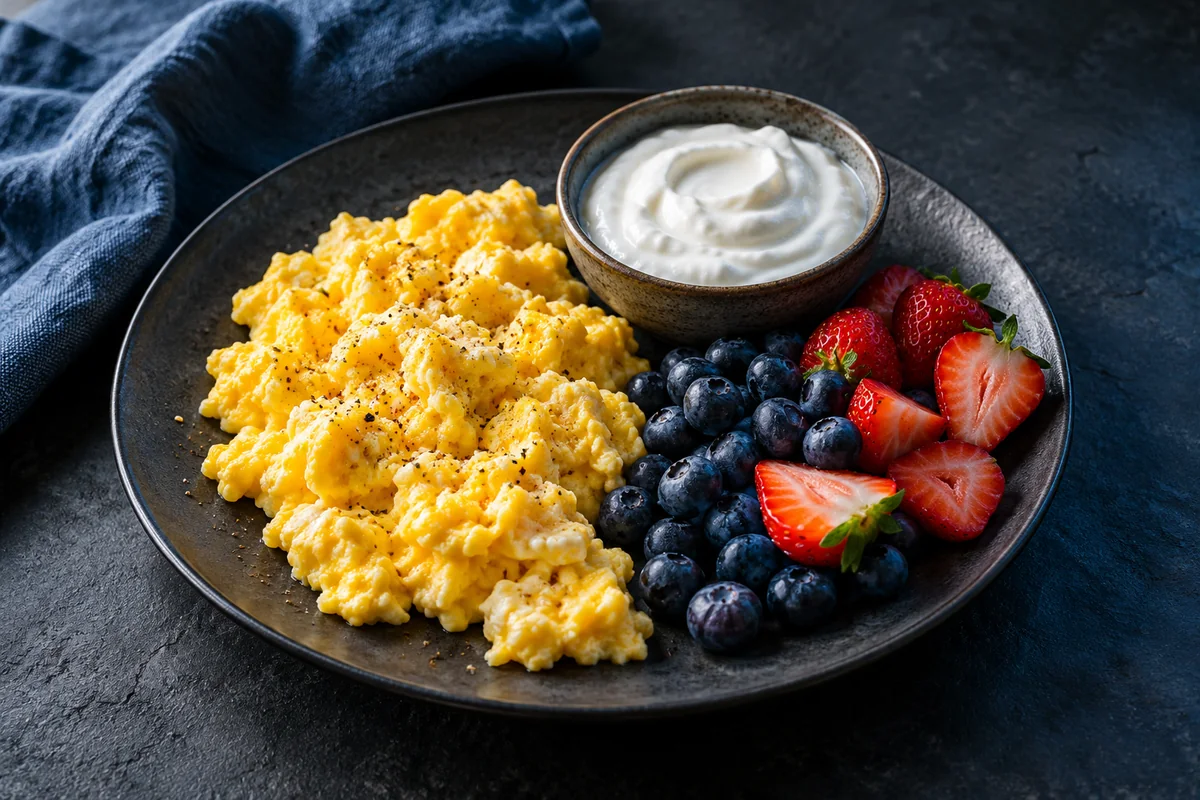
200 lb · current weight
4 meals · 45 / 45 / 45 / 45 g
The practical take.
- What it may help with
- Build a repeatable daily protein target and distribute it across meals you enjoy.
- What the evidence supports
- Daily intake and consistent training matter more than a single perfect meal or timing window.
- Joel’s approach
- Use the calculator’s range as a starting point, then build meals around it.
01 / PERSONALIZE YOUR FUEL
Your protein dashboard.
01 / FIND YOUR STARTING POINT
Make it practical.
For adults who lift. Under 18, pregnant or breastfeeding, or managing kidney disease or a prescribed protein restriction? Use individualized guidance instead.
66–660 lb are software limits, not healthy-weight limits.
Use a goal/reference weight
Current weight can overestimate practical needs when body fat is substantially elevated. A suitable reference weight can help; professional guidance is useful. Do not use a future bulking weight to increase this estimate.
Used only for comparison. Nothing is saved or sent.
EXAMPLE · 200 LB · BUILD MUSCLE
Confirm the adult scope to use your inputs. This is the default example.
Suggested starting target
Based on 200 lb current weight
Build muscle · Rounded for meal planning.
Based on published guidance; defaults selected by Grip & Grub. These are educational starting points, not prescriptions or expert-endorsed requirements.
Your intake versus the range.
Example · 200 lb current weight. Add your current protein intake to see a comparison.
| Practical range | 145–200 g |
|---|---|
| Suggested target | 180 g |
THE BIGGER PICTURE
Your weight. A practical range.
Build muscle · Example basis: 200 lb current weight. The line shows suggested targets, not predicted muscle growth.
View chart data table
| Weight (lb) | Low (g) | Suggested (g) | High (g) |
|---|---|---|---|
| 100 | 70 | 90 | 100 |
| 110 | 75 | 100 | 110 |
| 120 | 85 | 110 | 120 |
| 130 | 90 | 120 | 130 |
| 140 | 100 | 125 | 140 |
| 150 | 105 | 135 | 150 |
| 160 | 115 | 145 | 160 |
| 170 | 120 | 155 | 170 |
| 180 | 130 | 165 | 180 |
| 190 | 135 | 170 | 190 |
| 200 | 145 | 180 | 200 |
| 210 | 150 | 190 | 210 |
| 220 | 155 | 200 | 220 |
| 230 | 165 | 210 | 230 |
| 240 | 170 | 220 | 240 |
| 250 | 180 | 225 | 250 |
| 260 | 185 | 235 | 260 |
| 270 | 195 | 245 | 270 |
| 280 | 200 | 255 | 280 |
| 290 | 210 | 265 | 290 |
| 300 | 215 | 270 | 300 |
02 / SPREAD IT THROUGH YOUR DAY
Meals make it manageable.
Example · 200 lb current weight · 180 g/day across 4 eating occasions. About 45 g each. These bars divide protein, not muscle growth or absorption limits.
View exact meal amounts
| Eating occasion | Protein (g) |
|---|---|
| Meal 1 | 45 |
| Meal 2 | 45 |
| Meal 3 | 45 |
| Meal 4 | 45 |
| Total | 180 |
03 / BUILD YOUR PLATE
Start with a protein anchor.
Approximate protein from named anchor foods only; sides are excluded. Food values [8]
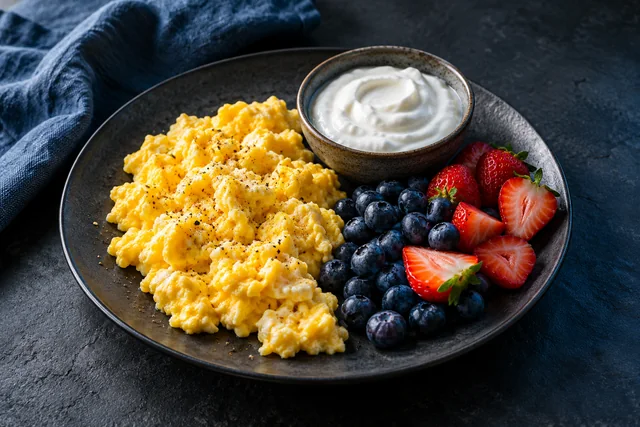
Eggs, Greek yogurt & berries
≈45 g anchor protein3 large eggs + 9 oz plain low-fat Greek yogurt. Meat portions are edible cooked weight; brands and preparation vary.
Illustrative meal image · not a verified weighed portion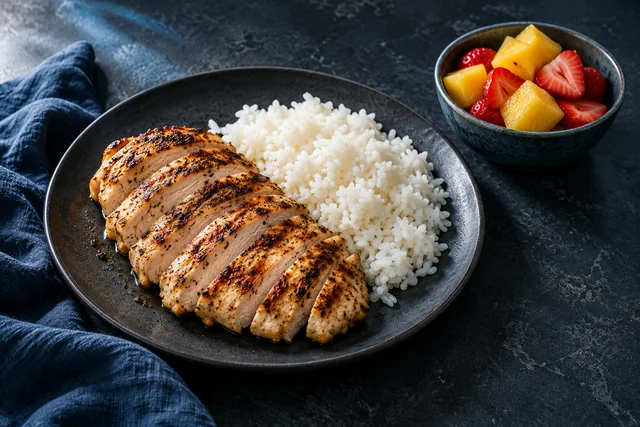
Chicken, rice & fruit
≈43 g anchor protein5 oz cooked skinless chicken breast. Meat portions are edible cooked weight; brands and preparation vary.
Illustrative meal image · not a verified weighed portion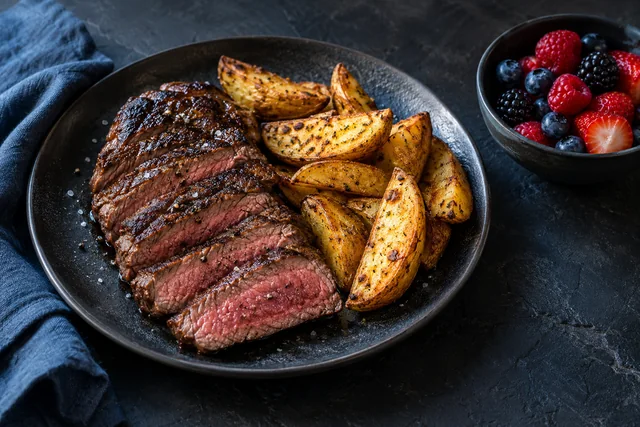
Steak, potatoes & berries
≈43 g anchor protein5 oz cooked tenderloin steak. Meat portions are edible cooked weight; brands and preparation vary.
Illustrative meal image · not a verified weighed portion04 / UNDERSTAND THE WHY
The science.
Made practical.
Clear guidance to turn a daily target into a repeatable routine.
Put the numbers into practice
Start with a target you can repeat. About 0.73–1.0 g per pound is a useful planning range for adults who lift. Aiming near 0.91 g per pound can provide a practical buffer against undershooting; 1 g per pound is a convenient rule near the upper end, rather than a mandatory minimum for every lifter. [2][3][4][5]
Make daily intake the priority. Consistently eating enough protein matters more than perfect timing. Spread it across meals in a way that fits your routine, and remember that adding more brings diminishing returns. [2][6]
Choose a target you can sustain, keep training consistently, and consider higher intakes in the context of your goals. The calculator’s suggested targets are Grip & Grub’s practical starting points.
A useful starting point
You put work into getting stronger. Your protein habits should support it. For most adults who lift, about 0.73–1.0 grams of protein per pound of body weight per day is a useful planning range. You do not have to hit one magic number to the gram. Start with a repeatable target, build meals around it, and keep training consistently. [1]
Use the calculator: enter your weight in pounds, choose your goal, and see a starting target and meal breakdown. These are educational estimates for generally healthy adults, not a personalized medical prescription.
A range you can use
| Goal | Practical daily range | Suggested starting point |
|---|---|---|
| Maintain strength and support training | About 0.73–1.0 g per pound | About 0.82 g per pound |
| Build muscle | About 0.73–1.0 g per pound | About 0.91 g per pound |
| Lose fat while lifting | About 0.91–1.09 g per pound | About 1.0 g per pound |
The starting points are Grip & Grub’s practical choices within the evidence, not a prescribed requirement. Maintaining and building share the same range. The slightly higher build default provides a planning buffer; it does not mean that everyone needs more protein to grow than to maintain.
For a 200 lb lifter choosing build muscle, our calculator suggests 180 g per day, with a rounded practical range of 145–200 g. Four eating occasions would average 45 g each. The rounding makes the plan easier to use; it does not describe an exact biological threshold.
Your total comes first; meals make it manageable
A daily target is easier to reach when protein appears in several meals. Use three, four or five eating occasions if that fits your schedule. Our bars divide your daily amount into practical portions; they do not measure how much muscle you will build.
There is no hard rule that protein beyond 30 g in a meal is simply wasted. Research comparing larger and smaller doses has shown a longer acute anabolic response to a larger serving. That does not establish that eating all your protein in one enormous meal produces better long-term gains. [7]
For a 180 g day, three meals average 60 g, four average 45 g, and five average 36 g. Pick a pattern that fits appetite, training and your daily life. You do not need to panic about a narrow post-workout deadline. [3]
Turn the number into food
Build a meal around a protein source, then add foods that meet your energy needs and preferences. These examples give protein from the named anchor foods only, not complete meal totals. Values are approximate; brands and preparation vary. Cooked meat portions refer to edible cooked weight. [8]
| Meal idea | Protein anchor | Approximate anchor protein |
|---|---|---|
| Eggs, Greek yogurt and berries | 3 large eggs +9 oz plain low-fat Greek yogurt | 45 g |
| Chicken, rice and fruit | 5 oz cooked skinless chicken breast | 43 g |
| Steak, potatoes and berries | 5 oz cooked tenderloin steak | 43 g |
Rice, potatoes and other sides can contribute additional protein. Check food labels or a reliable food database if you want a complete meal total. Photos illustrate the meal idea; they are not verified weighed portions.
Prefer plant-based meals? Beans, lentils, soy foods and other protein-rich choices can contribute to a well-planned day. One cup of cooked black beans provides about 16 g in the cited food table, so swapping a cup of beans for a meat serving will not preserve its protein total automatically. Controlled studies show that well-planned, protein-matched plant-based diets can support similar training adaptations in the young adults studied. [8][9][10]
Cutting weight changes the context
When calories are lower, preserving muscle becomes a priority. Our lose-fat option starts around 1 g per pound and offers a practical range around 0.91–1.09 g per pound. This is a starting framework, not a claim that every dieter needs its upper end.
Lean, resistance-trained athletes in demanding calorie deficits are a more specialized population. Current guidance discusses a wider range—approximately 0.86–1.45 g per pound of total body weight—for that context. It should not become the default recommendation for everyone trying to lose a few pounds. Research on dieting athletes also has meaningful uncertainty. [1][11]
Some older recommendations use pounds of fat-free mass, rather than total body weight. Those are different calculations. Do not take a fat-free-mass multiplier and apply it to total body weight. [12]
Which weight should I use?
Current body weight is the default. If substantially elevated body fat makes the estimate impractical, a suitable goal/reference weight may be more useful. Choose that basis deliberately; the calculator always shows which weight it used. A large body weight alone does not tell us whether a lifter has excess body fat. Do not automatically reduce a strongman’s calculation based on size, or use a future bulking weight to inflate today’s estimate. [4]
Questions lifters ask
Do women need a different calculator?
We do not assign women a lower protein multiplier simply because they are women. Sports-nutrition guidance supports adequate protein within athletic ranges; this tool does not invent menstrual-cycle adjustments. [13]
What if I am an older lifter?
Prioritize a sufficient daily total and substantial protein portions across meals, including breakfast. There is no automatic birthday-based gram increase in this calculator. Personal appetite, health and training context still matter. [4][14]
Do I need protein powder?
It can be a convenient way to fill a gap. It is not required by this calculation, and a product purchase does not change your target.
What about rest days?
Keep a consistent daily planning target. This tool does not lower protein on days without a lifting session.
Is more always better?
A higher number is not a higher score. Protein supports training; it cannot replace appropriate training or the rest of your nutrition. Our range describes a planning framework, not a promise of results.
Who should skip this estimate?
People under 18, pregnant or breastfeeding users, and people with kidney disease or a prescribed protein restriction should seek individualized guidance instead of using this adult lifting estimate.
Sources & credits
Reviewed Oct. 23, 2026. Research and commentary; some sources reviewed as abstracts.
1. ISSN position stand, 2026 ↗
2. Huberman Lab: Layne Norton, 2022 ↗
3. Andy Galpin / Huberman Lab ↗
5. FoundMyFitness: Higher Protein ↗
6. Norton and Layman: Protein Masterclass ↗
8. UF/IFAS: Food protein table ↗
9. Hevia-Larrain et al., 2021 ↗
11. Refalo, Trexler and Helms, 2026 ↗