
Nutrition & Supplements
Bulking Without Getting Sloppy: How Much Extra Food Builds Muscle?
How to build muscle with a controlled surplus—and when added body mass can serve heavy strongman competition. Calories, dietary fat, recovery and monitoring.
The practical take.
- What it may help with
- Choose whether your goal is muscle-efficient gaining or useful mass for a very heavy strongman contest.
- What the evidence supports
- Larger surpluses do not reliably produce proportionally greater muscle gains. Strongman event demands can make extra mass valuable, but no universal optimal gain rate is established.
- Joel’s approach
- Add food deliberately, keep protein and training fuel covered, and monitor event results, conditioning, recovery and health alongside weight.
Read full guide & sources
You need food to grow. You do not need to turn every meal into an eating contest.
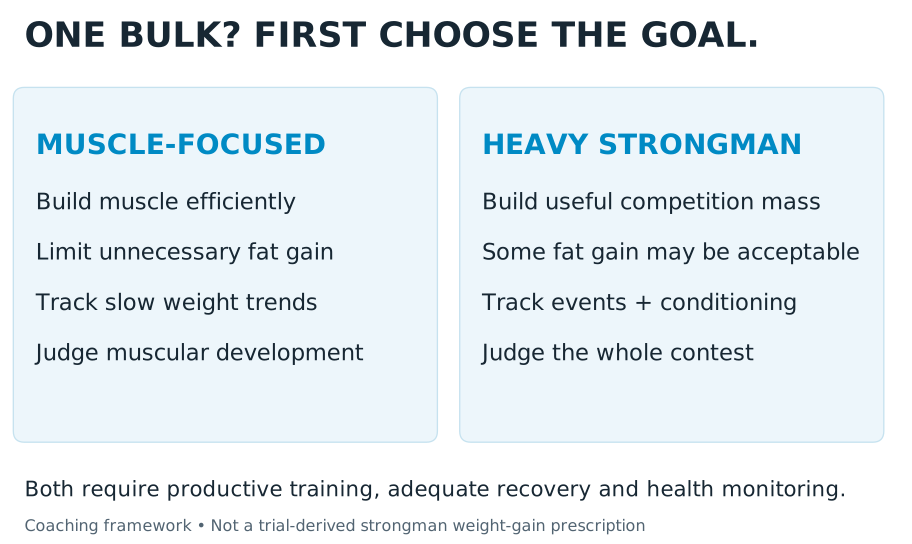
But before somebody tells a heavyweight strongman to stay shredded year-round, we need to get something straight: building muscle efficiently and building the best body for a heavy contest are not always the same goal.
If you are getting heavier, your static lifts are climbing, your truck pull is improving, and you can still move and finish events, that body weight may be doing its job. Strongman does not hand out points for visible abs.
The question is whether the extra food and weight are making you a better athlete. That is the difference between a productive gaining phase and simply buying bigger pants.
Two goals. Two ways to judge the bulk.
| Your goal | What success looks like |
|---|---|
| Build muscle while limiting fat gain | Productive training, muscular development, and a slow, controlled weight trend |
| Build a heavier body for a very heavy strongman contest | Better event performance and absolute strength, with conditioning, movement, recovery, and health remaining acceptable |
The first goal usually favors a modest surplus. The second may justify accepting more total weight and some additional fat. That is a sport-specific tradeoff, not evidence that a giant surplus builds muscle faster.
What the bulking studies actually show
In a study of 39 elite athletes, the group following a planned weight-gain diet gained more body weight and more fat than the group eating freely, without a statistically significant advantage in lean-body-mass gain. These were athletes from mixed sports, not a group of elite heavyweight strongmen. [1]
A 2023 study compared intended maintenance, 5% surplus, and 15% surplus diets during eight weeks of lifting. Only 17 participants completed it, and the surplus groups did not achieve neatly separated weight-gain rates. Faster weight gain was more clearly related to increased skinfolds than to greater muscle thickness. Some outcomes favored higher intake, including bench-press improvement, so “more food never helps” would also misrepresent the findings. [2]
A 2026 crossover study in 20 trained men found that adding carbohydrate-energy to a protein supplement did not significantly improve hypertrophy or strength within its study conditions. It was small, used habitual diets and training, and did not establish that extra carbohydrates or calories are useless for every athlete. [3]
The defensible conclusion: bigger surpluses do not reliably buy proportionally bigger muscles. These studies also do not settle the best body weight for a truck pull or a very heavy strongman contest.
Strongman changes the conversation
A heavy truck pull is not a bodybuilding stage.
Greater body mass can be mechanically useful in a harness pull: depending on the setup, it can help traction and provide a counterweight as you lean into the harness. Footwear, surface, harness angle, technique, and force production still matter. This is a biomechanical rationale—not proof that deliberately gaining fat makes every athlete pull faster. [4]
Research in novice strongman athletes links body structure and gym strength with performance. A combined measure of body mass plus squat strength was strongly associated with overall results. That association supports the relevance of size and strength; it does not separate the effects of added muscle, fat, skill, and training. [5]
Static strength can improve substantially during a productive gaining phase. Added muscle, better fueling, and changes in leverage or positioning may contribute. But an extra ten pounds on the scale does not guarantee a particular increase in your deadlift, and body weight by itself does not establish that your tissues can safely tolerate a heavier load.
For an open-weight athlete preparing for a brutal contest, accepting some fat gain may be reasonable if the additional mass produces a worthwhile competitive benefit. Keeping conditioning up makes that strategy more useful. We still need to check the complete event lineup and health—not just one lift.
| Contest demand | What to watch as body weight rises |
|---|---|
| Heavy truck or sled pull | Start, traction, sustained pace, and finish time under comparable conditions |
| Maximal static events | Actual competition-standard lifts and technical consistency |
| Heavy yoke or farmer’s carry | Pick, speed, footwork, drops, and ability to finish |
| Loading or repeated-effort events | Transitions, breathing, pace, and recovery between runs |
| Full contest | Total performance across events and recovery between efforts |
These are coaching checkpoints, not a validated formula. More body mass may help some events more than others. A weight-class athlete also needs to account for the class limit.
Not every added pound has to be muscle to have competitive value. Every added pound should still be part of a deliberate plan.
How much extra food should you start with?
For an experienced lifter primarily trying to build muscle with limited fat gain, roughly 5–10% above observed maintenance is a reasonable starting range. Recent powerlifting guidance uses this approach. It is not a scientifically proven optimum for every athlete. [6]
| Observed maintenance | Add 5% | Add 10% | Resulting daily intake |
|---|---|---|---|
| 2,500 calories | 125 | 250 | 2,625–2,750 |
| 3,000 calories | 150 | 300 | 3,150–3,300 |
| 3,500 calories | 175 | 350 | 3,675–3,850 |
| 4,000 calories | 200 | 400 | 4,200–4,400 |
Calculated examples. Actual maintenance and response must be observed.
A calculator is a starting estimate, not a blood oath. If your training workload rises, some extra food may simply cover the additional work rather than create a surplus.
For a strongman pursuing a higher contest body weight, start from the same assessment of intake, weight, and performance. Then individualize the rate according to the contest, preparation timeline, current body composition, and response. We do not have evidence that every heavyweight should automatically add 1,000 calories or gain a fixed amount each week.
How fast should the scale move?
A 2026 review suggests approximately 0.1–0.25% of body weight per week for experienced lifters, with potentially slower gains near their muscular potential. Earlier bodybuilding guidance proposed 0.25–0.5% weekly for novice/intermediate lifters. These are adjustable targets for total weight—not promises of pure muscle. [7], [8]
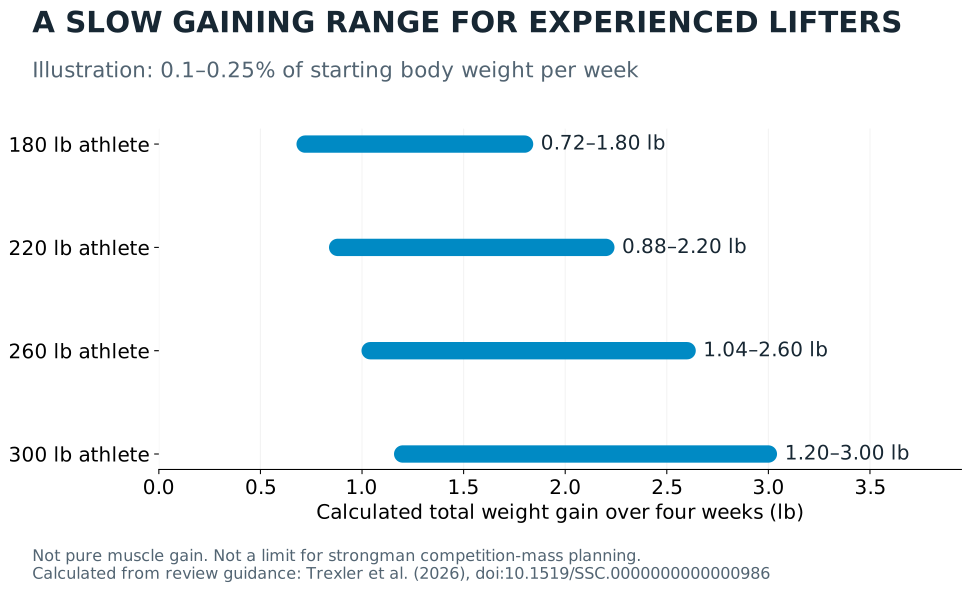
An experienced strongman may deliberately pursue a different rate because additional competition mass is part of the objective. That is a performance decision. It does not change the underlying evidence about the rate of muscle growth.
More calories can help recovery. Fat has a role.
If you are under-eating for the work you do, increasing food can help support training, adaptation, and recovery. The IOC consensus identifies problematic low energy availability as a risk to multiple systems, including musculoskeletal health, immunity, glycogen synthesis, and performance. [9]
Dietary fat is useful here. It provides about nine calories per gram, making it easier for a large athlete to meet substantial energy needs without eating an impossible mountain of food. Adequate fat also supplies essential fatty acids and supports normal cellular function and absorption of fat-soluble vitamins. [8]
Eggs, beef, dairy, fish, olive oil, nuts, and other fat sources can fit. The portions and overall diet matter. Adding fat can be particularly practical when appetite or meal volume makes adequate intake difficult.
But correcting inadequate intake and continually adding more are different things. Once energy and fat needs are met, extra fat has not been established as an independent shortcut to faster recovery. Fat does not replace protein for muscle remodeling or carbohydrate for replenishing glycogen. [10], [11]
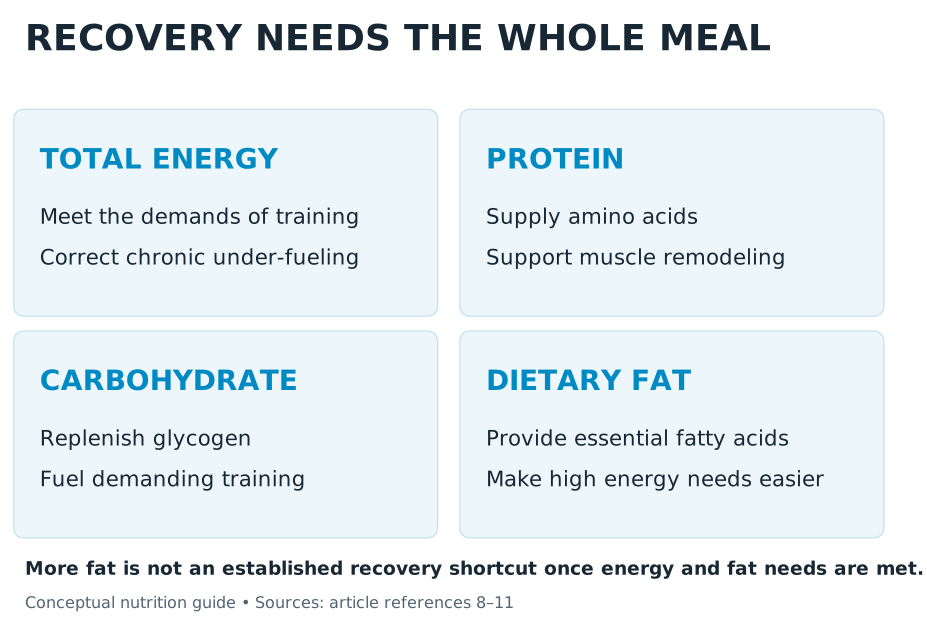
For a heavy training block, build complete meals. Enough protein, enough carbohydrate, adequate fat, and enough total food. A spoonful of tallow is not going to fix four hours of sleep and a training program that beats you into the floor.
Can you build muscle without gaining weight?
Yes. Muscle gain and fat loss can happen together.
A 2026 trial in 30 resistance-trained participants found improvements in measured fat-free mass with both a high-protein maintenance diet and a moderate deficit. It did not include a surplus group, so it cannot establish which approach maximizes growth. Fat-free mass also includes more than contractile muscle. [12]
A meta-analysis found that energy deficits impaired lean-mass gains from resistance training, even though strength gains were less affected. That supports avoiding prolonged under-fueling when growth is the priority; it does not prove everyone needs an aggressive bulk. [13]
If your training is improving at stable body weight, you may not need to force the scale. If your goal is specifically more mass for a heavy open contest, stable weight may not accomplish that separate objective.
Protein first. Then fuel the work.
A practical protein range is around 1.6–2.2 grams per kilogram daily, approximately 0.7–1.0 gram per pound. The major protein meta-analysis found an average breakpoint near 1.6 g/kg, with uncertainty extending higher. This is not an exact ceiling for every person. [14]
Very large athletes carrying substantial body fat do not automatically need to multiply their entire weight by the highest figure. Individual planning is more useful than chasing the biggest number.
Once protein is covered, use carbohydrate and fat to meet energy needs. Rice, potatoes, pasta, oats, fruit, protein foods, vegetables, and appropriate fats can do the job. Convenient foods can fit too. You do not have to choose between eating like a monk and living at the drive-through.
Don’t let water weight write the program
Increasing food—especially carbohydrate—can raise body weight through glycogen, associated water, and more digestive contents. Early scale gain is not all new muscle or fat. Body-composition measurements also require consistent conditions and careful interpretation. [15]
Watch weekly averages. Give slower trends several weeks to emerge. A bigger waist after one giant meal is not the same thing as a sustained increase over a month.
The practical check-in
Here is my coaching framework, not a protocol proven by one trial:
- Establish your baseline. Track morning weight and reasonably consistent intake for about two weeks. Note training and activity.
- Choose the actual goal. Muscle efficiency, a higher weight class, or more useful mass for a very heavy contest?
- Add food deliberately. For muscle-focused gaining, a modest surplus is a sensible starting point. Individualize strongman competition-mass plans.
- Track the return. Weekly average weight, waist trend, training performance, event results, conditioning, recovery, and health.
- Adjust gradually. Small changes—often around 100–150 calories daily—are a practical way to steer the trend, not a physiological magic number.
- Review the whole program. More food cannot indefinitely compensate for poor training, inadequate sleep, or accumulating fatigue.
If weight rises and the athlete gets stronger while maintaining conditioning, movement, and recovery, that can be a successful strongman gaining phase even with some fat gain. If performance stalls while the burden of extra weight grows, reassess.
Maintaining conditioning does not prove that blood pressure, sleep quality, or other health markers are fine. Include those in the review, especially during substantial weight gain. Small observational strongman studies highlight the importance of looking beyond performance alone. [16]
The Grip & Grub take
For building muscle efficiently, start with enough food and a modest surplus. Experienced lifters generally need patience more than a second dinner.
For strongman, especially a very heavy open-weight contest, more mass can be strategically valuable. A gaining phase is not a failure just because every pound was not muscle. Adequate calories and dietary fat can help you meet the demands of training and recovery, alongside protein and carbohydrate.
Getting sloppy is gaining without a plan or enough return. Getting bigger, stronger, and better at your events is a different story. Feed the work. Track the results. Build the body your sport rewards—and keep checking the cost.
Research references
- Garthe et al. Effect of nutritional intervention on body composition and performance in elite athletes. 2013. https://pubmed.ncbi.nlm.nih.gov/23679146/
- Helms et al. Effect of Small and Large Energy Surpluses on Strength, Muscle, and Skinfold Thickness in Resistance-Trained Individuals. 2023. https://pubmed.ncbi.nlm.nih.gov/37914977/
- Henselmans et al. Effects of Modest Carbohydrate–Energy Supplementation on Resistance Training Adaptations in Trained Men. 2026. https://pubmed.ncbi.nlm.nih.gov/42356347/
- The Biomechanics and Applications of Strongman Exercises: a Systematic Review. 2019. https://pmc.ncbi.nlm.nih.gov/articles/PMC6901656/
- Interrelationships between strength, anthropometrics, and strongman performance in novice strongman athletes. 2012. https://pubmed.ncbi.nlm.nih.gov/22233785/
- Renner and Amdi. Weight class management in powerlifting: An evidence-informed practical review. 2026. https://journals.sagepub.com/doi/full/10.1177/17479541261483232
- Trexler et al. Fat-Free Mass Accretion: Limits, Targets, and Best Practices. 2026. https://doi.org/10.1519/SSC.0000000000000986
- Iraki et al. Nutrition Recommendations for Bodybuilders in the Off-Season: A Narrative Review. 2019. https://pmc.ncbi.nlm.nih.gov/articles/PMC6680710/
- Mountjoy et al. 2023 IOC consensus statement on Relative Energy Deficiency in Sport (REDs). https://bjsm.bmj.com/content/57/17/1073
- International society of sports nutrition position stand: nutrient timing. 2017. https://pmc.ncbi.nlm.nih.gov/articles/PMC5596471/
- Carbohydrates and fat for training and recovery. 2004. https://pubmed.ncbi.nlm.nih.gov/14971430/
- Vargas-Molina et al. Comparison of two nutritional protocols in body re-composition of resistance-trained participants. 2026. https://doi.org/10.1007/s00421-026-06209-6
- Murphy and Koehler. Energy deficiency impairs resistance training gains in lean mass but not strength: A meta-analysis and meta-regression. 2022. https://pubmed.ncbi.nlm.nih.gov/34623696/
- Morton et al. Protein supplementation and resistance-training-induced gains in muscle mass and strength: systematic review, meta-analysis and meta-regression. 2018. https://pubmed.ncbi.nlm.nih.gov/28698222/
- Slater et al. Is an Energy Surplus Required to Maximize Skeletal Muscle Hypertrophy Associated With Resistance Training? 2019. https://pmc.ncbi.nlm.nih.gov/articles/PMC6710320/
- Chappell and Simper. A Case Study Series of the Health Status and Key Anthropometry in Very Large Strength Athletes. 2020. https://journal.iusca.org/index.php/Journal/article/view/2