
Nutrition & Supplements
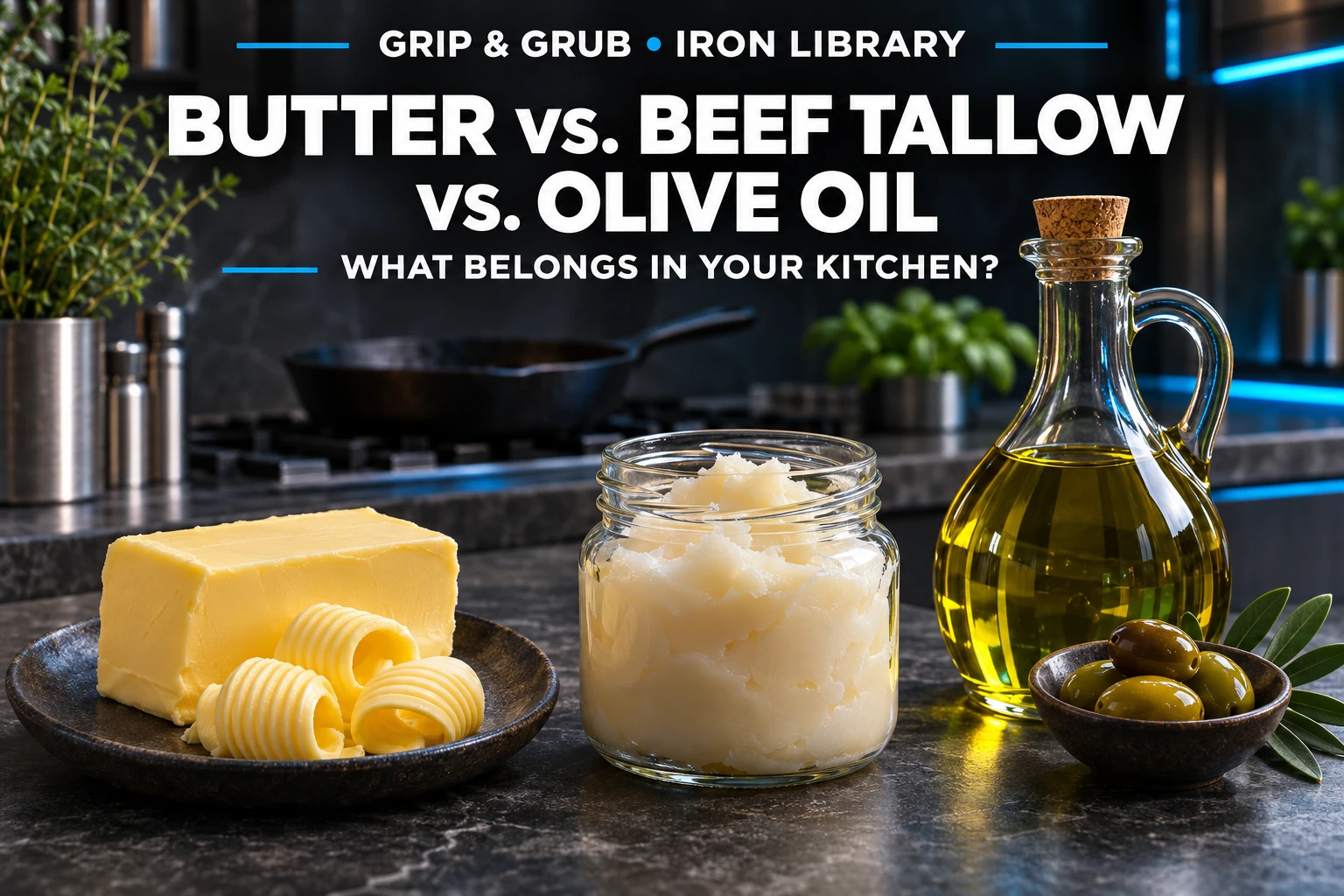
Butter vs. Beef Tallow vs. Olive Oil: What Belongs in Your Kitchen?
A lifter’s guide to butter, beef tallow and olive oil: cooking heat, oxidation, reuse and what the heart-health research actually shows.
The practical take.
- What it may help with
- Choose cooking fats for flavor and the job while considering the overall dietary pattern.
- What the evidence supports
- Cooking stability and cardiovascular outcomes are different tests. Heat-chart reductions describe one experiment, and tallow-blend chemistry does not establish human health superiority.
- Joel’s approach
- Use olive oil as an everyday option, butter for flavor, and tallow when it suits the food; manage heat and avoid indefinite reuse.
Read full guide & sources
You can squat heavy, eat steak, and still have olive oil in your kitchen. Nobody is taking your strongman card.
You can also enjoy butter on your potatoes without turning dinner into a cardiovascular crime scene. The problem starts when a cooking preference becomes a religion and every jar needs to be either a miracle or a menace.
Butter, beef tallow, and olive oil can all have a place. They taste different, behave differently under heat, and have different health evidence behind them.
Here’s my approach: olive oil for most everyday cooking, butter when its flavor matters, and tallow when it fits the meal. Use enough to cook good food. You don’t need to drink the stuff to prove you’re pro-fat.
The quick scoop
| Fat | Where it earns its place | What to keep in mind |
|---|---|---|
| Extra-virgin olive oil | Everyday sautéing, roasting, dressings, finishing | Heating reduces some antioxidants; it still works as a cooking oil |
| Butter | Eggs over controlled heat, baking, finishing, late-stage basting | Milk solids brown and burn; it is rich in saturated fat |
| Beef tallow | Savory roasting, browning, selected frying uses | Useful cooking properties do not prove a heart-health advantage |
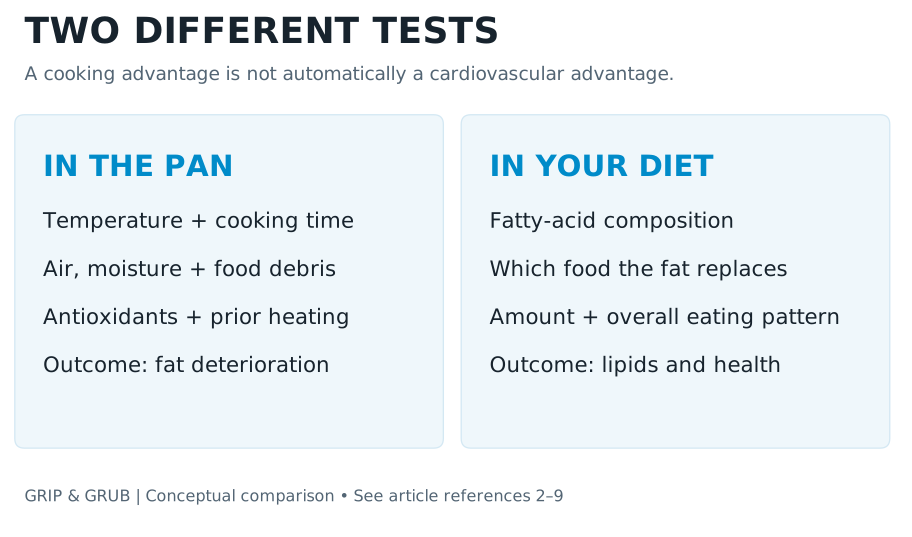
The big distinction: surviving a hot skillet and protecting your heart are two different tests. [1], [2], [3], [4], [5]
First, stop treating all fat like the same ingredient
Most fats contain a mixture of saturated, monounsaturated, and polyunsaturated fatty acids. The proportions change.
Olive oil is mostly monounsaturated fat, particularly oleic acid. Butterfat is predominantly saturated. Tallow sits closer to a roughly even saturated–unsaturated split, although the animal and fat tissue make a difference. The American Oil Chemists’ Society reports typical tallow at approximately 46–55% saturated fatty acids and 40–43% oleic acid. [1], [6]
Yes, that is the same oleic acid prominent in olive oil. No, that does not make tallow olive oil wearing a cowboy hat. The rest of the mixture still matters.
Butter also contains water and milk solids. A tablespoon of butter and a tablespoon of oil are not identical amounts of pure fat. That is one reason internet comparison charts can get sloppy.
Smoke point is useful. It is not a health score.
Smoke point tells you when a fat begins visibly smoking under the test conditions. It does not tell you every chemical change happening in the pan, and it definitely does not predict your cholesterol response.
Oil can deteriorate through oxidation, reactions involving water, and polymerization during prolonged heating. Temperature matters, but so do time, exposure to air, food debris, moisture, antioxidants, and whether the fat has already been used. [7], [8]
A high smoke point does not automatically mean “healthiest.” A lower smoke point does not automatically mean “poison.” Still, visible smoking is a useful signal to lower the heat rather than keep cooking through it.
Yes, you can cook with olive oil
“Never heat olive oil” is one of those rules that sounds scientific until you look at the studies.
Olive oils have performed reasonably well in frying research. Extra-virgin olive oil combines a high monounsaturated-fat content with phenolic compounds that help protect it against oxidation. It is useful for ordinary sautéing and roasting—not just a ceremonial drizzle on salad. [3], [9]
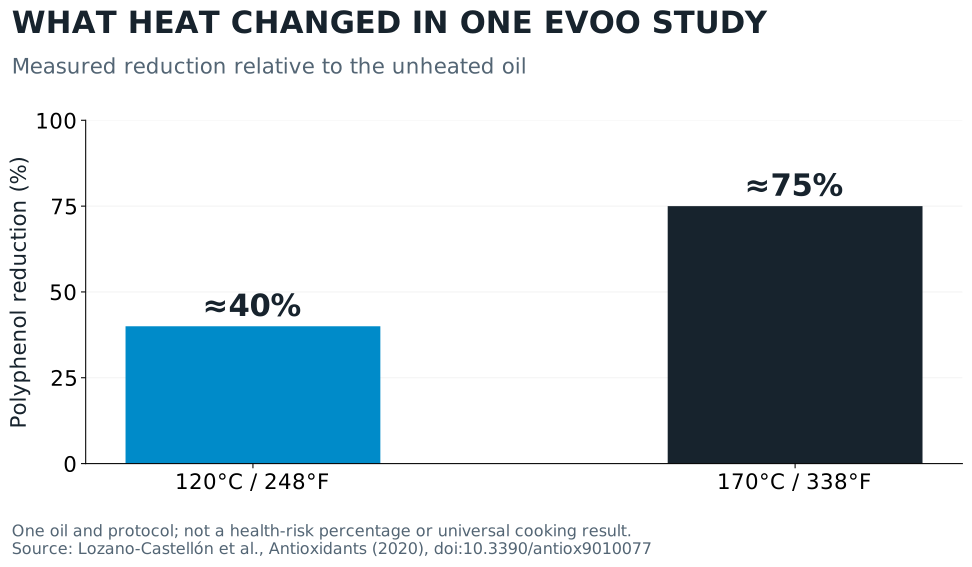
Heat does reduce some of those compounds. In a 2020 study simulating home sautéing with one EVOO, measured polyphenols fell about 40% at 120°C and 75% at 170°C. Those are results from that experiment, not guaranteed losses every time you make dinner. [3]
Losing some antioxidants does not mean the oil suddenly becomes toxic.
Use EVOO for everyday cooking and save some for finishing if you enjoy the flavor. Refined olive oil is another option when you want a milder taste and more smoke-point margin. It generally has fewer phenolic compounds than EVOO. Neither needs to sit in an empty pan over maximum heat while you search for the chicken. [10]
Tallow earns its place through cooking—not internet mythology
Beef tallow can make roasted potatoes taste outstanding. It can work well for browning and frying. You are allowed to appreciate that without claiming it fixes every problem in modern nutrition.
A September 2026 study mixed tallow with soybean oil and repeatedly fried food in the blends. Adding tallow improved several stability measurements compared with soybean oil alone. That is a legitimate result. [4]
But read the fine print: the researchers tested blends and frying chemistry. They did not show that pure tallow beats EVOO in every cooking situation. They did not test heart attacks, lifespan, testosterone, or deadlift PRs.
Tallow also varies by source. Fat around the kidneys can have a different fatty-acid profile from fat under the skin. Rendering and product quality matter. “Tallow” is an ingredient category, not one perfectly standardized formula. [1]
Keep a jar if you like it. Use it because it works in your food. It does not need a superhero backstory.
Butter: flavor champion, limited heat tolerance
Butter’s milk solids brown and eventually burn. That makes regular butter useful for controlled-heat cooking, baking, finishing, and carefully managed basting. It makes it less forgiving when you crank the burner and walk away.
Clarified butter and ghee remove most water and milk solids, allowing higher-temperature cooking. That is a cooking upgrade. It does not remove the saturated fat or make the cardiovascular evidence equivalent to olive oil. [11]
For steak, I like the practical idea of doing the initial browning with a suitable fat, then lowering the heat and adding butter near the end for flavor. That is a culinary suggestion, not a performance protocol.
Reheated forever is a different conversation
Cooking your eggs once is not the same as running the same fryer oil through repeated batches for hours.
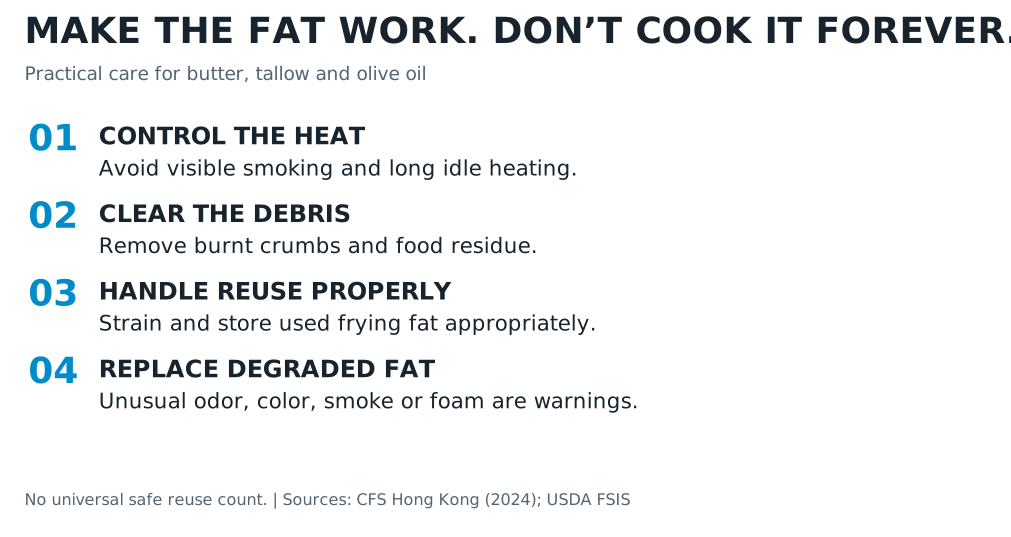
Heat, oxygen, moisture, and food particles contribute to deterioration. Stable fats still degrade. Tallow does. Olive oil does. Butter does. None of them unlock unlimited reuse.
For deep frying, Hong Kong’s Centre for Food Safety recommends temperatures around 150–180°C, removing residues, and changing oil when it develops unusual odor or color, smoking, or foaming. Those are warning signs—not a complete laboratory test of oil quality. [8]
USDA guidance allows properly handled reuse, including straining out food particles and appropriate storage. There is no single reuse count that fits every fat, food, temperature, and cooking time. [12]
One more myth worth retiring: normal cooking does not automatically turn olive oil into a major trans-fat source. A systematic review found little appreciable trans-fat formation below 200°C, with more at higher temperatures and prolonged heating. That finding concerns trans fats specifically; other forms of deterioration can still occur. [13]
Your arteries do not care how good the potatoes taste
This is where “all three can fit” needs to stay separate from “all three have the same health evidence.”
In a randomized trial, adults consumed 50 grams daily of butter, EVOO, or coconut oil for four weeks. The change in LDL cholesterol was approximately 0.38 mmol/L—about 15 mg/dL—higher with butter than olive oil. [2]
That was a substantial daily amount, an older adult population, and a short trial. It does not tell us exactly what a teaspoon of butter will do in every lifter. It does show that the choice of fat can affect blood lipids.
A network meta-analysis of 54 trials also found that beef fat and several oils produced lower LDL than butter. Animal fats are not interchangeable. But lower LDL than butter does not establish that tallow is the best everyday fat or that it prevents cardiovascular events. [5]
Tallow contains stearic acid, which behaves differently from some other saturated fatty acids. A small feeding trial comparing fats in 10 men helps support that distinction. It used liquid diets with 40% of calories from the test fat—useful mechanistic evidence, far from an ordinary meal. [14]
For clinical outcomes, the corrected PREDIMED analysis found fewer major cardiovascular events with a Mediterranean diet supplemented with EVOO than with the control diet. However, it tested a whole dietary pattern, and allocation irregularities required a corrected analysis. It was not a clean experiment proving olive oil alone caused all the benefit. [15]
The broader Cochrane review found that reducing saturated fat lowered combined cardiovascular events by about 17% relative, with little or no clear effect on overall mortality. Evidence specifically isolating replacement with monounsaturated fat was limited. [16]
My read: olive oil has the strongest case of these three as the everyday default. Butter and tallow can still fit. That is a recommendation based on the combined evidence, not a claim that a perfect three-way lifetime trial exists.
What I would actually keep in the kitchen
| Cooking job | My practical pick | Why |
|---|---|---|
| Daily vegetables, rice dishes, ordinary sautéing | EVOO | Versatile and supported by favorable nutrition evidence |
| Dressing or finishing | EVOO | Keeps its original flavor and unheated phenolic compounds |
| Eggs over controlled heat | Butter or EVOO | Choose the taste you enjoy; watch the pan |
| Savory roasting | EVOO or a modest amount of tallow | Both have useful culinary roles |
| Higher-temperature browning | Refined olive oil or well-rendered tallow | More forgiving than regular butter; still avoid smoking |
| Baking | The fat the recipe was designed around | Structure and water content affect the result |
| Butter flavor on meat or potatoes | Butter near the end | A little can do the job |
These are practical cooking choices, not a mandatory ranking for every recipe.
If you already eat plenty of fatty beef, cheese, and full-fat dairy, making olive oil your main added fat is a reasonable way to balance the pattern. There is a difference between enjoying some butter and pouring extra saturated fat onto every meal because someone called it ancestral.
All cooking fats contribute energy. For a lifter trying to gain weight, that can help. For someone cutting, an enthusiastic free-pour can make the calorie target harder to manage. Neither butter nor tallow has an established special advantage for muscle growth.
The Grip & Grub take
Keep all three if you like them. Make olive oil the daily workhorse. Let butter bring the flavor. Use tallow when it suits the food.
Buy what you will actually use, follow storage directions, control the heat, and pay attention to the overall diet and your blood lipids.
Cook good food. Fuel your training. You do not need to fear the butter dish—or turn it into a supplement stack.
Research references
- American Oil Chemists’ Society. Animal Fats. https://www.aocs.org/resource/animal-fats/
- Khaw et al. Randomised trial of coconut oil, olive oil or butter on blood lipids and other cardiovascular risk factors. BMJ Open. 2018. https://bmjopen.bmj.com/content/8/3/e020167
- Lozano-Castellón et al. Domestic Sautéing with EVOO: Change in the Phenolic Profile. Antioxidants. 2020. https://pmc.ncbi.nlm.nih.gov/articles/PMC7022658/
- Zhang et al. Enhancing Repeated Frying Stability of Soybean Oil by Blending With Beef Tallow. Journal of Food Science. 2026. https://pubmed.ncbi.nlm.nih.gov/42760792/
- Schwingshackl et al. Effects of oils and solid fats on blood lipids: a systematic review and network meta-analysis. Journal of Lipid Research. 2018. https://pubmed.ncbi.nlm.nih.gov/30006369/
- Endotext. Fat Composition of Oils, Lard, Butter, and Margarine. https://www.ncbi.nlm.nih.gov/books/NBK570127/table/lipid_diet_cardiov.T.fat_composition_of/
- de Alzaa et al. Evaluation of Chemical and Physical Changes in Different Commercial Oils during Heating. 2018. https://myolivebranch.co.uk/wp-content/uploads/2018/05/ASNH-02-0083.pdf
- Hong Kong Centre for Food Safety. Safe Use of Oil for Deep-frying. 2024. https://www.cfs.gov.hk/english/multimedia/multimedia_pub/multimedia_pub_fsf_212_04.html
- Casal et al. Olive oil stability under deep-frying conditions. Food and Chemical Toxicology. 2010. https://pubmed.ncbi.nlm.nih.gov/20678538/
- Colorado State University, Kendall Reagan Nutrition Center. Cooking with Fats and Oils: Can they withstand the heat? https://www.chhs.colostate.edu/krnc/monthly-blog/cooking-with-fats-and-oils/
- American Society of Baking. Clarified Butter. https://asbe.org/article/clarified-butter/?topic=ingredient
- USDA FSIS. Can oil be reused safely? https://ask.fsis.usda.gov/article/Can-oil-be-reused-safely
- Influence of Heating during Cooking on Trans Fatty Acid Content of Edible Oils: A Systematic Review and Meta-Analysis. Nutrients. 2022. https://pubmed.ncbi.nlm.nih.gov/35406103/
- Denke and Grundy. Effects of fats high in stearic acid on lipid and lipoprotein concentrations in men. American Journal of Clinical Nutrition. 1991. https://pubmed.ncbi.nlm.nih.gov/1845606/
- Estruch et al. Primary Prevention of Cardiovascular Disease with a Mediterranean Diet Supplemented with Extra-Virgin Olive Oil or Nuts. Corrected report. NEJM. 2018. https://www.nejm.org/doi/full/10.1056/NEJMoa1800389
- Hooper et al. Reduction in saturated fat intake for cardiovascular disease. Cochrane. 2020 updated version. https://pubmed.ncbi.nlm.nih.gov/32827219/