
Nutrition & Supplements
Fiber & Gut Health for Lifters: Feed Your Muscle. Respect Your Gut.
A practical guide to fiber, high-protein diets, digestive comfort and realistic expectations for probiotics.
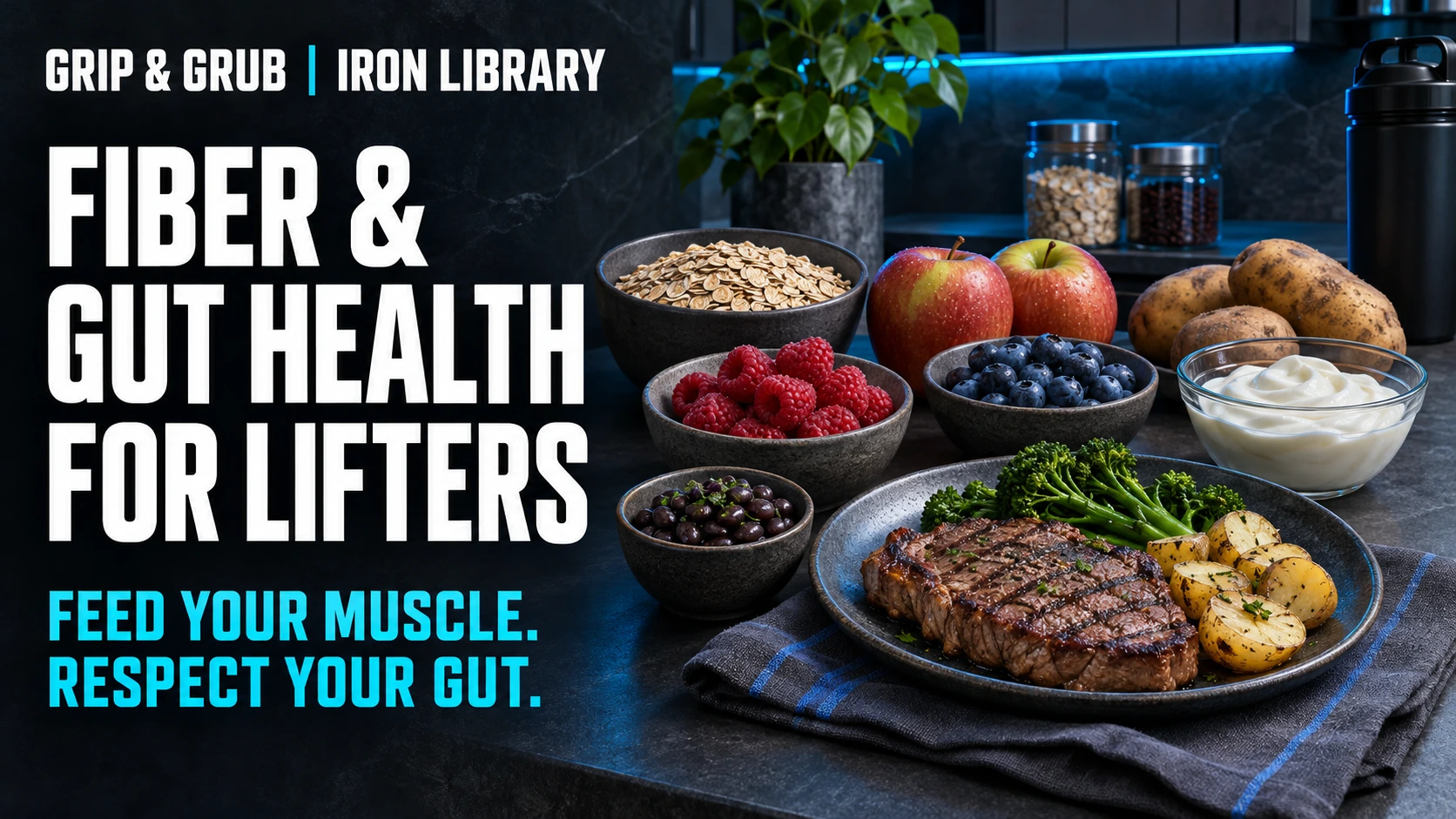
The practical take.
- What it may help with
- Support bowel function and build a varied diet around protein and adequate training fuel.
- What the evidence supports
- Fiber evidence is stronger for bowel function than muscle growth. Probiotic effects depend on the specific product and outcome; no universal fiber optimum for lifters is established.
- Joel’s approach
- Add tolerated foods gradually, adjust workout meals for comfort, and follow psyllium fluid and medication precautions.
Read full guide & sources
You know your protein total. You know your creatine dose. You can explain why your favorite pre-workout hits harder than the other one.
But ask how much fiber you ate yesterday and suddenly everybody needs to check their phone.
Meanwhile, your stomach is inflated, your bathroom schedule is questionable, and you’re trying to brace under a heavy bar with a digestive system that has filed a formal complaint.
Keep the protein. Keep the steak. Give your gut something to work with, too.
Fiber is not a secret anabolic supplement. It is one of the basics that gets overlooked when eating for strength turns into nothing but protein targets and calorie totals.
What fiber actually does
Fiber resists digestion in the small intestine. Depending on its properties, it can hold water, influence stool consistency and transit, or become fuel for microbes in the colon. Different fibers do different jobs. [1]
Some microbes ferment fiber into short-chain fatty acids, including butyrate, which helps fuel cells lining the colon. That is useful biology. It is not proof that a bowl of oatmeal adds 20 pounds to your squat. [1], [2]
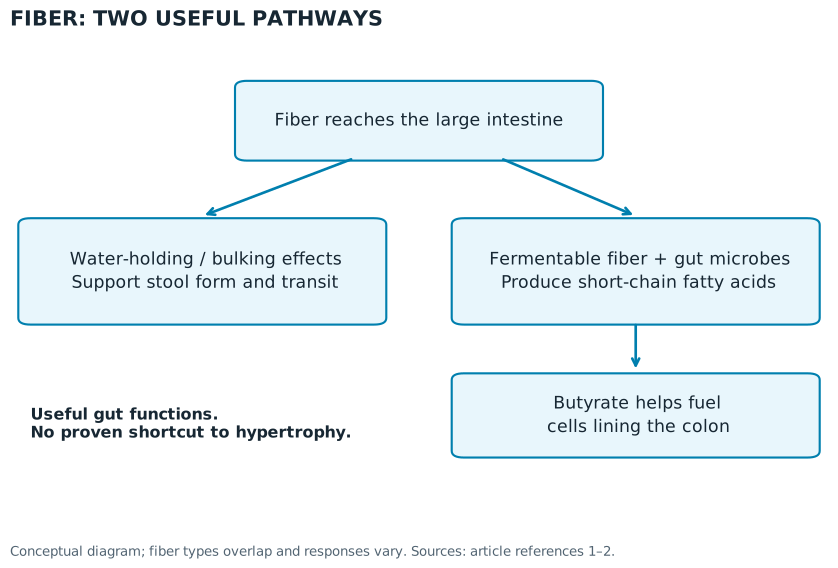
The old “soluble versus insoluble” explanation is a starting point. Whether a fiber forms a gel and how readily it ferments also matter. A scoop of psyllium and a bar packed with inulin are not interchangeable just because both put fiber on the label. [1]
Does eating high protein wreck your gut?
Not automatically. Let’s retire that headline before it gets its own supplement company.
A 2025 systematic review examined 50 randomized trials, with 15 included in its network meta-analysis. Most microbiome-related outcomes did not differ significantly across the protein-and-fiber combinations studied. Some metabolites changed, but a change in a stool or blood marker does not automatically mean disease—or lost gains. [3]
A separate trial analysis published in 2026 followed 112 older adults. Increasing food-based protein intake to roughly 1.6 grams per kilogram daily did not produce significant adverse changes in microbiota composition or diversity over the study period. These were older adults, not bodybuilders eating extreme protein intakes, so keep the comparison honest. [4]
The practical move is to build a complete diet around your protein, not declare war on protein.
Beef with potatoes and vegetables. Eggs with oats and fruit. Greek yogurt with berries. You can support strength goals and eat fiber-containing foods in the same day. Revolutionary stuff.
The boring benefits are the useful ones
Fiber has stronger evidence for bowel function than for building bigger biceps.
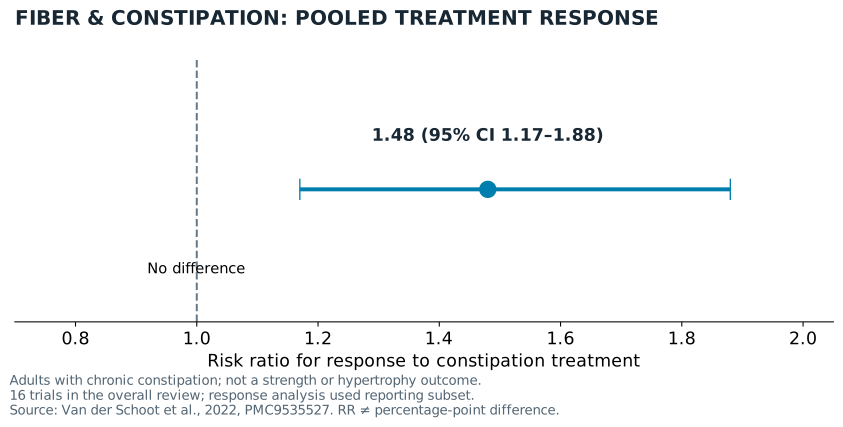
A 2022 review of 16 randomized trials involving 1,251 adults with chronic constipation found improvements in treatment response, stool frequency and consistency. Psyllium had supportive evidence. Gas increased, too, and results varied across studies. [5]
Certain fibers also help with cholesterol. A meta-analysis of 28 trials found that psyllium reduced LDL cholesterol by about 0.33 mmol/L, roughly 13 mg/dL, on average. The median dose was approximately 10.2 grams daily. That is an average from research, not a guarantee or a starting-dose instruction. [6]
Regularity and cardiovascular health might not sell as well as “unlock your anabolic microbiome.” They still matter if you want to keep training for years.
How much do you need?
There is no proven fiber number that maximizes hypertrophy.
WHO recommends at least 25 grams daily of naturally occurring fiber from food for adults. A 2025 sports-nutrition opinion paper proposed gradually bringing low intakes toward approximately 30 grams daily over six weeks. The authors also acknowledged the shortage of athlete-specific trials. [2], [7]
For many adult lifters, around 30 grams is a practical planning point—not a universal prescription, ceiling, or number to force tomorrow.
If you currently eat very little, increase gradually. Add one manageable serving, see how you feel, and build from there. Drink enough fluid; fiber does not excuse running through the day dehydrated. [8]
For a big strongman eating a mountain of calories, blindly scaling fiber upward can make getting enough food uncomfortable. Use tolerance, regularity and adequate fueling to guide the plan. That is a practical application, not a separate research-proven strongman target.
Don’t turn your pre-squat meal into a fiber challenge
A fiber-containing daily diet does not require a huge fiber load immediately before training.
If a big bean bowl or fiber-heavy shake makes your stomach miserable under a belt, move it to another meal. Lower-fiber choices near exercise can help some athletes with comfort; exact timing is individual, and lifting-specific evidence is limited. [2]
| Situation | Practical approach |
|---|---|
| Normal meals away from training | Include tolerated fiber-rich foods |
| Pre-workout meal causes bloating or urgency | Trial a smaller fiber load; move those foods elsewhere |
| High-calorie gaining phase | Spread fiber across meals so fullness does not crowd out fuel |
| Fat-loss phase | Use filling whole foods while keeping sufficient protein and training fuel |
| Competition day | Use familiar meals and portions already tested in training |
These are coaching applications, not a validated universal timing protocol.
White rice before training and oats at breakfast can coexist. Your carbs do not need to fight each other.
Before you blame protein, inspect the bar
Sometimes the problem is not the protein. It is everything hitchhiking with it.
Lactose can cause symptoms in people who do not digest it well. Certain sugar alcohols can contribute to gas. Large portions of fermentable ingredients can be uncomfortable, especially after a sudden change. [1], [9]
If you are eating multiple protein bars, drinking shakes and adding a new “gut health” powder, you have several variables—not a diagnosis.
Try changing one thing at a time. Record what you ate, the portion, the timing and the symptoms. Do not eliminate half the grocery store because one bar made you regret your life choices.
Persistent symptoms deserve an actual assessment. Blood in the stool, ongoing abdominal pain or unexplained weight loss should not be handled by buying another supplement. [10]
Fermented foods and probiotics: useful, but calm down
Fermented foods and probiotic capsules are not the same thing. Probiotic effects depend on the organisms, strains, dose and outcome studied. Not every product marketed as a probiotic has demonstrated a benefit. [11]
In a small Stanford trial, 36 adults were assigned to higher-fiber or higher-fermented-food diets. The fermented-food group increased microbial diversity and reduced several inflammatory markers. The fiber group showed other microbial changes without an overall improvement in its primary cytokine-response outcome. Neither diet was tested for adding muscle or improving a squat max. [12]
Enjoy yogurt or kefir if you tolerate them. Do not turn a small microbiome study into a promise that fermented food fixes everything.
Probiotic performance research is mixed. A 2025 meta-analysis found improvements in some outcomes but no significant lean-body-mass benefit. A 2026 analysis found its clearest performance signals in endurance-related measures. That does not establish a reliable strength or hypertrophy payoff for lifters. [13], [14]
Here is a useful reality check: a 2026 exploratory probiotic trial randomized 60 male athletes consuming a high-protein diet. Despite favorable findings in selected subgroups, there were no statistically significant between-group differences across evaluated outcomes in the full analysis population. Subgroup results are leads for future research, not a shopping list. [15]
Buying more bacterial strains is not the same as buying more results.
What about low-FODMAP diets?
Low-FODMAP is not another name for low-fiber. It targets particular fermentable carbohydrates that can trigger symptoms in susceptible people.
Small studies in runners suggest short-term benefits for some exercise-related symptoms. That does not make strict restriction the default diet for every lifter. Monash University emphasizes reintroduction and personalization rather than staying on a restrictive phase indefinitely. [16], [17]
If symptoms persist, work with a qualified dietitian or clinician to identify the issue. The goal is the widest diet you comfortably tolerate, not winning a contest for the fewest foods remaining.
Put fiber into meals you already eat
You do not need a personality transplant. Start with familiar foods. Whole grains, legumes, fruits, vegetables, nuts and seeds are useful sources. [8]
| Your usual meal | A practical addition |
|---|---|
| Eggs | Oatmeal and fruit |
| Greek yogurt | Berries and a tolerated portion of seeds |
| Beef-and-rice bowl | A small serving of beans and vegetables |
| Chicken dinner | A whole-grain side and cooked vegetables |
| Protein-heavy snack routine | Fruit and nuts alongside some of those snacks |
Yogurt and steak provide other nutrients; they are not meaningful fiber sources themselves. The additions are doing that job.
Start with portions you tolerate. You do not have to introduce beans, bran, seeds and a fiber powder on the same afternoon.
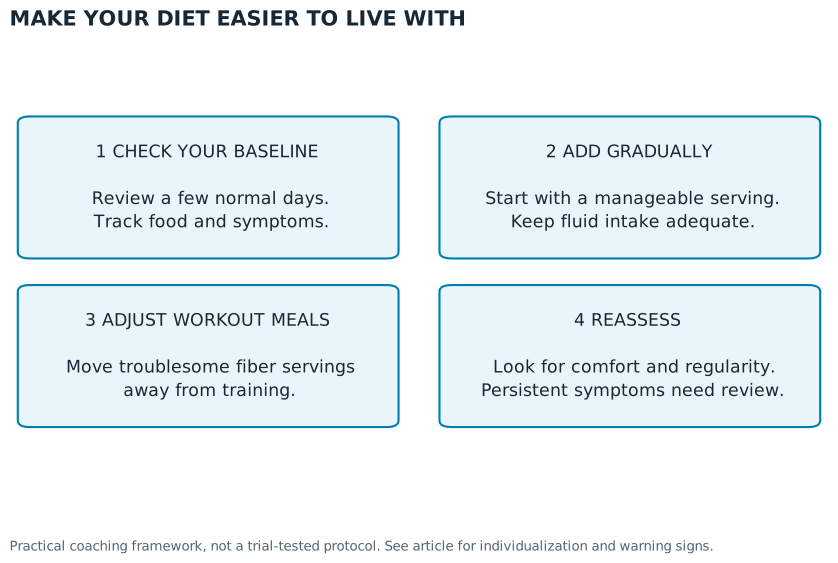
The athlete action plan
- Check your baseline. Look at a few normal days before deciding you need a supplement.
- Add gradually. Build around foods you like and tolerate, with adequate fluid. [8]
- Keep the fundamentals. Fiber should fit alongside sufficient protein, calories and training fuel.
- Protect training comfort. Move troublesome servings away from workouts and change one variable at a time.
- Use supplements for a reason. Psyllium can be useful for some people, but follow the label, take it with adequate water and check medication timing with a pharmacist. Do not dry-scoop it. [18]
- Judge the right outcomes. Comfortable digestion, easier bowel movements and a diet you can sustain matter more than chasing a supposedly perfect microbiome.
You do not need to choose between eating like a strength athlete and taking care of your gut.
Keep the steak. Add some fiber. Stop asking a probiotic capsule to organize your entire diet.
Sources
- Gill et al. Dietary fibre in gastrointestinal health and disease. Nature Reviews Gastroenterology & Hepatology, 2021.
- Mancin, Burke & Rollo. Fibre: The Forgotten Carbohydrate in Sports Nutrition Recommendations. Sports Medicine, 2025. Current opinion; not a dosing trial.
- Mak et al. Dietary protein–fiber interactions: systematic review and network meta-analysis, 2025.
- Zöhrer et al. High-protein diet, strength training and microbiota in older adults. Published January 2026.
- Van der Schoot et al. Fiber supplementation for chronic constipation: systematic review and meta-analysis, 2022.
- Jovanovski et al. Psyllium and LDL/non-HDL cholesterol and ApoB: meta-analysis, 2018.
- WHO. Carbohydrate intake for adults and children: recommendations, 2023.
- NIDDK. Eating, Diet & Nutrition for Constipation.
- NIDDK. Eating, Diet & Nutrition for Gas in the Digestive Tract.
- NIDDK. Symptoms & Causes of Constipation.
- NIH Office of Dietary Supplements. Probiotics: Health Professional Fact Sheet.
- Wastyk et al. Gut-microbiota-targeted diets modulate human immune status. Cell, 2021.
- Probiotics, body composition, recovery and exercise performance: systematic review and meta-analysis, 2025.
- Probiotic intake and athletic ability: systematic review and Bayesian meta-analysis, 2026.
- Miyamoto et al. BB536 in high-protein male athletes: exploratory randomized trial, 2026.
- Short-term low-FODMAP diet and exercise-related gastrointestinal symptoms: randomized crossover study, 2019.
- Monash University. The low-FODMAP diet is not a lifetime diet.
- MedlinePlus. Psyllium: medication information and precautions.