
Nutrition & Supplements
Fuel Competition Day: Strongman & Powerlifting
Practical competition-day food, carbohydrate, fluid and sodium planning for strongman and powerlifting, including heat, nerves and weigh-ins.
The practical take.
- What it may help with
- Prepare familiar food, drinks and snacks around actual event demands and warm-up times.
- What the evidence supports
- The practical feeding ranges are rehearsal frameworks, not validated strongman or powerlifting doses. Drink examples show arithmetic rather than performance outcomes.
- Joel’s approach
- Rehearse your plan, count food and drink together, avoid forced overdrinking, and separate weigh-in recovery from routine fueling.
Read full guide & sources
You packed your belt. Your sleeves. Your shoes. Your lucky shirt that probably needs to be retired by a hazardous-materials team.
Your nutrition plan? An energy drink, whatever is at the gas station, and the assumption that somebody brought gummy bears.
Then the contest runs late. You’re hungry, overheated, and trying to figure out why your stomach feels like a washing machine before the final event.
Pack your food like you pack your equipment. Competition day is a terrible time to improvise the basics.
The goal is simple: reach the last event fueled, hydrated and comfortable enough to perform. Not stuffed. Not jittery. Not trying to rescue an aggressive weight cut with a gallon of water.
Six hours at a meet is not six hours of exercise
Powerlifting and strongman share some nutrition needs. They do not have identical demands.
Three heavy squat attempts with long rests are different from a carry medley, deadlift repetitions and stones. Warm-ups matter, too. So does standing outside sweating while the next event gets set up.
A study of strongman preparation documented athletes using carbohydrate snacks, easily digested meals, small portions and fluids. Useful information—but a survey of what competitors do does not prove an optimal dose. [1]
Resistance-exercise research suggests carbohydrate feeding can help training volume, particularly in longer or fasted sessions. That is not proof that candy immediately before an attempt increases your one-rep max. [2], [3]
Fuel the actual demands of the contest, not just the number of hours printed on the schedule.
Win breakfast before you worry about the last event
If you are not making weight, arrive having eaten enough the day before and maintained normal hydration. You do not need to win a pasta-eating contest at dinner.
For breakfast, rehearse a familiar meal about two to four hours before your first demanding warm-up. A useful starting example is roughly 60–120 grams of carbohydrate with 20–40 grams of protein, keeping fat and fiber modest if they bother your stomach.
That is a practical meal example, not a scientifically proven strongman prescription. Smaller athletes, early starts and nervous stomachs may need less or split portions. Broad sports guidelines allow a wide carbohydrate range before exercise, but the upper end should not be mechanically multiplied by a very large athlete’s body weight. [4]
Think bagel and jam with yogurt, cereal and tolerated milk, or rice with a modest portion of chicken. If weigh-in comes first, the actual recovery window determines what you can comfortably eat.
Between events: keep the fuel coming without force-feeding
There is no well-established carbohydrate dose that fits every strongman contest or powerlifting meet.
The familiar 30–60 g/hour recommendation comes largely from prolonged endurance and stop-start exercise. Higher endurance intakes are not automatically appropriate because your meet lasts all afternoon. [5]
Here is a framework to rehearse—not a requirement to hit every number on the clock:
| Competition situation | Practical starting approach |
|---|---|
| Powerlifting, fed beforehand, long rests | Snacks and a small meal during suitable breaks; about 20–40 g carbohydrate/hour averaged across the day can be a planning range |
| Strongman with repeated demanding events | Trial about 30–60 g/hour during the active competition period, adjusted to workload and tolerance |
| Long delay with little activity | Reassess hunger and the next warm-up; a small meal may fit better than constant sports snacks |
| Short competition with minimal workload | Normal pre-event eating and an occasional snack may be enough |
These ranges are applied coaching estimates extrapolated from broader sports nutrition, not validated sport-specific targets. Count drinks, meals and snacks together.
A sports drink, two gels, candy and a sandwich all count. Your stomach does not give each product its own separate carbohydrate allowance.
Eat for the next warm-up
Do not ask only, “When is my next event?” Ask, “When do I need to start warming up and bracing again?”
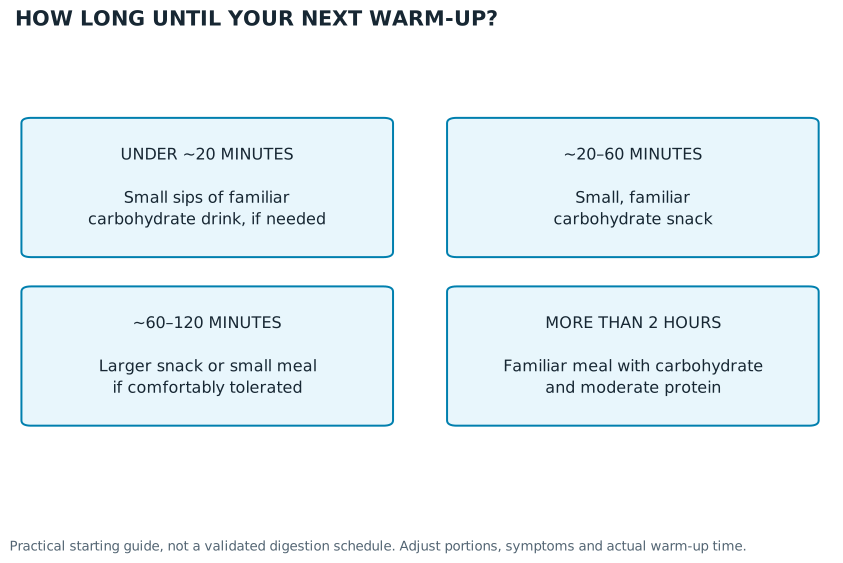
| Time before the next warm-up | Option to test |
|---|---|
| Under about 20 minutes | Small sips of a familiar carbohydrate drink if needed |
| About 20–60 minutes | Small carbohydrate snack, such as applesauce, pretzels or part of a bagel |
| About 60–120 minutes | Larger snack or small meal if tolerated |
| More than two hours | Familiar carbohydrate-containing meal with moderate protein |
Small, familiar foods are easier to adjust than a giant meal. Sports nutrition guidance supports carbohydrate-rich snacks and liquid options when solids are difficult. [6]
There is nothing wrong with steak, vegetables or dietary fat. A huge burger right before stones is simply a questionable scheduling decision.
Fluids: stop copying the biggest guy’s bottle
General sport guidance often uses 0.4–0.8 liters per hour, with individual adjustment. A cool indoor meet with long rests may require less. A heavily sweating athlete outside may need more. This is not a minimum, a ceiling or a mandate to drink on schedule regardless of thirst. [4]
A more useful preparation tool is measuring sweat loss during representative training. [7]
Estimated sweat rate = (body-mass loss in kg + fluid consumed in liters − urine produced in liters) ÷ session hours.
For example, losing 0.6 kg while drinking 0.5 L during one hour, with no urination, suggests approximately 1.1 L/hour of sweat loss. This is an estimate to inform planning, not a command to force that amount down.
Use consistent dry clothing and account for anything that changes measured mass. Food intake and wet clothing can distort the calculation. Repeat under conditions resembling the contest rather than applying one winter gym measurement to a summer parking lot.
If you do not have an individualized plan, thirst is a useful guide. Avoid forced overdrinking. Sodium does not make excessive fluid intake safe or reliably prevent exercise-associated hyponatremia. [8]
Hydration is replacement, not a drinking competition.
Sodium: read the units
General exercise-drink guidance includes approximately 500–700 mg sodium per liter, while individual needs vary. Large sweat-sodium losses can justify a more tailored approach. Food contributes sodium, too. [9]
A drink containing 600 mg/L does not provide 600 mg if you only drink half a liter.
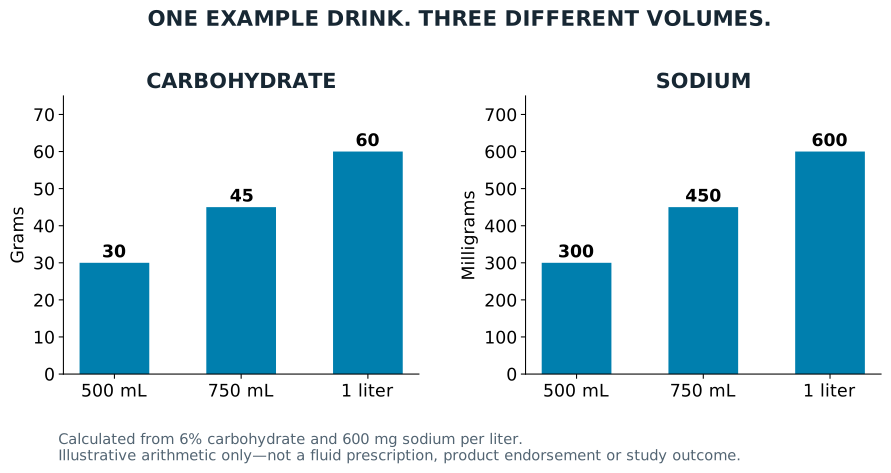
| Volume of that example drink | Carbohydrate | Sodium |
|---|---|---|
| 500 mL | 30 g | 300 mg |
| 750 mL | 45 g | 450 mg |
| 1 liter | 60 g | 600 mg |
AIS describes typical sports drinks as approximately 4–8% carbohydrate. Electrolyte-only products may supply almost no carbohydrate; carbohydrate powders may supply little sodium. Read the label rather than trusting the word “performance.” [10]
A packet containing 1,000 mg sodium mixed into 500 mL is 2,000 mg/L. Stronger is not automatically better. Mix products as directed and rehearse them. Athletes with prescribed fluid or sodium restrictions need their clinician’s guidance, not a generic competition chart.
A simple strongman-hour example
Suppose you drink 500 mL of the example drink above, providing 30 g carbohydrate and 300 mg sodium. Add a snack labeled as 20 g carbohydrate.
That is 50 g carbohydrate total, plus any sodium in the snack. It is not 50 g from food plus another uncounted bottle.
This demonstrates accounting. It does not mean every athlete needs this combination every hour. If the schedule slows down, the weather changes or your stomach objects, adjust.
When nerves shut your appetite down
Try smaller portions, an earlier meal or a familiar liquid option. A handler can track what you actually ate while you focus on the contest. Competition guidance specifically recognizes liquid meals or snacks as an option for nervous athletes. [11]
Do not solve every dip in energy with another scoop of pre-workout.
Caffeine can improve performance, but sensitivity and unwanted effects vary. Anxiety and sleep disruption matter, especially when competing again tomorrow. Count caffeine from coffee, energy drinks, gels and pre-workout together. [12]
You want to be ready to lift. You do not need to hear colors.
Heat changes more than your electrolyte needs
Shade, cooling and appropriate warm-ups belong in the plan alongside food and fluids. IOC heat guidance emphasizes preparation for expected conditions, recovery areas, hydration access and adapting clothing and warm-ups. [13]
Bring cold drinks and towels. Get out of unnecessary layers between events. Avoid turning every warm-up into an extra workout. Know where the medical team is.
Confusion, collapse or abnormal behavior in the heat requires urgent medical attention. Do not assume the athlete just needs more salt, sugar or motivation. [13]
Keep perishable meals cold, too. USDA recommends cold storage at or below 40°F/4°C. Food should not sit unrefrigerated for more than two hours—or one hour when temperatures exceed 90°F/32°C. [14]
Food poisoning is not the kind of gut training we are after.
Weigh-ins: recovery time is not imaginary
Confirm the actual rules and schedule. In the IPF, weigh-in starts no earlier than two hours before the relevant competition and lasts 90 minutes. That does not mean every lifter gets two full hours between stepping off the scale and warming up. Other events may use different arrangements. [15]
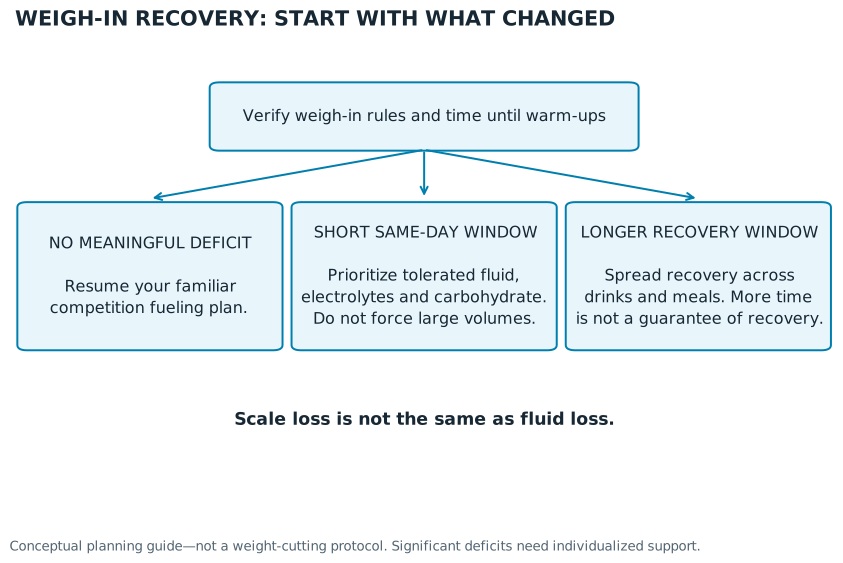
If you did not meaningfully dehydrate or restrict food, resume your normal plan. Do not create a recovery emergency because the internet says everybody needs one.
After a real fluid deficit, AIS describes replacing roughly 1.2–1.5 times the estimated fluid loss over two to four hours, with electrolytes, as tolerated. That is not permission to cram the entire amount into a short warm-up window. [16]
Total scale loss is not the same thing as fluid loss. Gut contents and glycogen-associated changes also affect body mass. Do not multiply the entire weight cut by 1.5 and call that your drinking prescription.
A properly prepared oral rehydration solution may help after meaningful dehydration, but it may not supply enough carbohydrate for refueling. Follow mixing directions and address food separately. More recovery time creates opportunities; it does not guarantee a large cut was harmless. [16]
A small 2025 trial in 26 male powerlifters found group-level maintenance of absolute strength after approximately 4.8% rapid weight loss and a two-hour recovery period. It was a simulated competition and does not establish that every athlete can safely reproduce the result. This article is a fueling guide, not instructions for an aggressive cut. [17]
Long days need real meals. Multiday contests need recovery.
Candy can be useful fuel. It does not have to become your entire food group.
Use longer breaks for a small familiar meal. Moderate protein portions can fit when digestion time allows; protein supports recovery but does not replace carbohydrate as competition fuel. General protein-timing guidance commonly uses 20–40 g every three to four hours, not a shake after every attempt. [18]
After day one, eat a tolerated carbohydrate-containing meal with protein and gradually replace remaining fluid and electrolyte losses. Tomorrow’s contest starts with tonight’s recovery.
Your competition-day checklist
- Rehearse it. Test breakfast, drinks and snacks during demanding training.
- Pack options. Bring familiar solids and a liquid-carbohydrate backup.
- Know the labels. Track carbohydrate, sodium and caffeine separately.
- Follow the real schedule. Eat around warm-ups and adjust for delays.
- Plan for the venue. Cooler, ice, shade and drinking access matter.
- Separate weigh-in recovery from routine fueling. Different problems need different plans.
- Give your handler the plan. Include what you tolerate and what you want to avoid.
You put months into getting stronger. Do not leave the last event at the mercy of an empty cooler and your fourth energy drink.
Pack smart. Fuel consistently. Finish strong.
Sources
- Winwood et al. Competition-day preparation strategies of strongman athletes, 2019.
- King et al. Acute carbohydrate feeding and resistance exercise: meta-analysis, 2022.
- Henselmans et al. Carbohydrate intake and strength performance: systematic review, 2022.
- Academy of Nutrition and Dietetics, Dietitians of Canada & ACSM. Nutrition and Athletic Performance, 2016.
- Burke et al. Carbohydrates for training and competition, 2011.
- NSW Institute of Sport. Food choices for the run-in to competition.
- NATA. Fluid replacement for the physically active, 2017.
- Wilderness Medical Society. Exercise-associated hyponatremia guideline, 2019 update.
- Australian Institute of Sport. Electrolyte supplements.
- Australian Institute of Sport. Sports drinks.
- USOPC Sport Nutrition Team. Fueling for Competition.
- ISSN. Caffeine and exercise performance position stand, 2021.
- IOC. Consensus on sport events in the heat, 2023.
- USDA. What is the Danger Zone?
- IPF. Official technical rules; check current version and event schedule.
- Australian Institute of Sport. Electrolyte supplements: how and when to use.
- Matras et al. Rapid weight loss and powerlifting performance: randomized trial, 2025.
- ISSN. Nutrient timing position stand, 2017.