Nutrition & Supplements
Dietary Fats for Strength Athletes: Stop Fearing the Yolk
Learn how dietary fats support strength athletes, where animal fats fit, and what the science says about muscle growth, testosterone, joints, and heart health.
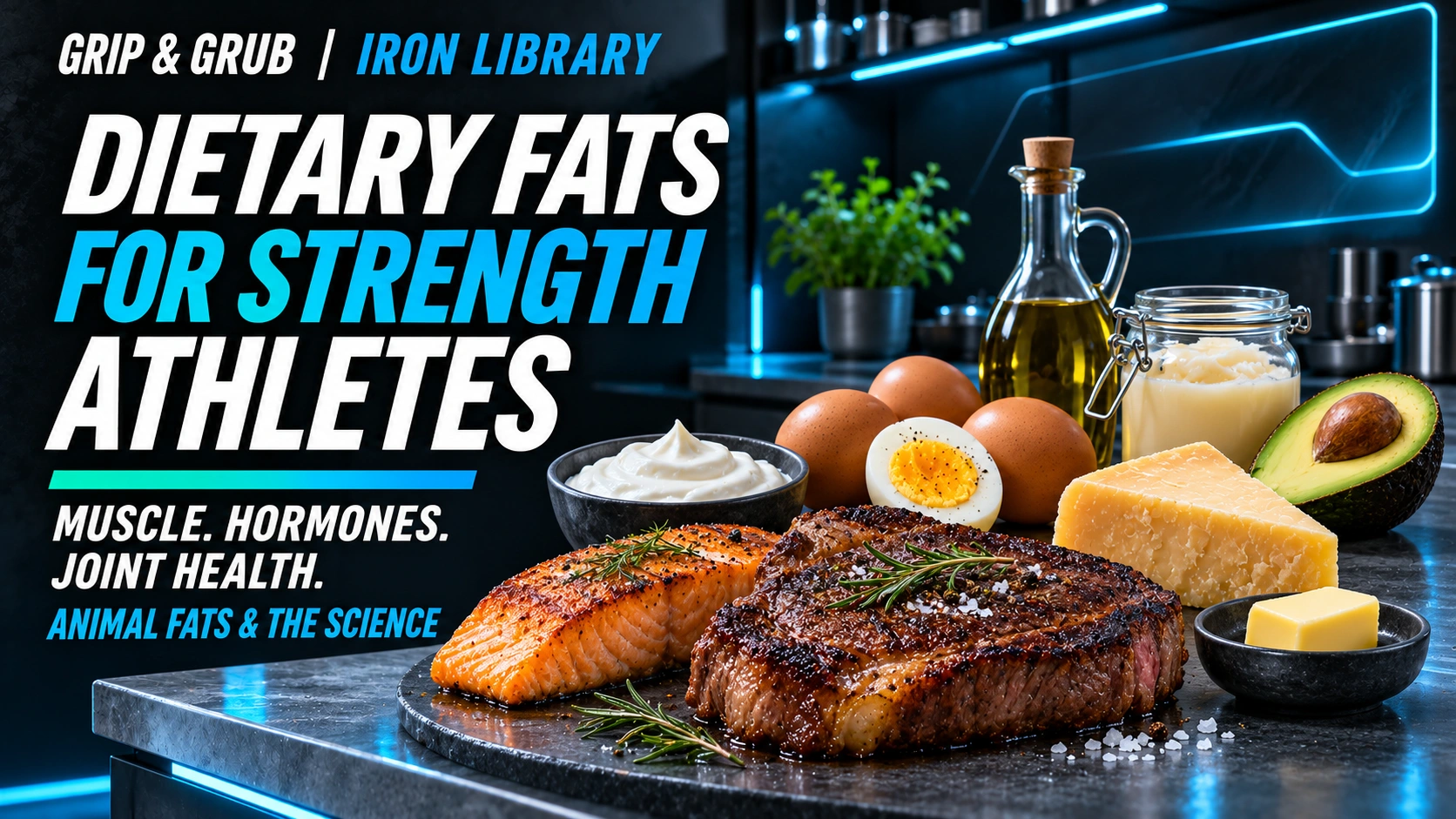
The practical take.
- What it may help with
- Supports adequate energy, essential fatty acids and normal physiology. Extra fat is not a proven independent muscle-building shortcut.
- What the evidence supports
- Acute protein synthesis, hormone measurements, osteoarthritis symptoms and cardiovascular events are different outcomes; keep their research limits in view.
- Joel’s approach
- Animal foods and unsaturated fats can share a practical diet. Saturated fat is part of total fat, and a planning range is not a personal prescription.
Read full guide & sources
Muscle growth, hormones, joint health, and the truth about animal fats.
Somewhere along the way, eating a whole egg became a moral decision. Butter became the villain. Then the internet swung the other direction, and suddenly people were acting like a spoonful of beef tallow could add fifty pounds to their deadlift.
Let’s get breakfast out of the culture war.
Your body needs fat. You can eat beef, whole eggs, yogurt, cheese, and fatty fish while building a strong, healthy body. You don’t need to apologize for the yolk. But you also don’t need to turn every meal into a butter-drinking contest.
Fat matters. The source matters. The amount matters. And being strong does not make your cardiovascular system exempt from biology.
What fat actually does for a lifter
Dietary fat supplies energy, essential fatty acids, building material for cell membranes, and support for absorbing vitamins A, D, E, and K. It contributes to normal physiology, including hormone-related processes. [1,2]
At roughly 9 calories per gram, it also packs more energy into a bite than protein or carbohydrate, which provide about four. That can help when you’re a large strength athlete struggling to eat enough.
But fat is not the main fuel for a max-effort lift. Heavy lifting and repeated hard sets depend heavily on your immediate energy systems and carbohydrate availability. Don’t let a campaign to defend steak convince you to throw away your potatoes.
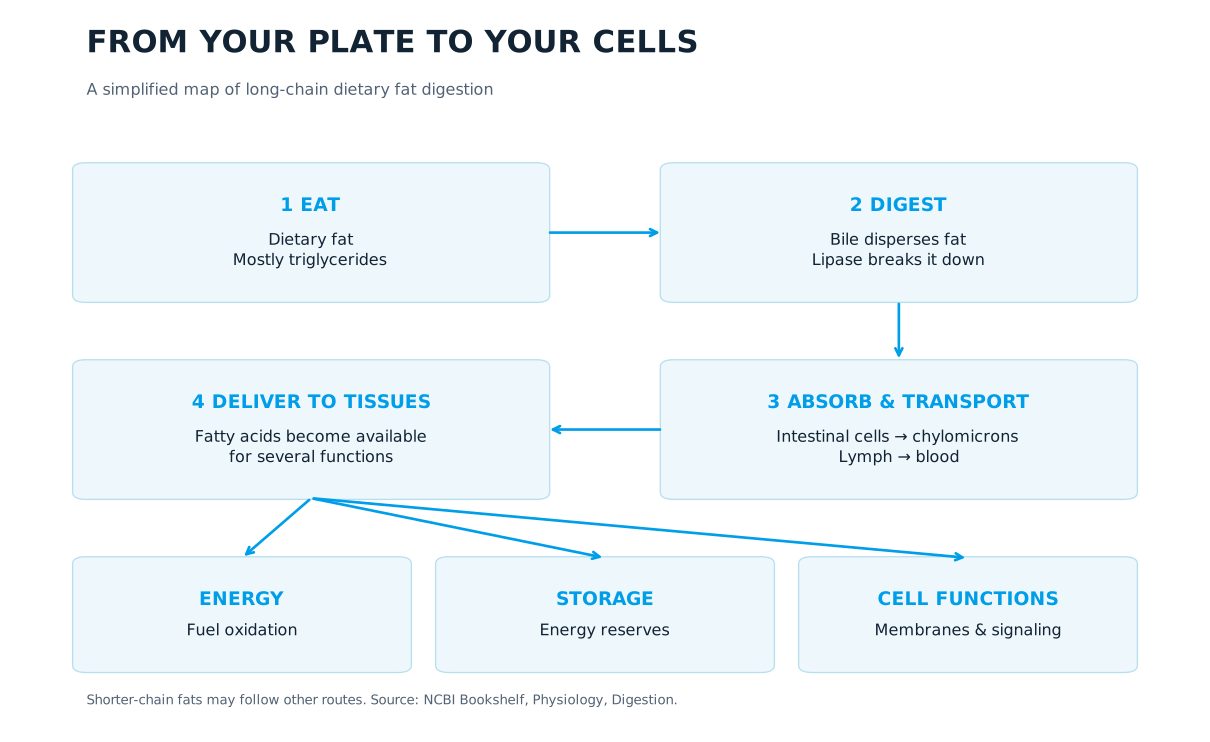
When you eat fat, bile helps disperse it in the small intestine and digestive enzymes break it down. Most long-chain dietary fats are absorbed, repackaged, and carried through lymph and then blood. Your tissues can use them for energy, storage, membranes, and signaling. [1]
“Animal fat” is not one thing
Beef fat, salmon fat, butter, and egg yolks do not have identical nutritional profiles. Neither do olive oil and coconut oil. The animal-versus-plant argument misses a lot.
| Fat type | Common sources | What a lifter should know |
|---|---|---|
| Saturated | Butter, tallow, cheese, fatty meat, coconut oil | Can fit into the diet; replacing some with unsaturated fats generally improves LDL cholesterol. |
| Monounsaturated | Olive oil, avocado, nuts, and a substantial share of beef and pork fat | Useful fat sources; animal fat is not purely saturated. |
| Polyunsaturated | Fatty fish, walnuts, seeds, and several plant oils | Includes essential omega-3 and omega-6 fats. |
| Industrial trans | Partially hydrogenated oils | Avoid these when present. They are not a performance tool. |
Even saturated fatty acids differ. Stearic acid, found in beef fat, generally has a smaller LDL-raising effect than palmitic or myristic acid. But a food contains a mixture, so one favorable ingredient doesn’t erase the rest of its composition. [3,4]
Yes, tallow contains oleic acid, the monounsaturated fat prominent in olive oil. That does not make tallow nutritionally interchangeable with olive oil.
Does fat build muscle?
It helps support the environment in which muscle gets built: enough energy, adequate nutrition, and a diet you can actually follow. But extra fat is not a proven hypertrophy booster.
Training supplies the stimulus. Protein supplies amino acids. Sufficient energy supports the process. Carbohydrate helps you do the work. Dietary fat has a role alongside those pieces; it doesn’t replace them. [2]
Keep the yolk—but read the whole study
A 2017 trial found a greater immediate muscle protein synthesis response after whole eggs than after egg whites with the same amount of protein. Both meals supplied 18 grams of protein; the whole eggs also supplied 17 grams of fat. [5]
Sounds like a win for the yolk. But it does not prove fat caused the difference. Whole eggs also bring phospholipids, micronutrients, and additional calories. A few hours of muscle protein synthesis is also not the same thing as months of measured muscle growth.
A 2026 trial in 65 resistance-trained young adults found no statistically significant difference in post-exercise myofibrillar protein synthesis between protein-matched egg whites, whole eggs, salmon, pork, lentils, and mycoprotein. That doesn’t prove every food is identical; it shows why one acute study shouldn’t become a universal rule. [6]
My take: whole eggs are a useful food. Egg whites are a useful tool. Combine them when you want more protein without pushing calories or fat as high. There is no trophy for throwing away every yolk, and no bonus muscle for insisting on unlimited yolks.
Testosterone: your butter dish is not a hormone clinic
Cholesterol is used to make steroid hormones, including testosterone. Your body also manufactures cholesterol. Eating more cholesterol or saturated fat does not automatically mean you produce more testosterone.
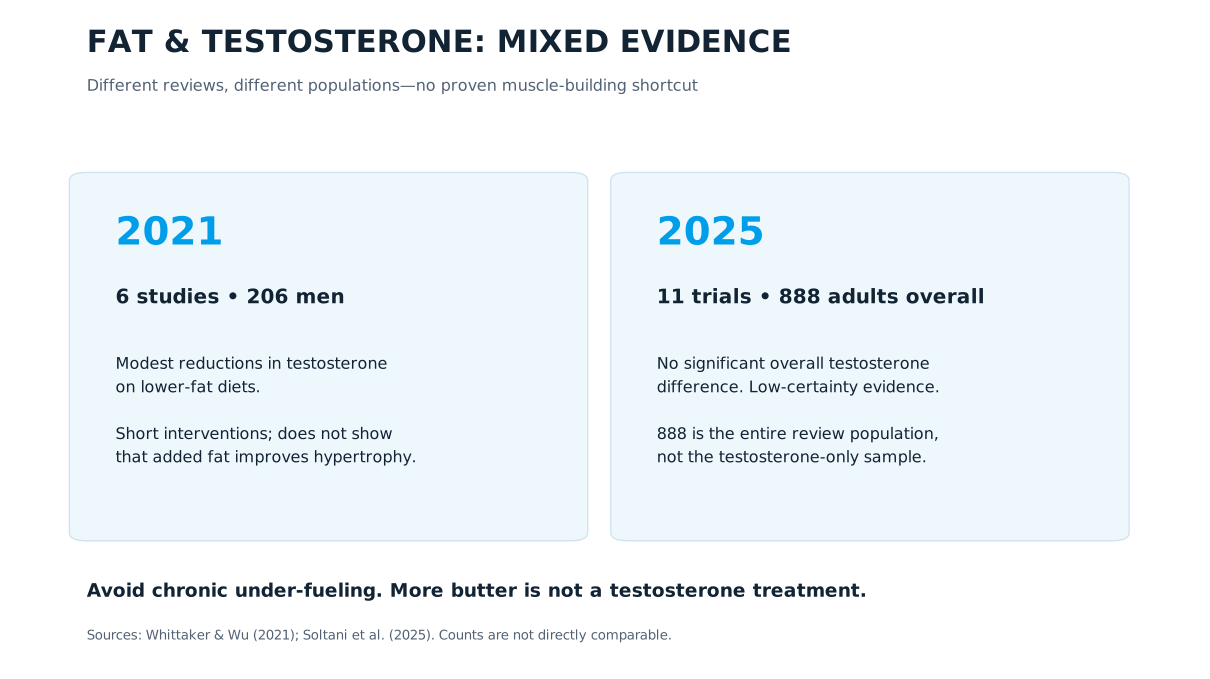
The human research on total fat intake is mixed:
| Research | What it found | What it doesn’t establish |
|---|---|---|
| 2021 review: 6 intervention studies, 206 men | Lower-fat diets produced modest reductions in total and free testosterone. | That adding saturated fat improves strength or muscle growth. |
| 2025 review: 11 randomized trials, 888 adults overall | No statistically significant overall testosterone difference between lower- and higher-fat diets; evidence certainty was low. | That extremely low-fat diets are ideal, or that every athlete responds identically. |
The 888 participants were spread across the review’s sex-hormone analyses—not 888 male lifters in a testosterone trial. The reviews used different populations and definitions, so comparing their head counts like a scoreboard would be misleading. [7,8]
The more practical concern is chronic under-fueling. The IOC’s REDs consensus describes how inadequate energy availability can disrupt reproductive function and bone health in both male and female athletes. [9]
Don’t slash calories into the floor, strip every gram of fat from your meals, sleep five hours, and expect your body to be thrilled. But if you have symptoms of a hormone problem, get evaluated instead of prescribing yourself more butter.
Do fats lubricate your joints?
If eating butter greased your knees, every pancake breakfast would count as physical therapy.
Your joints use synovial fluid and specialized molecules—including hyaluronic acid and lubricin—to help surfaces move with low friction. Dietary fat does not travel from your plate into your knee like oil into an engine. [10]
Omega-3 fats are a different conversation. EPA and DHA help influence inflammatory signaling. That gives them a plausible role in certain joint conditions, but it is not mechanical lubrication. [11]
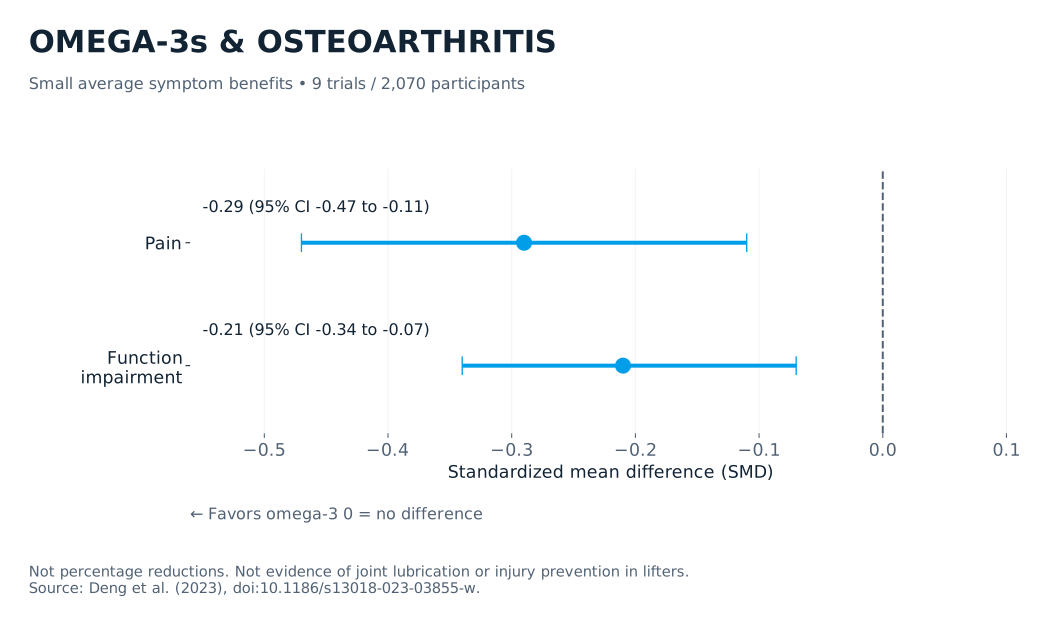
A 2023 meta-analysis of nine trials involving 2,070 people with osteoarthritis found small average improvements in pain and function with omega-3 supplementation. These were people with diagnosed osteoarthritis, not healthy lifters being tested for injury prevention. [12]
Eat well, manage training load, recover, and address persistent pain. Tallow is not a substitute for any of those things.
Which animal foods earn a place on the plate?
Beef: Complete protein, iron, zinc, and vitamin B12 make it useful athlete food. Choose the cut and portion to fit your energy needs. Leaner beef leaves more room for other fats and training carbs; fattier beef makes calories easier to reach.
Whole eggs: Protein plus choline and other nutrients. Keep the yolks when they fit your plan. Add whites when you need extra protein with fewer calories.
Salmon and sardines: Protein plus EPA and DHA. These deserve attention in a discussion about animal fats. Animal fat does not just mean ribeyes and butter. A practical food-first habit is fatty fish around twice a week. [11]
Yogurt and cheese: Useful sources of protein and calcium, with amounts varying by product. Full-fat versions can fit. Lower-fat versions can also be smart when you want protein without as much saturated fat.
Butter, ghee, tallow, and lard: Cooking fats and flavor. They provide concentrated energy, but they don’t provide the protein package of meat, eggs, or fish. Use them intentionally rather than treating them as supplements.
Cheese and butter are not the same food
A 2023 meta-analysis found that cheese produced lower average LDL cholesterol than butter in comparable dairy-fat interventions—about 0.19 mmol/L, or roughly 7 mg/dL lower. [13]
The structure and other nutrients in a food can change how the body responds. That’s the “food matrix” idea in normal English.
It does not mean cheese lowers LDL compared with every other food, or that unlimited cheese is protective. The comparison matters.
Enjoy animal fats. Keep your eyes open about saturated fat.
The 2025–2030 U.S. dietary guidelines include animal foods among fat sources and name butter and tallow as cooking options. They also retain a general saturated-fat limit of no more than 10% of daily calories. Both statements belong in the conversation. [14]
The 2026 American College of Cardiology statement is more cautious about emphasizing full-fat animal foods and supports replacing saturated fat with unsaturated fat for cardiovascular health. [3]
Long-term randomized evidence deserves attention, too. An updated 2020 Cochrane review found about 17% lower relative risk of combined cardiovascular events with saturated-fat reduction. It found little or no clear effect on overall mortality. That is a relative change across study populations—not a 17-percentage-point reduction in your personal risk. [15]
You can eat steak and still respect that evidence. Adjust portions, use some leaner cuts, include fish and unsaturated fats, and pay attention to LDL cholesterol and, when appropriate, ApoB with your clinician. A big squat does not cancel an unfavorable lipid result.
And no, coconut oil does not get a free pass because it comes from a plant.
What about Huberman, Layne Norton, and Rhonda Patrick?
In his 2024 Huberman Lab discussion, Layne Norton emphasizes the distinction between saturated and unsaturated fats and pushes back on blanket claims about seed oils. Rhonda Patrick’s September 2026 discussion highlights different saturated fatty acids, food structure, and the foods being replaced. [4,16]
Their conversations are useful starting points. The underlying research still has to carry the claim.
You can prefer olive oil, butter, or tallow in your kitchen. But “I prefer this” and “all seed oils cause inflammation” are different statements. Controlled human evidence does not justify that blanket accusation. Repeatedly overheated frying oil and a measured amount of fresh cooking oil are also different situations. [3,16]
Will fish oil put pounds on your deadlift?
Don’t buy it expecting a new max.
A 2026 systematic review found no clear benefit for muscle strength or fat-free mass in healthy adults without obesity; the certainty of evidence was very low. That leaves uncertainty, not a reliable strength promise. [17]
Fatty fish can still be excellent food. A supplement may help fill a dietary gap, but more isn’t automatically better. High-dose omega-3 trials have reported increased atrial-fibrillation risk in some cardiovascular-risk populations. That’s a reason to discuss high-dose use with a clinician, not to fear a salmon dinner. [11]
How much fat should you eat?
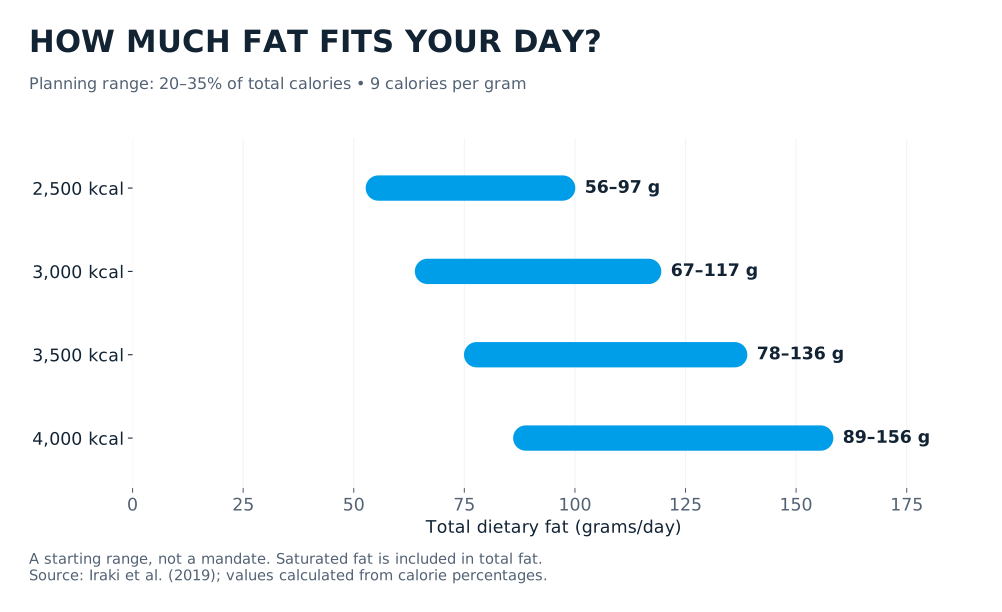
For many adult strength athletes, roughly 20–35% of daily calories is a reasonable planning range. It is a starting point, not a requirement to hit the upper end. Individual needs, goals, and medical circumstances can shift it. [2]
| Daily calories | Approximate total fat at 20–35% |
|---|---|
| 2,500 | 56–97 g |
| 3,000 | 67–117 g |
| 3,500 | 78–136 g |
| 4,000 | 89–156 g |
At 3,000 calories, 30% from fat equals 100 grams. Ten percent of calories from saturated fat is about 33 grams. That is a general ceiling, not a target; some people need a lower limit to manage LDL. Saturated fat is already part of total fat—it is not an additional allowance. [3,14]
During a gaining phase, fat can help you meet energy needs. During fat loss, measured portions help keep calories manageable. Either way, leave enough room for protein and the carbohydrates that support your training.
Timing is mostly about comfort. A normal meal containing fat a few hours before training is usually fine. A huge fatty meal immediately before a hard session may sit poorly. After training, fat can stay on the plate alongside protein and carbohydrate; there’s no automatic need to avoid it. [2]
The Grip & Grub action plan
- Set total calories and protein first. Fit fats and carbs around your training demands and preferences.
- Start with a moderate fat intake. Use the range above, then adjust based on performance, appetite, body-weight trends, and health markers.
- Eat a mix of foods. Beef, eggs, dairy, and fish can share the week with olive oil, avocado, nuts, vegetables, fruit, and starches.
- Give fatty fish a regular spot. Don’t make butter your entire animal-fat strategy.
- Measure added fats for a few days. Oil, tallow, and butter are easy to underestimate because a small amount carries a lot of energy.
- Keep the promises realistic. Adequate fat supports health. Extra fat does not guarantee more testosterone, bigger muscles, or pain-free joints.
You don’t need to be afraid of a steak. You don’t need to throw out every yolk. And you don’t need a nutrition influencer’s permission to enjoy some butter.
Eat enough. Train hard. Get your protein. Keep your carbs useful and your fats intentional. The goal is to stay strong for years—not win an argument about breakfast.
Educational information for adults, not individualized medical nutrition advice.
Research & further reading
- NCBI Bookshelf. Physiology, Digestion.
- Iraki et al. (2019). Nutrition Recommendations for Bodybuilders in the Off-Season.
- ACC (2026). Food and Health: Nutrition for Prevention and Management of Cardiovascular Disease.
- FoundMyFitness (September 11, 2026). Why Saturated Fats Differ in Their Effects on LDL.
- van Vliet et al. (2017). Whole eggs versus egg whites and post-exercise muscle protein synthesis.
- 2026 whole-food protein trial. Diverse protein-rich foods and post-exercise protein synthesis.
- Whittaker & Wu (2021). Low-fat diets and testosterone in men.
- Soltani et al. (2025). Low-fat versus high-fat diets and sex hormones.
- IOC (2023). Consensus statement on Relative Energy Deficiency in Sport.
- Jay & Waller (2014). The biology of lubricin: near frictionless joint motion.
- NIH Office of Dietary Supplements. Omega-3 Fatty Acids: Health Professional Fact Sheet.
- Deng et al. (2023). Omega-3 supplementation for osteoarthritis: meta-analysis.
- Pradeilles et al. (2023). Cheese versus other dairy foods: randomized-trial meta-analysis.
- USDA/HHS. Dietary Guidelines for Americans, 2025–2030.
- Hooper et al. (2020; updated version). Reduction in saturated fat intake for cardiovascular disease.
- Huberman Lab (August 12, 2024). Dr. Layne Norton: Tools for Nutrition & Fitness.
- 2026 systematic review. Omega-3 supplementation, fat-free mass and strength.