
Nutrition & Supplements
Grass-Fed, Grass-Finished Beef: Better Fuel or Just a Better Label?
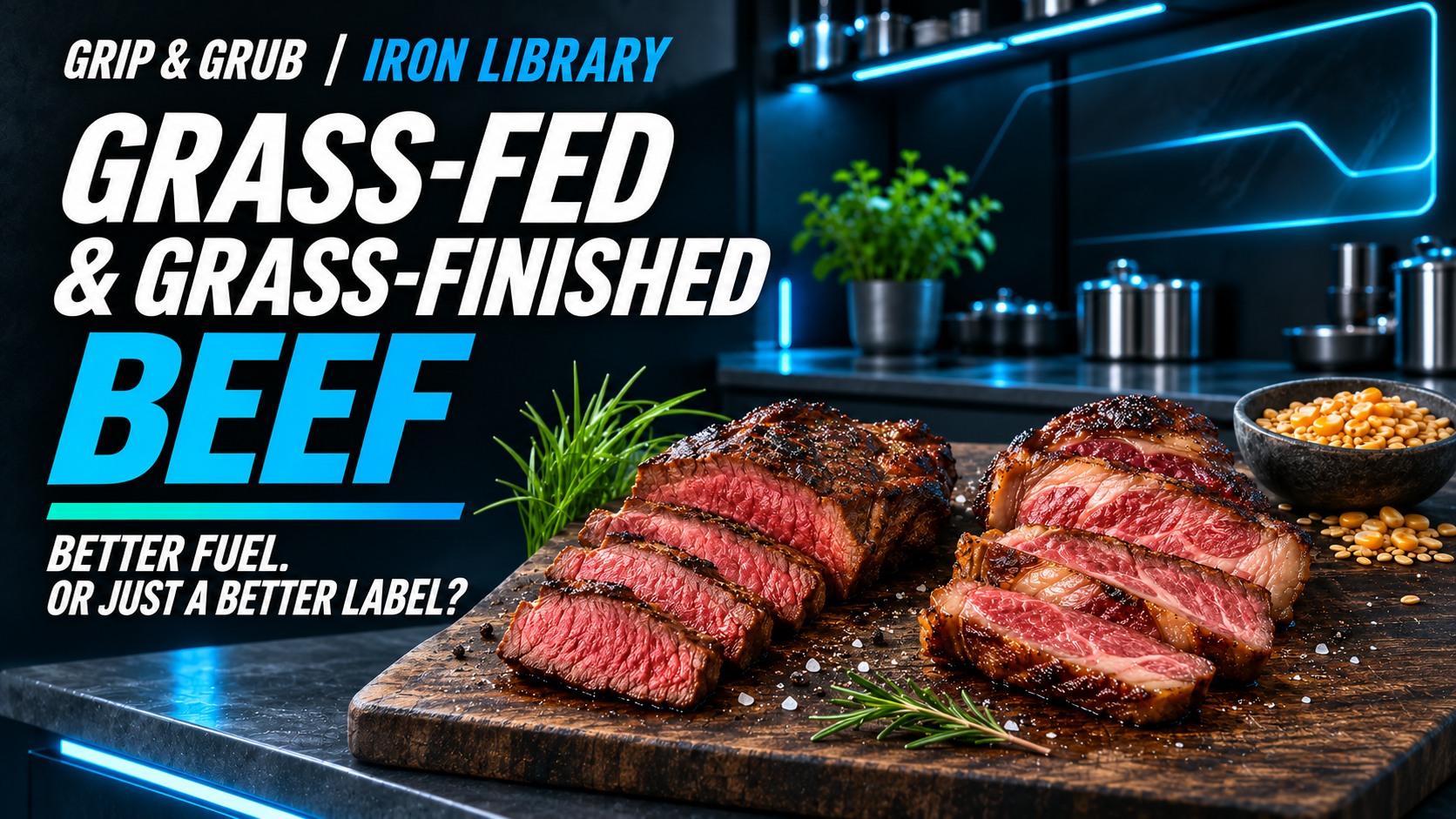
Grass-fed beef has more omega-3s and some pasture-derived nutrients. But does that make you stronger or healthier? Joel separates the research from steakhouse marketing.
The practical take.
- What it may help with
- A slightly different nutrient profile, especially omega-3 fats and some pasture-derived compounds.
- What the evidence supports
- The nutrient differences are real. Better muscle growth or long-term health outcomes from switching beef? Not proven.
- Joel’s approach
- If you like it and can afford it, buy verified 100% grass-fed, grass-finished beef. If not, regular beef still gets the protein job done.
Read full guide & sources
Walk through the meat section and you'll see two ribeyes. One is regular beef. The other is labeled 100% grass-fed and costs enough extra that you start wondering if the cow had a personal trainer.
I love a good steak. But I'm not paying a premium just because somebody printed a picture of a pasture on the package.
So let's talk about what actually changes when cattle are raised and finished on forage—and what doesn't.
First, what does grass-fed and grass-finished actually mean?
Most conventional cattle eat grass or forage early in life, then spend a finishing period on an energy-dense ration that commonly includes grain. Regular beef isn't automatically a cow that ate nothing but corn.
For U.S. labeling, 100% grass-fed means a forage-based diet after weaning with no grain or grain byproducts. Animals must also have access to pasture during the growing season. Grass-finished describes the last feeding phase; by itself, it doesn't prove the animal never ate grain earlier. And USDA Organic has different rules—it doesn't automatically mean 100% grass-finished. USDA FSIS · UConn Extension
If I'm spending extra money, I want clear, verifiable language: 100% grass-fed and grass-finished, ideally backed by an independent certification that explains the standards.
The nutrition: same protein, different fat profile
Here's the biggest thing for lifters: both types of beef deliver complete protein, iron, zinc, vitamin B12 and naturally occurring creatine. There's no compelling evidence that grass-finished beef builds more muscle than grain-finished beef when your total protein, calories and training are matched.
Where grass-finished beef usually wins is the type of fat, not some magical new kind of protein.
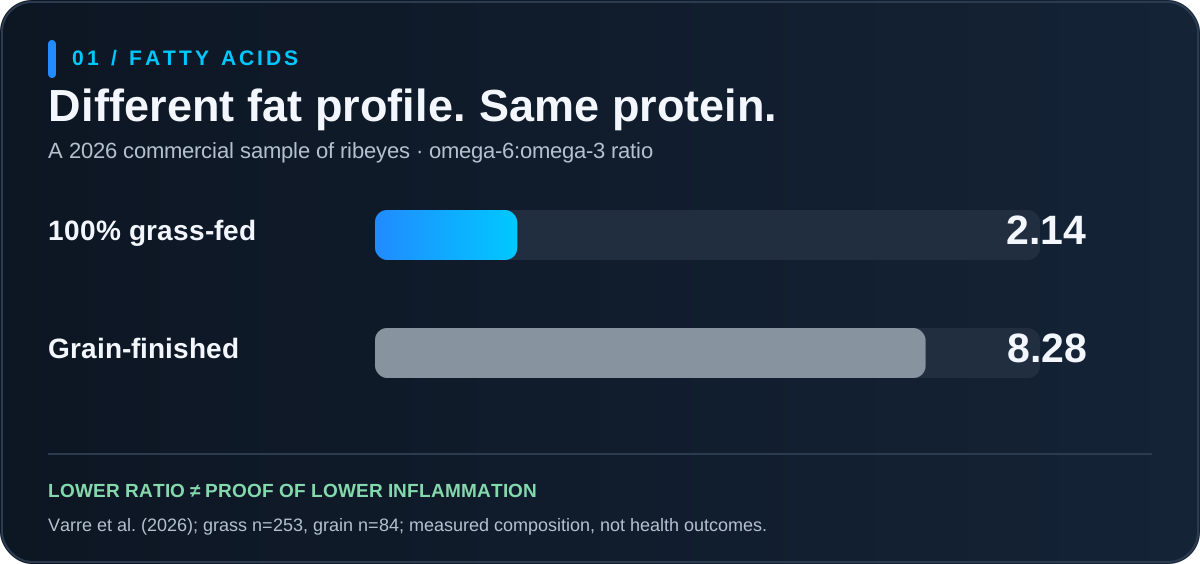
A 2026 analysis of commercial North American ribeyes found an average omega-6-to-omega-3 ratio of 2.14 in grass-fed beef versus 8.28 in grain-fed beef. Grass-fed samples also contained higher proportions of omega-3 fats, including ALA, EPA and DPA, and more CLA. That's a meaningful difference in composition. It's not proof that the person eating it has less inflammation or gets stronger. Varre et al., 2026
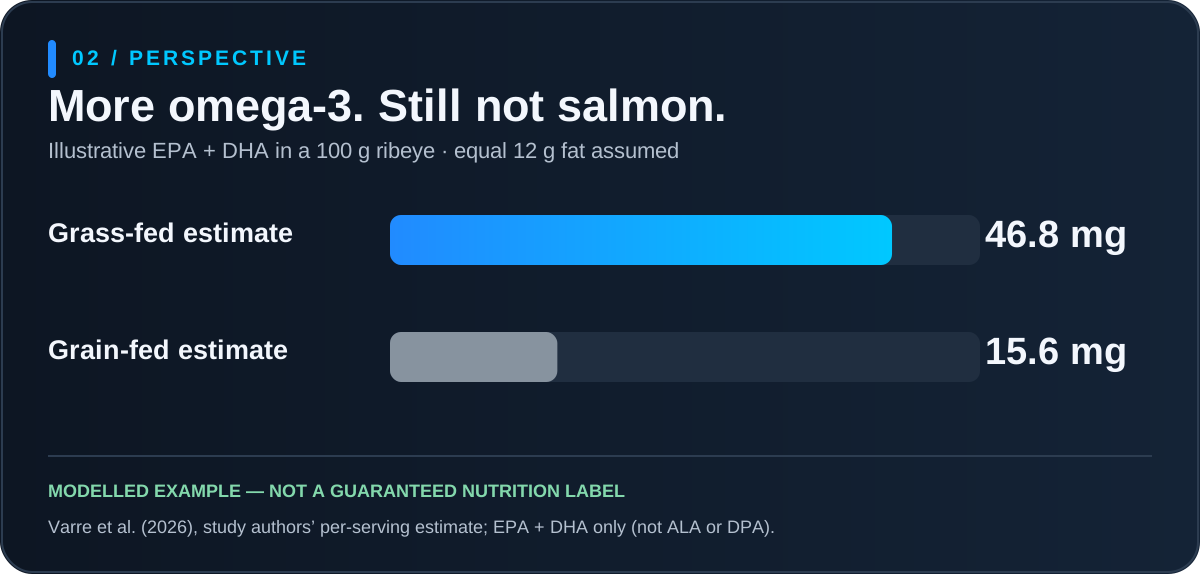
And before anybody calls this an omega-3 superfood, look at the actual dose. The researchers estimated that 100 grams of ribeye at an assumed 12 grams of fat would provide about 47 mg of EPA plus DHA from grass-fed beef versus 16 mg from grain-fed beef. Better? Yes. A replacement for fatty fish? Not even close. Varre et al., 2026
What about vitamins, antioxidants and CLA?
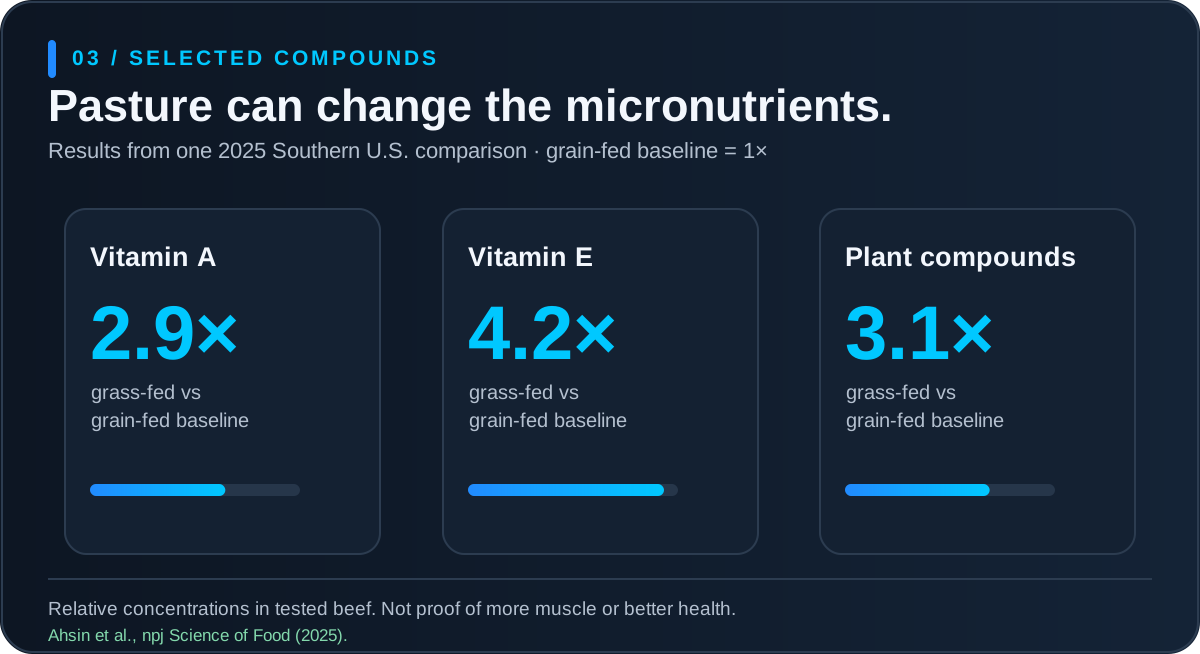
Pasture does more than supply calories to cattle. A 2025 study reported about 2.9 times as much vitamin A, 4.2 times as much vitamin E and 3.1 times as many measured phytochemical antioxidant compounds in grass-finished beef compared with the grain-finished samples it tested. The exact numbers will vary by pasture, cut and producer. Ahsin et al., 2025
CLA also tends to run higher in grass-fed beef. That's interesting nutrition science, but normal beef servings contain much smaller amounts than the doses used in a lot of experimental CLA research. I wouldn't buy a $20 steak expecting it to melt body fat.
One more detail: grass-fed is often leaner, but it does not automatically have less saturated fat in every matched cut. The specific cut, marbling and fat percentage still matter. And omega-6 isn't poison; the ratio above is not a substitute for looking at your whole diet.
Will it improve your health—or your deadlift?
This is where I separate the steak from the marketing.
In a small four-week randomized feeding trial, people eating grass-finished beef and lamb had more long-chain omega-3s in their blood than people eating concentrate-finished meat. But the trial did not find meaningful differences in cholesterol, triglycerides or blood pressure between groups. There are no good head-to-head trials proving that switching beef improves strength, recovery, heart disease risk or longevity. McAfee et al., 2011
So yes, the nutrients are different. The extra gains are not proven. Don't confuse a better-looking lab panel on the meat with a proven transformation in the athlete.
And grass-fed still counts as red meat. The World Health Organization's cancer review does not give it an exemption from the broader evidence on red-meat intake. How often you eat it, what else you eat and your overall dietary pattern matter more than a label alone.
What about hormones, antibiotics and how the cattle live?
This part gets mixed up constantly: grass-fed is a feeding claim, not automatically a no-antibiotics or no-hormones claim. Those are separate claims unless the specific certification includes them. The American Grassfed Association, for example, requires forage feeding, pasture access, and no added hormones or antibiotic treatment within its certified program. USDA FSIS encourages independent verification of animal-raising claims.
Both conventional and grass-finished beef are subject to food-safety rules. No label makes raw ground beef safe to eat, and the fact that cattle were given a medically needed treatment does not mean grocery-store beef is loaded with unsafe drug residues.
Pasture-based systems can give cattle more room to graze and express natural behavior. That's a legitimate reason to care where your food comes from. But healthy pasture management and animal welfare don't happen just because a bag says natural. Ask about the producer's actual practices.
Is grass-finished beef better for the planet?
Not automatically. Grazing can maintain healthy grasslands and sometimes improve soil conditions, but cattle still produce methane. Keeping them on pasture longer can also increase land use and emissions per pound of beef.
A 2025 U.S. life-cycle modeling study estimated that even efficient grass-fed beef systems produced about 10–25% more greenhouse-gas emissions per kilogram of protein than industrial U.S. beef under its studied assumptions. Other places and management systems vary, so don't turn that into a rule for every farm. But it does knock down the claim that grass-fed beef is automatically carbon-neutral. Eshel et al., 2025
My take: pasture and animal welfare can be reasons to pay more. A guaranteed climate win isn't one of them.
So is it worth the extra money?
For me, here's the breakdown:
- Buy grass-fed, grass-finished when: You enjoy the flavor, want the omega-3 and pasture-compound upgrade, care about verified raising practices, and the price fits your budget.
- Buy regular beef when: You're feeding a big athlete on a real-world budget. You still get high-quality protein and key nutrients. Put the savings toward the rest of your diet.
- Don't fall for: “Grass-fed builds more muscle,” “grain-fed beef is toxic,” or “this steak replaces your omega-3 food sources.” The research doesn't establish those claims.
My athlete action plan
1. Read the whole label. Look for 100% grass-fed, clarity about finishing, and credible third-party standards. Organic, pasture-raised and grass-finished are not interchangeable terms.
2. Compare the same cut and leanness. A 90/10 ground-beef comparison makes more sense than comparing a lean grass-fed sirloin to a heavily marbled conventional ribeye.
3. Build the whole plate. Keep your total daily protein, calories and food variety in order. If you want substantial EPA and DHA, fatty fish remains a more concentrated source.
4. Cook it safely. Grass-fed meat can be leaner and dry out faster. Use a thermometer: the USDA recommends 145°F plus a three-minute rest for whole beef steaks and roasts, and 160°F for ground beef.
Joel's final take
I like 100% grass-fed, grass-finished beef. There are real differences in the fatty-acid profile and some micronutrients. And I respect producers who can tell me exactly how their cattle were raised.
But I'm not going to pretend the cow did your reps for you. Buy the best beef your budget allows, hit your protein, train hard, and keep the big picture bigger than the label.
— Joel Dircks Grip & Grub · The Iron Library
Research & References
- Varre JV, et al. Nutritional composition of beef: a comparison of commercial North American grass- and grain-finishing systems. Journal of Animal Science (2026).
- Daley CA, et al. A review of fatty acid profiles and antioxidant content in grass-fed and grain-fed beef. Nutrition Journal (2010).
- Ahsin M, et al. Soil and pasture health underlie improved beef nutrient density. npj Science of Food (2025).
- McAfee AJ, et al. Grass diet red meat and plasma/platelet omega-3 in healthy consumers. British Journal of Nutrition (2011).
- Eshel G, et al. U.S. grass-fed beef carbon-intensity modeling. PNAS (2025).
- USDA FSIS: What is grass-fed meat? · USDA FSIS animal-raising label guidance (2024)
- American Grassfed Association: Certification Standards · UConn Extension: Food Label Guide
- WHO/IARC: Red meat and processed meat cancer evidence · FoodSafety.gov: Minimum cooking temperatures
Educational information, not individualized health or dietary advice. Nutrition varies by cut, fat content, season and producer. Charts describe cited study samples, not a guaranteed nutrient profile for any single product.