Training & Recovery
Conditioning for Strongman: Build an Engine Without Killing Your Strength
Combine easy cardio, sleds, carries and intervals with heavy lifting while protecting strength, recovery and useful competition body mass.
The practical take.
- What it may help with
- Build fitness that helps you use your strength and competition body mass across events.
- What the evidence supports
- Concurrent-training findings vary by outcome and population. Fatigue, local workload and scheduling matter; optional examples are not proven optimal strongman protocols.
- Joel’s approach
- Start with manageable easy work, add harder efforts selectively, and review strength, event performance, recovery and health.
You picked up the farmer’s handles. Congratulations. Now you have to go somewhere with them.
Strongman rewards strength, but a lot of contests also ask you to keep producing it while your legs burn, your grip starts negotiating, and your lungs file a complaint. Then you get to come back for another event.
That is why conditioning belongs in the program. It should help you use your strength and size throughout the contest. It does not need to turn you into a distance runner or make every training day end with you lying on the floor.
Build the engine. Keep the horsepower. Stop confusing exhaustion with progress.
First: conditioning does not mean getting smaller
A heavier athlete can be a better strongman. Additional body mass may be useful for a heavy contest, and getting stronger while maintaining conditioning can be a productive strategy.
This article is not a disguised instruction to cut weight. The goal is to move your competition body effectively, complete the events, and recover enough to perform again.
If you are intentionally gaining weight, account for the extra training when planning food. Conditioning that accidentally turns your gaining phase into chronic under-fueling is poorly coordinated programming—not proof cardio destroys muscle.
Does cardio actually kill your gains?
Not automatically.
A 2022 systematic review found that combining aerobic and resistance training generally did not reduce maximal-strength or whole-muscle growth adaptations compared with lifting alone. Explosive-strength development was more vulnerable, particularly when both types of work happened in the same session. [1]
The research is not unanimous. A 2024 review found reduced lower-body strength adaptations in men, with differences across outcomes and populations. A 2026 umbrella review was broadly reassuring about combining training, but emphasized the shortage of evidence in highly trained and elite athletes. [2], [3]
So the answer is not “cardio is harmless at any dose.” It is conditioning can fit, but fatigue and scheduling matter.
An easy bike ride and ten rounds of murderous sled pushes are not the same training stress just because both go in the cardio column.
Find the actual weak link
If you cannot break a farmer’s handle off the floor, another twenty minutes on the bike probably is not the missing piece.
| What stops you? | What might need work? |
|---|---|
| The pick or first repetition | Strength, setup, or technique |
| Grip fails before everything else | Grip capacity and implement-specific practice |
| You start flying and finish crawling | Pacing, sustained output, or local muscular endurance |
| Your position falls apart | Bracing, technique, strength, or fatigue management |
| One run is good; the next falls apart | Recovery capacity, pacing, or excessive initial effort |
This is a coaching checklist, not a diagnostic test. Several problems can happen together. Strongman biomechanics research supports treating carries, pulls, and lifts as distinct tasks with their own demands. [4]
The three pieces of a useful engine
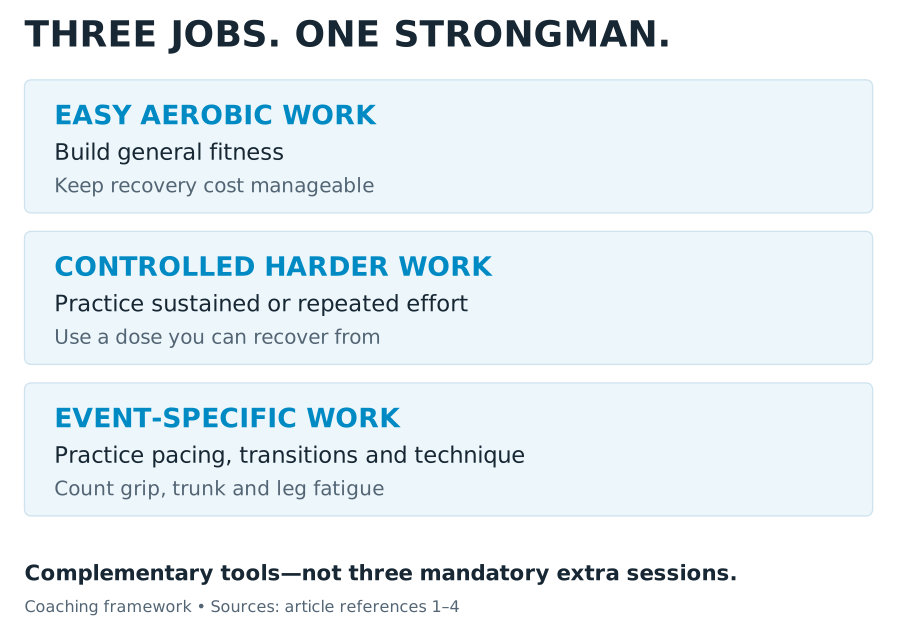
I would organize conditioning into three jobs:
Easy aerobic work: Build general fitness with a manageable recovery cost.
Controlled harder work: Improve your ability to sustain or repeat demanding efforts.
Event-specific work: Learn to breathe, brace, pace, transition, and move efficiently with the implements you actually compete with.
The aerobic system matters even when your sport is heavy. Repeated-sprint studies link phosphocreatine restoration with recovery of power, providing a physiological rationale for aerobic preparation. But those studies do not tell us exactly how many seconds a strongman will shave off a truck pull. [5]
A fitter engine helps support the work. It does not replace the ability to produce force or handle an awkward implement.
Easy cardio: keep the easy part
For a big athlete, a stationary bike, comfortable walking, an elliptical, or pool work can be useful choices. Pick something you tolerate well that does not leave important muscles beaten up for tomorrow.
Running is not banned. It simply may not be the most practical starting point for a very heavy lifter who is not accustomed to it.
Use comfortable conversation as a practical intensity check. The talk test has research support as an approximation of exercise intensity around ventilatory thresholds. It is not a laboratory measurement, and different watches use different definitions of “Zone 2.” [6]
My starting framework: two sessions of 15–25 minutes weekly at roughly 3–4 out of 10 effort, with comfortable speech. If that is manageable, gradually extend toward 25–40 minutes. Someone starting from very little activity may need shorter sessions.
These are coaching starting points, not a proven minimum dose or optimal strongman prescription. Your existing workload counts.
You should finish feeling like you could have continued. If your easy ride requires a motivational speech halfway through, check the effort.
Sleds: useful, versatile, and absolutely capable of tiring you out
The same sled can train different things depending on how you use it.
| How you use it | Main programming purpose |
|---|---|
| Light, continuous dragging | Easier conditioning |
| Moderate repeated pushes or drags | Repeat-effort capacity |
| Heavy short efforts with generous rest | Force production and event preparation |
| Longer demanding pulls | Sustained effort and pacing |
Sled work often involves less deliberate eccentric lowering than conventional lifting. That can make it a useful option, but “less eccentric work” does not mean “free recovery.”
In 11 strength-trained men, a demanding backward-drag session immediately reduced jump power. Measured power had recovered by three hours, and creatine kinase did not rise. That describes one protocol and selected measurements. It does not prove every sled session is damage-free or every athlete is ready to lift heavy three hours later. [7]
Also, stop comparing sled plate weight across completely different surfaces. Turf, rubber, asphalt, sled construction, and friction change the task. Record the surface, load, distance, and time so you can compare like with like.
Carries and medleys: specific work with a real bill attached
Farmer’s walks, yoke, sandbag carries, and loading medleys can train conditioning and event skill together. They also load your grip, trunk, legs, and shoulders.
A small acute study found substantial cardiovascular and metabolic responses during a session of strongman exercises. That supports the idea that these sessions are demanding. It does not prove they replace every benefit of aerobic training or establish the best long-term program. [8]
Separate heavy event practice from conditioning-oriented event work.
For heavy practice, prioritize the pick, position, speed, and technique. Rest enough to perform useful work again. For conditioning, use manageable loads and introduce fatigue deliberately.
Repeatedly failing a near-maximal pick is not a particularly efficient conditioning session. Neither is adding a brutal farmer’s finisher the day before grip is supposed to be fresh.
Intervals: repeat the output, not the disaster
Hard intervals can fit. Every interval does not need to be an all-out test.
A small 2024 study in resistance-trained men found no detectable strength or hypertrophy interference when roughly an hour of weekly cycling or circuit work was added on non-lifting days. There were only 23 participants across four groups, so treat the result as encouraging—not a guarantee for elite strongmen. [9]
Here are three illustrative options. Choose the one that solves a need; do not automatically add all three.
| Purpose | Example | Key instruction |
|---|---|---|
| General aerobic intervals | 4 × 2 minutes hard, 2 minutes easy between efforts | Controlled hard work; preserve output |
| Short repeated efforts | 6 × 20 seconds brisk, 100 seconds easy between efforts | Repeatable efforts, not six maximal tests |
| Event conditioning | 3–5 manageable runs lasting about 20–45 seconds | Recover enough to preserve useful technique |
Warm up first. Set the mode, load, and recovery to your current ability. These examples are coaching options, not trial-established optimal protocols.
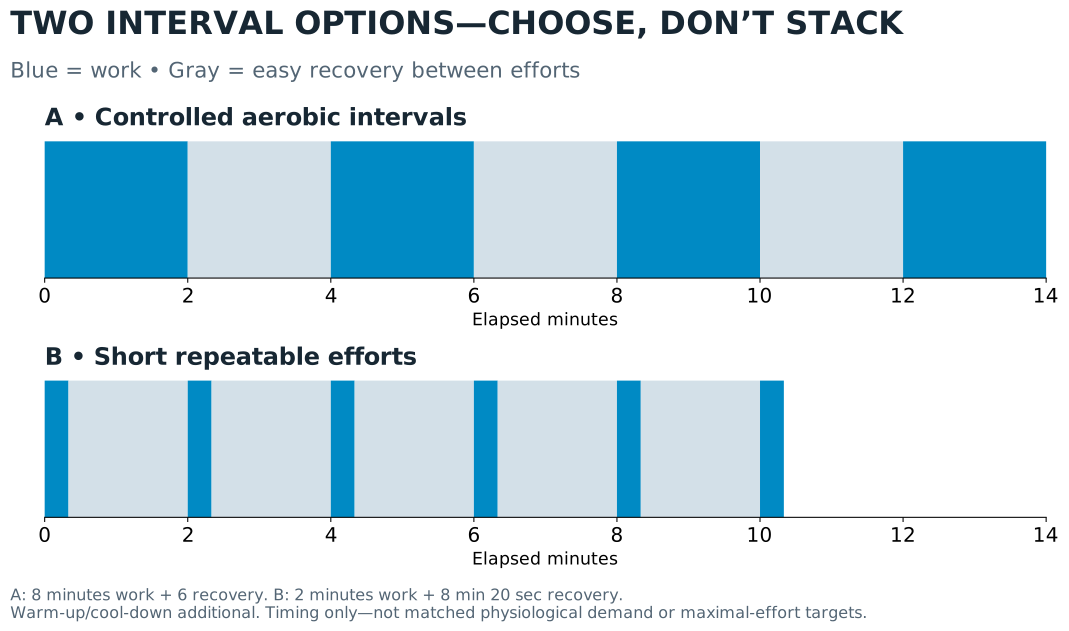
If Saturday already includes demanding medleys, that may be your harder conditioning for the week. You do not owe the air bike a sacrifice afterward.
Put conditioning where it does the least damage to the priority
If strength and power are the priority, protect those sessions.
A meta-analysis found a modest lower-body strength advantage when strength preceded endurance, without a meaningful difference in aerobic improvement. That supports lifting first when the two share a session. [10]
The 2022 review found less evidence of explosive-strength interference when the sessions were separated by at least three hours. That is a scheduling clue, not a magic recovery timer. [1]
In practice:
- Put fatiguing conditioning after priority strength work or in a separate session.
- Avoid hard leg intervals immediately before important squat or deadlift work.
- Count heavy carries toward grip and trunk workload.
- Remember that rowing can fatigue the back and grip; cycling can fatigue the quads. Low impact does not mean no local fatigue.
- Keep easy recovery-day activity genuinely easy.
A short, comfortable warm-up is different from a conditioning workout. Do not confuse “lift first” with “never warm up.”
What a week could look like
This example assumes an athlete already tolerates four training days. It is a scheduling illustration, not a complete personalized program.
| Day | Main work | Conditioning placement |
|---|---|---|
| Monday | Heavy lower-body strength | No mandatory finisher |
| Tuesday | Upper-body strength | Easy cardio afterward or later |
| Wednesday | Recovery | Rest or comfortable walking |
| Thursday | Secondary strength/power | Optional short intervals, only if needed |
| Friday | Recovery | Rest or easy movement |
| Saturday | Strongman events | Carries or medleys provide specific conditioning |
| Sunday | Recovery | Optional easy cardio if the week remains manageable |
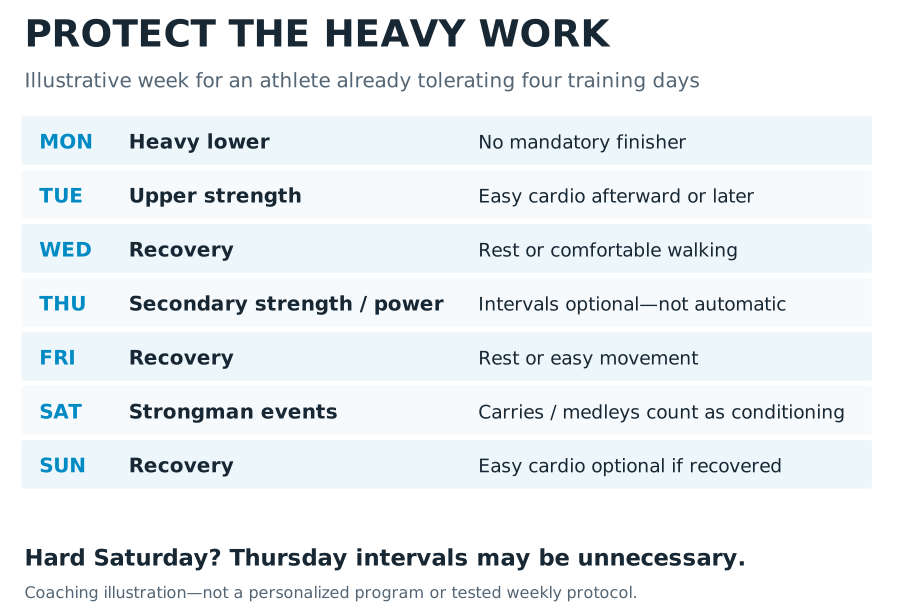
Do not automatically fill every optional slot. If Saturday is hard, Thursday intervals may be unnecessary. If you are just introducing cardio, start with two manageable easy sessions while keeping existing event work stable.
Getting heavier? Keep testing whether you can use it.
This connects directly to a productive strongman bulk.
A heavier body that produces more static strength and still moves effectively can be valuable in a heavy contest. Conditioning should support that goal. It does not have to chase a smaller number on the scale.
Track what matters: the same carry course, implement load, surface, rest period, and event standard. Is your pace holding up? Are you finishing? Can you recover and perform again?
Bodyweight-relative fitness numbers need context. A value expressed per kilogram can fall as body weight rises even if the absolute value is unchanged. Judge the athlete with several measures, not a single watch score.
Maintaining conditioning also does not prove blood pressure or other health markers are fine. Competitive usefulness and health deserve separate attention.
How to know the plan is working
Look for better output at a similar effort, less slowdown between comparable runs, and strength sessions that remain productive.
If your main lifts repeatedly deteriorate, local fatigue hangs around, or event technique gets worse, reduce or move the conditioning before adding more. One bad workout is not proof of interference. A persistent pattern deserves action.
Progress one variable at a time: duration, number of bouts, load, pace, or recovery interval. Changing all five makes it hard to know what helped—and easy to turn a manageable plan into a mess.
Fuel the engine and arrive fresh
Conditioning adds work. Eat enough for the combined program, keep protein adequate, and include carbohydrate to support demanding training and glycogen replacement. Dietary fat can help large athletes meet energy needs, but it does not replace carbohydrate or protein. Recovery also needs sleep. [11], [12]
Closer to competition, remove unnecessary fatigue and make the remaining work relevant. Do not introduce a punishing new circuit because you suddenly feel unprepared.
Strongman taper surveys describe real athlete practices, but they do not establish one best taper. Reduce workload according to your response and final event sessions while retaining familiar, manageable activity. [13]
The Grip & Grub take
Build general fitness with easy work. Add harder efforts selectively. Practice the actual events. Keep enough recovery available for the heavy lifting that makes you a strongman in the first place.
You can be big, strong, and conditioned. You do not need to choose between looking like a heavyweight and being able to finish a medley.
The goal is to use your strength when it counts. Your conditioning session does not get bonus points because you spent twenty minutes on the floor afterward.
Research references
- Schumann et al. Compatibility of Concurrent Aerobic and Strength Training for Skeletal Muscle Size and Function: An Updated Systematic Review and Meta-Analysis. Sports Medicine. 2022. https://pubmed.ncbi.nlm.nih.gov/34757594/
- Huiberts et al. Concurrent Strength and Endurance Training: A Systematic Review and Meta-Analysis on the Impact of Sex and Training Status. Sports Medicine. 2024. https://pubmed.ncbi.nlm.nih.gov/37847373/
- Held et al. Maximizing Adaptations in Concurrent Training: An Umbrella Review of Meta-analyses. Sports Medicine. 2026. https://pubmed.ncbi.nlm.nih.gov/41762427/
- Hindle et al. The Biomechanics and Applications of Strongman Exercises: a Systematic Review. 2019. https://pmc.ncbi.nlm.nih.gov/articles/PMC6901656/
- Contribution of phosphocreatine and aerobic metabolism to energy supply during repeated sprint exercise. https://pubmed.ncbi.nlm.nih.gov/8964751/
- The talk test: a useful tool for prescribing and monitoring exercise intensity. 2014. https://pubmed.ncbi.nlm.nih.gov/25010379/
- West et al. The metabolic, hormonal, biochemical, and neuromuscular function responses to a backward sled drag training session. 2014. https://pubmed.ncbi.nlm.nih.gov/23575361/
- Harris et al. Acute Physiological Responses to Strongman Training Compared to Traditional Strength Training. 2016. https://pubmed.ncbi.nlm.nih.gov/26439778/
- The Effect of Time-Equated Concurrent Training Programs in Resistance-Trained Men. 2024. https://pmc.ncbi.nlm.nih.gov/articles/PMC11057620/
- Gao and Yu. Effects of concurrent training sequence on VO2max and lower limb strength performance: A systematic review and meta-analysis. 2023. https://pubmed.ncbi.nlm.nih.gov/36776981/
- International society of sports nutrition position stand: nutrient timing. 2017. https://pmc.ncbi.nlm.nih.gov/articles/PMC5596471/
- Mountjoy et al. 2023 IOC consensus statement on Relative Energy Deficiency in Sport (REDs). https://bjsm.bmj.com/content/57/17/1073
- Tapering Practices of Strongman Athletes. 2018. https://pubmed.ncbi.nlm.nih.gov/29373426/