Training & Recovery
Tendons & Ligaments: Build a Body That Can Handle Heavy Weight
Build tendon capacity with progressive training, adequate nutrition, and realistic expectations for collagen. A strength-athlete guide to joint health and recovery.
The practical take.
- What it may help with
- Build connective-tissue capacity through progressive, tolerable loading and adequate nutrition.
- What the evidence supports
- Loading improves some tendon properties; size and mechanical stiffness are not proof of fewer injuries. Collagen findings are promising but limited.
- Joel’s approach
- Count overlapping training demands, keep complete protein central, and seek assessment for persistent pain or sudden new weakness.
What actually helps connective tissue: smart loading, enough food, and a realistic look at collagen—not another miracle joint stack.
Everybody wants a bigger engine.
Bigger quads. Bigger back. More horsepower off the floor. Enough pressing power to make the log question its life choices.
Then an elbow starts barking. A knee gets cranky. Your Achilles reminds you that walking downstairs is apparently a sport now.
Suddenly, the stuff connecting everything together becomes pretty important.
Muscle creates force. Connective tissue helps you transmit and control it. If you want to keep lifting heavy, you need to train and feed the whole system.
That does not mean buying twelve bottles labeled “joint support.” It means understanding what adapts, what helps, and where the marketing gets ahead of the research.
First, know which part is complaining
People use “joint,” “tendon,” and “ligament” like they’re interchangeable. They aren’t.
| Structure | Main job | Why lifters care |
|---|---|---|
| Muscle | Contracts to produce force | Moves the weight. |
| Tendon | Connects muscle to bone and transmits force; some tendons also store and return energy | Handles the pull from presses, squats, carries, and grip work. |
| Ligament | Connects bones and helps guide or restrain joint movement | Contributes to stability. A sprain or tear is a different problem from ordinary soreness. |
| Articular cartilage | Covers joint surfaces and helps distribute load with low friction | Part of the joint system—not a tendon that needs more curls. |
Pain near a joint does not tell you which structure is responsible. Tendinopathy generally means persistent tendon pain and impaired function associated with loading. A partial or complete tear is a different diagnosis. Imaging can help in selected cases, but scans and symptoms don’t always line up neatly. [1], [2]
That distinction matters because “do these five exercises for every painful joint” is not a serious plan.
Tendons can adapt. Give them a reason—and time.
Tendons are living tissue. They respond to mechanical loading, including changes in how they resist stretch and, sometimes, their size.
A 2022 systematic review covering 61 studies and 763 participants found that loading improved lower-limb tendon stiffness, material properties, and cross-sectional area. Resistance training was an important driver. Most research involved the Achilles and patellar tendons, so we shouldn’t pretend it precisely maps every finger, elbow, or shoulder. [3]
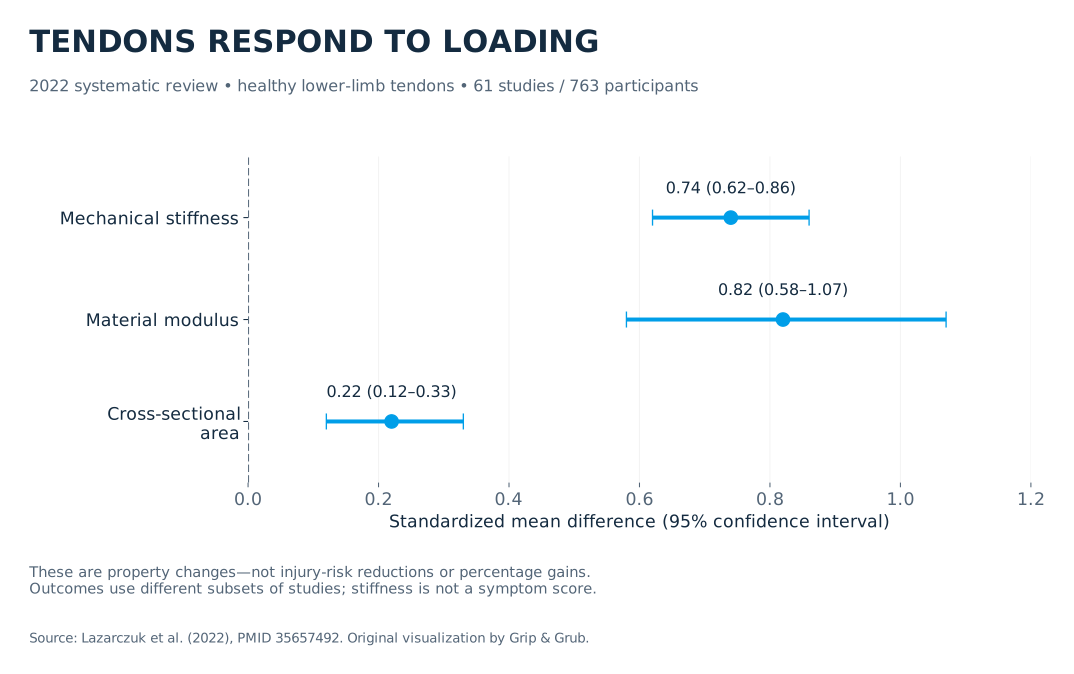
One translation worth making: mechanical stiffness does not mean “my knee feels stiff in the morning.” In this research, it describes how much force it takes to stretch the tendon. It is a mechanical measurement, not a pain score.
And a larger tendon is not automatically a healthier tendon. Context matters. A healthy tendon adapting to training and a painful tendon with structural changes are not the same situation.
Think in consistent training blocks, not miracle weekends. Changes can be measured over weeks, while rehabilitation often takes months. There is no universal stopwatch saying every tendon heals in 12 weeks.
Loading is the main course
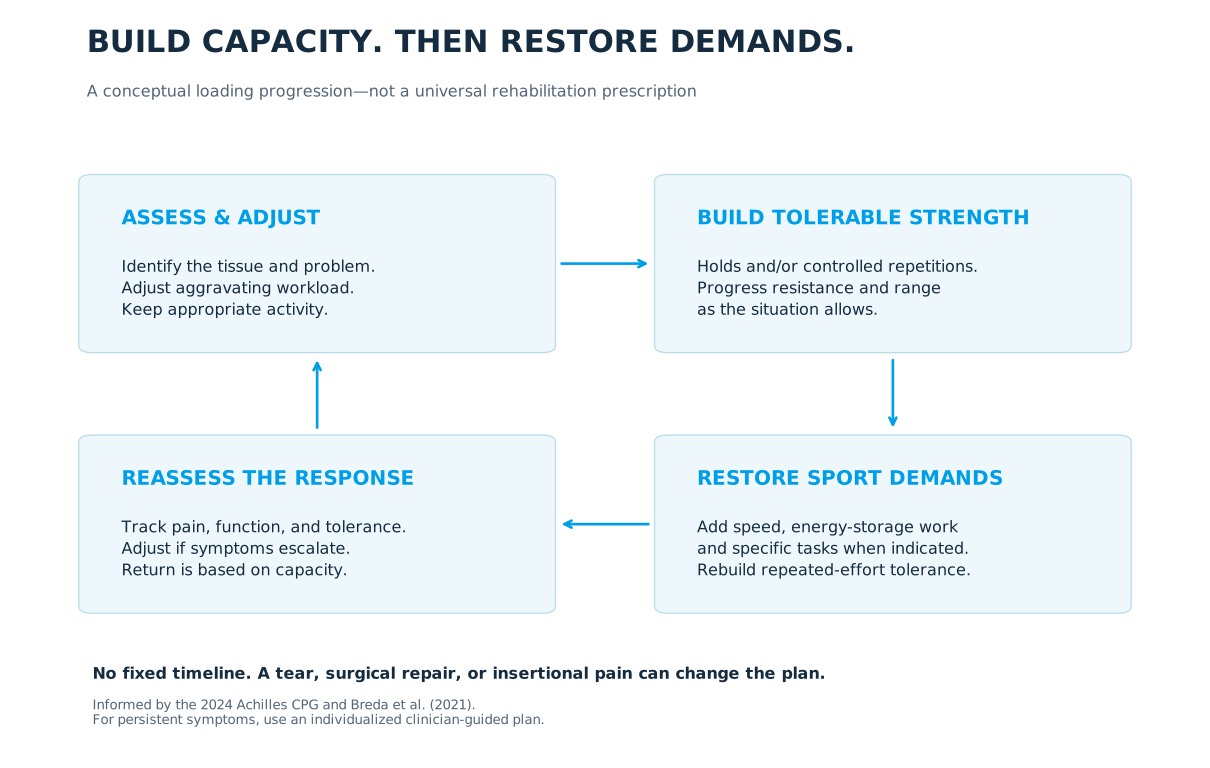
For diagnosed midportion Achilles tendinopathy, the 2024 clinical practice guideline recommends tendon-loading exercise as first-line treatment, with loads as high as tolerated and sessions at least three times weekly. It also advises against complete rest as the default. That is guidance for a particular condition—not permission to max out through every tendon injury. [4]
For a healthy lifter, the useful principle is progressive exposure: train the tissues for the demands you want them to handle, and build those demands over time.
For a lifter with persistent pain, the useful principle is assessment and an individualized loading plan.
Eccentrics, slow reps, or holds?
All can have a place.
- Isometrics: Producing force while holding a position. Useful when a particular position is tolerable, and sometimes helpful for symptoms.
- Controlled repetitions: Loading through movement, including both lifting and lowering. Heavy-slow resistance is one approach.
- Eccentrics: Emphasizing the lowering phase. Useful, but not the only legitimate method.
- Faster and sport-specific loading: Gradually preparing for the speed and complexity of actual sport when appropriate.
The key is choosing and progressing the load the person can tolerate. A systematic review found that isometrics were not consistently superior to moving repetitions for immediate or short-term tendon pain. Some people feel better after holds; others do not. [5]
A wall sit is an exercise, not a firmware update for your knees.
A useful patellar-tendon trial
In a randomized trial of 76 people with patellar tendinopathy, a staged progressive-loading program improved the VISA-P pain/function score more than eccentric-only treatment at 24 weeks. The adjusted difference was nine points. Return-to-sport rates were numerically higher, but that difference was not statistically significant. [6]
That supports a broader progression—not the claim that one exercise fixes every knee.
Sometimes the range of motion is the issue
“Stretch it harder” is not always the answer.
A 2025 randomized trial in 42 sport-active people with insertional Achilles tendinopathy compared two rehabilitation approaches. Both used progressive loading. The lower-compression approach limited ankle dorsiflexion during exercise, removed calf stretching, and used heel lifts. It produced better pain/function outcomes at 12 and 24 weeks. [7]
That does not mean deep ranges or stretching are bad for everyone. It means an irritated tendon where it attaches to bone can have different needs from pain farther up the tendon.
Where it hurts and what aggravates it can change the plan.
Grip athletes: count all the work your elbows are doing
Here’s the practical application for our crowd.
Heavy rows on Monday. Deadlifts Tuesday. Grippers Wednesday. Axle holds Thursday. Arm wrestling Saturday. Then you announce that your elbow is irritated “for no reason.”
Your calendar has six labels. Your tissues experience the combined workload.
As a programming principle, look at overlapping demands across lifting, grip sessions, event practice, work, and hobbies. Change the total exposure when needed—not just the exercise you happened to notice the pain during.
Introduce new implements and demanding variations progressively. Monitor the session, how function changes afterward, and whether symptoms are settling or escalating across days. A brief warm-up improvement is not automatic clearance for a max attempt.
These are practical applications of load management, not a finger-tendon protocol directly proven by Achilles trials.
Feed the repair work
There is no special tendon diet that makes reckless programming disappear. But under-fueling does not help.
Nutrition during injury recovery should support healing and preserve muscle. Activity may drop, so calorie needs can change, but immediately crash-dieting because you can’t train normally is not a great default. [8]
For most exercising adults, the ISSN describes 1.4–2.0 grams of protein per kilogram of body weight per day as a general range supporting muscle maintenance and growth. Injury, immobilization, body composition, and other circumstances can change individual needs. This is not a validated tendon-healing dose. [9]
Beef, eggs, dairy, fish, poultry, and appropriately planned plant proteins can supply the amino acids you need. Keep meals regular and keep complete protein central.
Vitamin C is required for normal collagen production. Get it from foods such as citrus, berries, peppers, or potatoes, or address an inadequate intake appropriately. Required does not mean megadosing produces stronger tendons. [10]
Collagen: promising, but keep the claim attached to the result
Your body makes collagen. A collagen supplement is digested into peptides and amino acids; it does not arrive at your elbow as a replacement cable.
The interesting question is whether adding collagen alongside training produces better outcomes than training alone.
Some studies suggest it can improve certain tendon measurements. That deserves attention. It does not yet establish a dependable way to prevent tears or make an injured tendon heal faster.
The small study that started a big conversation
In 2017, Keith Baar and colleagues studied eight men taking vitamin-C-enriched gelatin before brief exercise. Fifteen grams, taken about an hour beforehand, increased a circulating marker associated with type-I collagen synthesis. The researchers also used participants’ serum in engineered ligament experiments. [11]
Cool research. But the blood marker was not a direct measurement of a repaired human tendon, and the lab ligament experiments were not healed ligaments inside those participants.
That is mechanistic evidence. It is not proof that your next scoop prevents a biceps rupture.
A more direct tendon study
A 2025 trial followed 20 recreationally active, middle-aged men through 12 weeks of lower-body resistance training, twice weekly. The collagen group received 30 grams of hydrolyzed collagen plus 50 mg vitamin C after training. The placebo group also received vitamin C. [12]
Collagen produced larger average improvements in patellar tendon cross-sectional area, stiffness, and material modulus. There was no clear additional advantage for strength or measured muscle thickness.
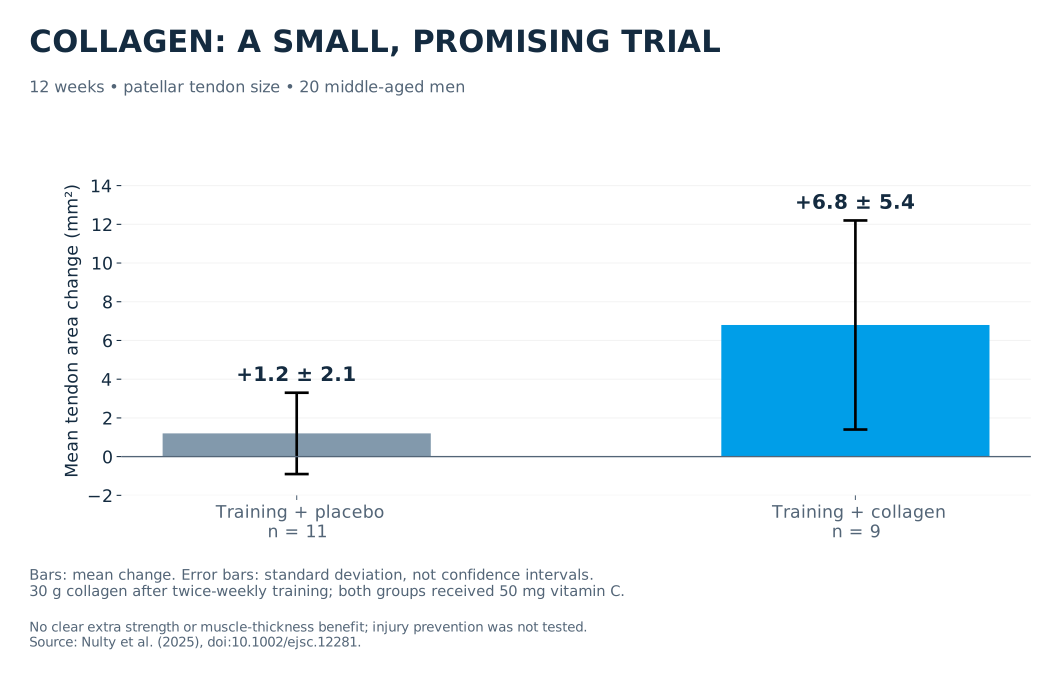
Notice the timing: after training, twice per week. That alone should stop us from treating “exactly 60 minutes before, every single day” as a proven universal requirement.
A separate 2025 trial in 22 female masters field-hockey athletes found greater gains in patellar tendon size and rate of force development with collagen during eight weeks of training. It did not find extra benefit for maximal force, measured muscle thickness, or jump height. Useful evidence, still a small and specific population. [13]
The less exciting results count too
A one-week study in 25 young men found that 30 grams of collagen daily did not further increase muscle connective-protein synthesis during intense resistance training. That measured connective tissue within muscle, so it does not directly settle tendon adaptation—but it challenges sweeping claims that collagen always increases connective-tissue synthesis. [14]
A 2026 conference abstract described 36 elite athletes with chronic Achilles, patellar, or plantar-fascia problems. Adding 10 grams of collagen daily to heavy-slow resistance training did not produce superior clinical outcomes versus placebo. Both groups improved. Because it is a conference abstract, it carries less detail and certainty than a full trial report. [15]
A 2026 tendon review pooled the discussion from eight trials involving 257 participants. Findings were encouraging for some structural properties, but protocols varied, studies were short, and 246 participants were men. Its search ended in May 2025, so its publication year does not mean it contains every later trial. [16]
My take: collagen is an optional tool with promising tendon data. The loading program still has to do its job.
If you want to try collagen, keep it simple
First, get your normal protein and training plan in order.
Then, if you want to experiment, 15–30 grams is a research-informed range to discuss, not an established injury-prevention prescription. Gelatin and hydrolyzed collagen have both been studied. Their protocols, timing, and frequency differ. [11], [12], [16]
Taking it around a planned loading session is reasonable. Roughly an hour before is based partly on early mechanistic work; post-training use also has supportive trial evidence. Neither timing has been proven universally best.
Some studies paired collagen with approximately 50 mg vitamin C; others used more. That does not establish that additional vitamin C helps someone whose intake is already adequate. A vitamin-C-containing food can be part of the meal. [10], [11], [12], [13]
Assess changes over a meaningful training block, and remember that improvement while taking a supplement does not prove the supplement caused it.
Collagen counts as protein, but it has a limited essential-amino-acid profile and is not an equivalent replacement for the complete proteins supporting your muscle goals. [9], [14]
And bone broth? Enjoy it if you like it. Research found large variation in collagen-related amino acids across preparations, so a mug is not automatically equivalent to a measured study dose. [17]
What about ligaments, cartilage, and the rest of the “joint stack”?
This is where we need to stop copy-and-pasting tendon results onto every structure in the body.
A 2026 review of nutrition after ACL reconstruction included 15 studies and found substantial limitations in the evidence. Protein intake was associated with better muscle retention and function, but effects on return to sport remained uncertain. Preserving the muscles around an injured joint is not the same as proving that a supplement rebuilt the ligament graft. [18]
Joint-pain relief, cartilage repair, tendon remodeling, and ligament healing are four different outcomes. A product showing one does not automatically deliver the others.
| Claim | What I would tell a lifter |
|---|---|
| Progressive loading can improve tendon properties | Supported; the right dose and progression depend on the person and tissue. |
| Isometrics are always the best pain treatment | Not supported. They are one option. |
| Collagen can add to some tendon adaptations | Promising, with small studies and important limitations. |
| Collagen reliably prevents tears or repairs cartilage | Not established. |
| Extra vitamin C repairs tendons faster when intake is adequate | Not established. Avoid deficiency; don’t assume more is better. |
| Stronger muscles make every ligament injury-proof | No. Strength is useful, but it does not eliminate risk. |
Editorial summary of the cited evidence, not a formal GRADE assessment.
Peptides deserve the same skepticism. A recent 2026 review of human BPC-157 evidence found only three small, poor-quality studies with 30 participants across different conditions—not convincing human tendon-repair trials. It rated certainty very low. We cannot turn animal healing findings into a reliable treatment promise for lifters. [19]
Know when to stop guessing
Persistent pain, declining function, or repeated flare-ups deserve a qualified assessment.
A sudden pop with bruising, visible deformity, or new weakness is a different situation. Stop the provoking activity and seek prompt evaluation rather than testing whether you can “still get one more set.” Those can be signs of a tendon tear. [20]
The point of rehabilitation is to restore capacity. Masking pain long enough to finish a workout is not the same achievement.
The Grip & Grub action plan
- Count your total workload. Lifting, carries, grip sessions, and event practice all add up.
- Build capacity progressively. Increase demanding work over time instead of cramming a month of enthusiasm into one Saturday.
- Match the exercise to the problem. Persistent tendon pain needs a diagnosis and a tolerable progression—not a random internet challenge.
- Eat enough and keep complete protein central. Collagen can be an addition, not the foundation of your diet.
- Use supplements with measurable expectations. Track function and training tolerance. Don’t equate a marketing claim with a repaired tissue.
- Give it time. Your competition calendar does not control biological recovery.
Building a bigger engine is great. Keeping the rest of the machine capable of using that engine is how you stay in the sport.
Train the muscle. Respect the connective tissue. Feed the work. And quit expecting a scoop of powder to negotiate with your bad decisions.
— Joel Dircks
Grip & Grub
Education for adult strength athletes; not a diagnosis or an individualized injury-rehabilitation plan.
The research behind this article
- ICON 2019 consensus: clinical terminology for tendinopathy.
- Imaging of tendinopathy: symptoms and imaging do not always match.
- Lazarczuk et al., 2022: tendon adaptations to mechanical loading.
- 2024 clinical practice guideline: midportion Achilles tendinopathy.
- 2020 systematic review: isometric exercise in tendinopathy.
- Breda et al., 2021: progressive loading versus eccentric treatment for patellar tendinopathy.
- 2025 randomized trial: reducing compression in insertional Achilles rehabilitation.
- Tipton, 2015: nutritional support for exercise-induced injuries.
- ISSN position stand: protein and exercise.
- NIH Office of Dietary Supplements: vitamin C.
- Shaw et al., 2017: vitamin-C-enriched gelatin before intermittent exercise.
- Nulty et al., 2025: collagen and patellar tendon adaptation in middle-aged men.
- Nulty & Erskine, 2025: collagen in female masters field-hockey athletes.
- Collagen during training did not further increase muscle connective-protein synthesis.
- 2026 conference abstract: collagen added to heavy-slow resistance in elite athletes with tendinopathy.
- 2026 systematic review: collagen and tendon structural/performance outcomes.
- Bone broth and variability in collagen precursor concentrations.
- 2026 systematic review: nutrition and rehabilitation after ACL reconstruction.
- 2026 systematic review: human BPC-157 efficacy and safety evidence.
- Mayo Clinic: biceps/triceps tendon injury signs.