
Nutrition & Supplements
Collagen: The Protein Your Tendons Actually Care About
What collagen is good at, what it isn’t, and how lifters can use it without buying the hype.
The practical take.
- What it may help with
- Consider connective-tissue nutrition alongside appropriate mechanical loading.
- What the evidence supports
- Some small trials report tendon adaptations; that is different from proven injury prevention or extra muscle growth.
- Joel’s approach
- Keep complete protein in your diet. My optional collagen routine and the studied protocols are explained separately below.
Walk into any gym and ask somebody what protein does, and the answer is probably going to be:
“Builds muscle, bro.”
Fair enough.
But not all proteins are built the same, and not every protein is trying to do the same job.
That brings us to collagen.
Collagen has become one of those supplements that gets thrown into everything from coffee to $14 smoothies while somebody on Instagram tells you it’s going to fix your knees, erase your wrinkles, rebuild your hairline, and possibly save your marriage.
We’re going to aim a little lower.
Because collagen does have some interesting science behind it—especially for people who lift weights. When you understand what collagen is, how it differs from whey, and why timing it around training may matter, it starts to make a lot more sense.
Collagen is protein—but it isn’t whey
Let’s get this out of the way first.
I don’t consider collagen a replacement for whey protein, beef, eggs, dairy, or other high-quality complete protein sources.
Whey and collagen have different jobs.
Whey is loaded with essential amino acids, particularly leucine. That’s exactly what you want when the goal is stimulating muscle protein synthesis.
Collagen has a very different amino-acid profile. It’s especially rich in glycine, proline, and hydroxyproline—amino acids heavily represented in tendons, ligaments, cartilage, bone matrix, skin, and other connective tissues.
Human research comparing whey and collagen after exercise shows this difference clearly. Whey produced a larger rise in leucine and essential amino acids and increased myofibrillar protein synthesis compared with placebo. Collagen produced larger increases in glycine and proline, but it did not significantly increase early post-exercise muscle connective protein synthesis in that trial. Whey versus collagen study
So don’t dump your whey in the garbage.
Whey helps build the engine. Collagen supplies some of the raw material used in the cables, suspension, and framework holding that engine together.
If you’re getting stronger, eventually that support system matters too.
Why lifters should care about collagen
Muscles aren’t the only tissues adapting when you train.
Every time you squat, deadlift, press, sprint, jump, carry, crush a gripper, or try to pick up some ridiculous object that common sense says should probably remain on the floor, you’re putting force through connective tissue.
Your muscles create force. Your tendons transmit that force to bone. That’s where collagen becomes interesting.
A 2026 systematic review examined eight randomized trials involving 257 participants. When collagen was paired with resistance or plyometric training, the strongest evidence favored improvements in tendon cross-sectional area and stiffness, particularly in studies using roughly 15–30 grams per day. The review also found no consistent additional strength benefit beyond training itself. 2026 tendon review
That distinction matters. I don’t call collagen a muscle-building supplement. I look at it as a possible connective-tissue nutrition tool.
A 2025 randomized trial in 20 middle-aged men gives us a useful longer-term example. Both groups trained their lower body twice weekly for 12 weeks. The collagen group received 30 grams of hydrolyzed collagen plus 50 mg vitamin C after training and had greater improvements in patellar tendon cross-sectional area, stiffness, and Young’s modulus than placebo. Strength and muscle-size gains came from training, with no clear extra collagen advantage for those outcomes. 12-week tendon trial
The evidence is promising. It is also still built on small studies, short interventions, and mostly male participants. That’s a reason to pay attention—not a reason to pretend the question is settled.
Why take collagen before you train?
Here’s the coolest part.
One foundational study had subjects consume vitamin-C-enriched gelatin and then measured collagen-related amino acids in their blood. Glycine, proline, hydroxyproline, and hydroxylysine climbed after ingestion and peaked at roughly one hour.
Then the subjects exercised.
The group taking 15 grams one hour before exercise showed approximately double a blood marker associated with type-I collagen synthesis compared with placebo. The study used gelatin, only eight men, brief rope-skipping bouts, and a blood marker rather than a direct tendon measurement, so it is useful mechanistic evidence rather than proof of long-term injury prevention. Vitamin-C-enriched gelatin study
The pre-workout strategy is still pretty logical:
It’s basically trying to have the construction materials sitting at the job site when the foreman finally yells:
“Alright boys, we’re working.”
15 grams or 30 grams?
Researchers have directly compared 0, 15, and 30 grams of hydrolyzed collagen before resistance exercise.
In resistance-trained young men, 30 grams with 50 mg vitamin C one hour before heavy back squats produced a greater whole-body collagen-synthesis response than either 15 grams or placebo. Fifteen grams did not significantly outperform zero grams in that study. Young-men dose-response trial
A later crossover study in eight resistance-trained middle-aged men found that both 15 and 30 grams increased the response compared with zero collagen, with 30 grams producing the largest response. Middle-aged dose-response trial
That’s why my practical range is:
- General active person: around 15 grams
- Bigger athlete, heavy strength training, or somebody deliberately prioritizing connective tissue: 15–30 grams
- Maximum evidence-based pre-training dose I’m interested in right now: around 30 grams
Could 40 or 50 grams work even better? Maybe. We don’t have good evidence showing that, so I’m not going to invent an answer just because more powder looks more hardcore.
There is also no scientifically validated grams-per-pound bodyweight formula for collagen. For now, 15–30 grams is a much more defensible range.
Why the vitamin C?
This isn’t supplement voodoo.
Vitamin C is required for normal collagen biosynthesis. Your body uses it as a cofactor in reactions necessary to create and stabilize collagen. The NIH specifically identifies collagen production as one of vitamin C’s essential biological functions. NIH vitamin C fact sheet
Collagen delivers building material. Vitamin C helps your body build with it.
And no, you don’t need to shotgun an entire bottle of vitamin C before leg day. The resistance-exercise trials described above used 50 mg alongside the collagen.
I personally like a simple range of approximately 50–200 mg vitamin C with the collagen. More isn’t automatically better.
My simple pre-workout collagen protocol
If I’m deliberately using collagen to support connective-tissue adaptation around training, I’m keeping this ridiculously simple.
About 60 minutes before lifting
15–30 g hydrolyzed collagen peptides+roughly 50–200 mg vitamin C+waterThen I train.
That’s it.
Collagen. Vitamin C. Water. Lift.
What about joints, bone, and skin?
This is where supplement marketing usually outruns the evidence.
Some randomized trials using specific collagen peptides have found reductions in exercise-related knee discomfort in active people over about 12 weeks. Positive knee-discomfort trial
Other randomized work in healthy, active, middle-aged and older adults found that knee pain improved similarly with collagen and placebo. Neutral knee-pain trial
So the honest answer is that findings are mixed, the products and doses differ, and collagen is not a diagnosis or a reconstruction project for a damaged knee.
Collagen is also a major structural component in ligaments, cartilage, and bone matrix. The biological rationale is strong, but direct exercise-specific evidence is not equally strong for every tissue. The best training-related evidence right now is tendon remodeling.
Skin research deserves the same caution. Some meta-analyses report improvements in hydration, elasticity, and wrinkles. A 2025 analysis found that those apparent benefits were no longer convincing when researchers isolated higher-quality or non-industry-funded trials. Skin-aging meta-analysis
Could collagen potentially help your skin? Sure. Would I tell you it will transform you into a 22-year-old Instagram model? Absolutely not.
Collagen doesn’t replace your normal protein
I’m repeating this because somebody is still going to drink 30 grams of collagen after reading half this article and tell me:
“I got my protein in.”
Not exactly.
Collagen contributes protein and amino acids, but its amino-acid profile makes it considerably less effective than whey for stimulating muscle protein synthesis.
Research in older men found that adding whey or pea protein above the recommended dietary allowance increased integrated myofibrillar protein synthesis, while the same supplemental amount of collagen did not. Older-men protein trial
So keep eating beef, eggs, fish, dairy, whey, and other complete proteins.
Use collagen for what collagen may be good at. Don’t make a screwdriver do a hammer’s job.
The big picture
The most important part of this entire article isn’t actually the collagen.
It’s the training.
Mechanical loading is the stimulus telling connective tissue, “Hey, we need to adapt to this.” Collagen isn’t replacing that signal.
What we’re trying to do is supply plenty of the relevant amino acids around the same time that signal occurs.
Collagen provides the materials. Vitamin C supports collagen production. Training provides the reason to build.
That’s a logical combination, and one of those supplement strategies where the mechanism, acute laboratory research, and longer-term training studies are beginning to line up.
Not perfectly. Science rarely gives us perfect.
But enough that I think collagen is worth considering for people who train hard and plan on doing this stuff for a long time.
Building muscle is great. Being able to keep using it is even better.
Want to try collagen?
Equip sponsors Grip & Grub. My product recommendation is separate from the research evidence discussed in this article.
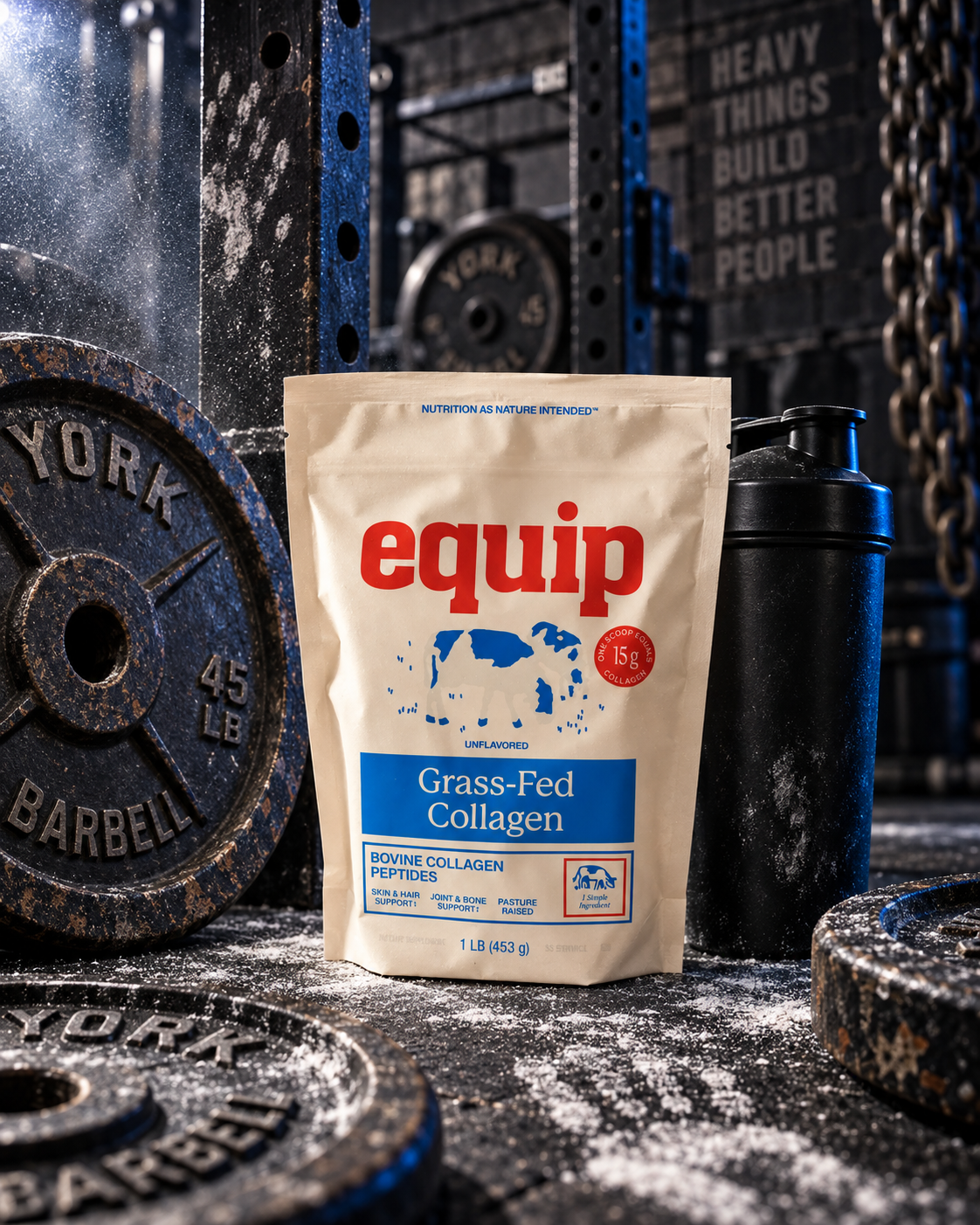
If you’re interested in trying collagen yourself, the one I use and recommend is Equip Grass-Fed Collagen.
Equip’s current product page lists 14 grams of grass-fed, pasture-raised bovine collagen peptides per scoop, primarily Type I and Type III collagen, with glycine, proline, and hydroxyproline. Equip product details
Close to the commonly studied 15-gram dose.
2 scoops = 28 gClose to the 30-gram dose used in newer resistance-training research.
If you want to try it, use code JOEL to save 15% off your first Equip order.
Train hard. Feed the muscle. Take care of the stuff holding the muscle together.
— Joel Dircks
Grip & Grub
Research & References
- Shaw G, et al. Vitamin C-enriched gelatin supplementation before intermittent activity augments collagen synthesis. American Journal of Clinical Nutrition, 2017.
- Lee J, et al. The collagen synthesis response to resistance exercise with 30 g, 15 g, or 0 g hydrolyzed collagen. Journal of Nutrition, 2024.
- Nulty CD, et al. Hydrolyzed collagen before resistance exercise in resistance-trained middle-aged men. American Journal of Physiology-Endocrinology and Metabolism, 2024.
- Nulty CD, Phelan K, Erskine RM. Hydrolysed collagen supplementation and patellar tendon adaptations to 12 weeks’ resistance training. European Journal of Sport Science, 2025.
- Buchalski A, et al. Collagen supplementation on tendon-related structural and performance outcomes: a systematic review, 2026.
- NIH Office of Dietary Supplements. Vitamin C Fact Sheet for Health Professionals.
- Amino-acid and protein-synthesis responses to whey, collagen, and placebo after resistance exercise, 2023.
- McKendry J, et al. Whey, pea, and collagen supplementation and integrated muscle protein synthesis in older males, 2024.
- Myung SK, et al. Effects of collagen supplements on skin aging: systematic review and meta-analysis, 2025.
This article is for education and general information, not individualized medical advice. If you have a medical condition, injury, food allergy, or take medications that affect your nutrition or training, talk with an appropriate healthcare professional.