Nutrition & Supplements
NAC, Vitamin C & Vitamin E: Could Antioxidants Hurt Your Gains?
Are you helping your recovery or shutting down the signals that build muscle?
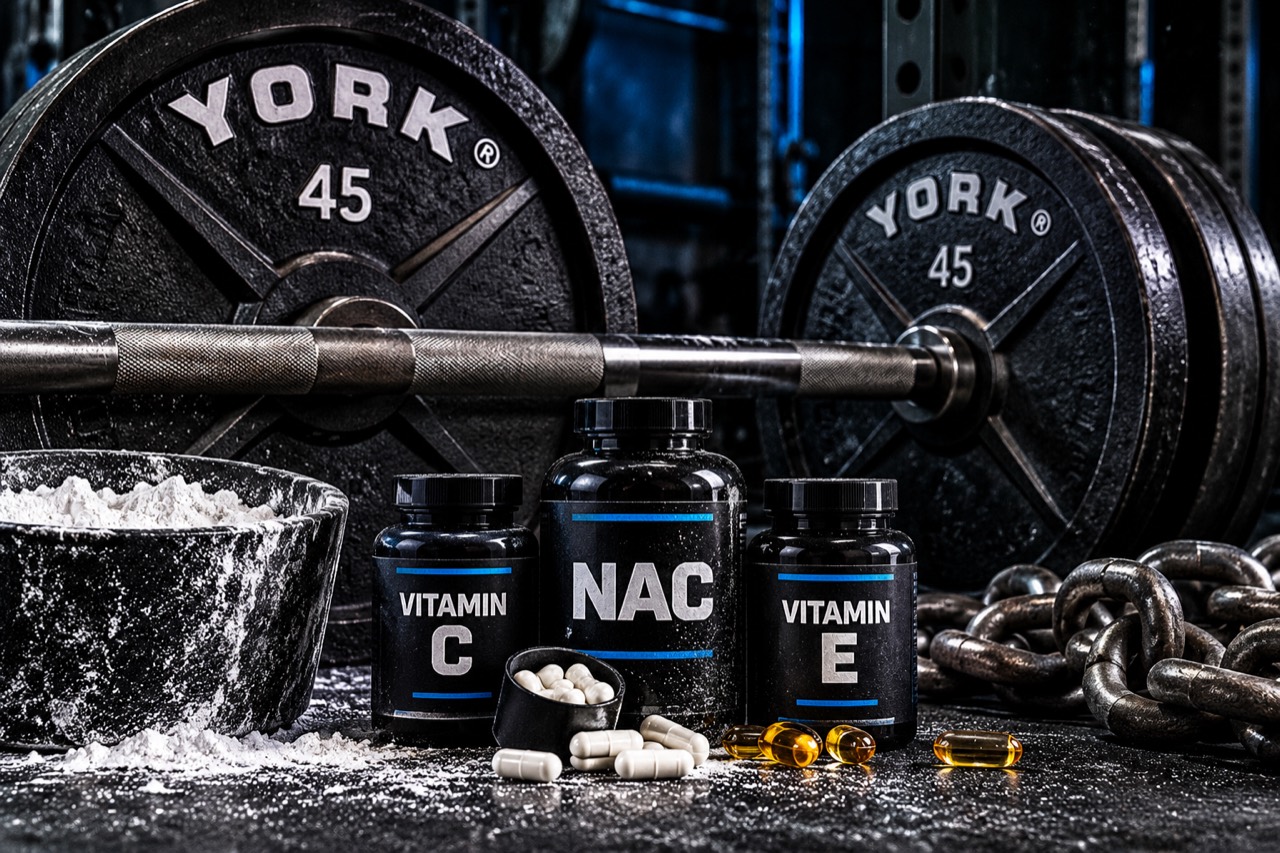
The practical take.
- What it may help with
- Distinguish normal dietary antioxidants from routinely taking large supplemental amounts.
- What the evidence supports
- Some combined C/E trials suggest interference; long-term oral NAC effects on muscle growth remain unresolved.
- Joel’s approach
- Eat fruit and vegetables, question unnecessary megadoses and discuss medical-use supplements with your clinician.
After years of competing in strength sports, I’ve learned that recovery is just as important as training. But here’s something most lifters probably haven’t considered: What if some of the supplements you’re taking to recover are actually working against your gains?
We’ve always been told antioxidants are good. They fight free radicals, reduce oxidative stress, and protect our cells. Sounds great, right?
Well, like most things in strength training, more isn’t always better.
Why your muscles need some stress
When you train hard, your body produces reactive oxygen species (ROS), a group of molecules that includes some free radicals.
Too much oxidative stress over time can damage cells. But the temporary increase from exercise actually helps signal your body to adapt.
Think of it like this: Training creates the stress. Recovery builds the muscle. Your body needs the signal to know there’s work to do.
Those signals help regulate muscle growth, mitochondrial function, and other training adaptations.
If you’re constantly trying to eliminate oxidative stress with high doses of antioxidants, you might be interfering with part of that process.
What does the science say?
Researchers have looked at high-dose vitamin C and E supplementation during resistance training, and some findings should get a lifter’s attention.
2014 study — strength training
Participants took 1,000 mg of vitamin C and 235 mg of vitamin E daily during 10 weeks of resistance training.
Researchers found reduced muscle-growth signaling and smaller improvements in certain strength measurements. Interestingly, actual muscle growth was not significantly different between groups.
2016 study — older men doing strength training
In a study of 34 men aged 60–81, after 12 weeks of resistance training:
- Placebo group: 3.9% increase in lean body mass.
- Antioxidant group: 1.4% increase in lean body mass.
The supplemented group gained less lean mass, although both groups improved strength.
These were relatively small studies, and not every study has found negative effects. A 2020 systematic review found mixed results across trials, with no significant effect in its combined analysis of isokinetic strength. Those findings do not establish a universal loss of muscle or strength from supplementation.
But here’s my takeaway: If I’m putting in the work under a heavy barbell, I don’t want to potentially limit the results just to take more vitamins.
What about NAC?
N-acetylcysteine (NAC) helps your body produce glutathione, one of its major internal antioxidants.
NAC has legitimate medical uses and has been studied for fatigue, respiratory health, and oxidative stress.
The question for lifters is whether routine daily supplementation helps when you’re training hard.
Some human research suggests NAC can interfere with certain exercise-related metabolic signals. The 2015 Trewin study used an NAC infusion during cycling in seven participants and measured insulin sensitivity and signaling. It was not a long-term trial of oral NAC and muscle growth.
We don’t have strong long-term studies showing that oral NAC directly reduces muscle growth.
So I’m not saying NAC kills gains. The evidence isn’t there.
I’m saying there’s a difference between using something for a specific purpose and taking it every day because more antioxidants sound better.
How much is too much?
Here’s what strength athletes should understand:
| Supplement | What to know |
|---|---|
| Vitamin C | Studies have raised concerns at 1,000 mg daily when combined with high-dose vitamin E. |
| Vitamin E | Studies using 235 mg daily alongside vitamin C have shown some impaired adaptations. |
| NAC | No established dose has been proven to reduce muscle growth; chronic use remains a question. |
| Food sources | Normal dietary antioxidant intake is beneficial and not the concern here. |
Because the vitamin studies used C and E together, they do not identify which vitamin caused the effects or establish the same outcome for either one alone.
We also don’t have convincing evidence that simply separating antioxidant supplements from training by a couple of hours eliminates potential interference.
The bigger concern is regularly taking large supplemental doses throughout a training cycle.
How I’d approach antioxidants
I’m not telling anyone to stop eating fruit, vegetables, or other antioxidant-rich foods. Your body needs vitamins C and E.
I would focus on getting those nutrients through food, avoid unnecessary high-dose antioxidant stacks, and look at whether daily NAC serves a specific purpose.
If a supplement is being used for a medical reason or to correct a deficiency, that’s a different situation. Discuss changes with your clinician rather than stopping a prescribed treatment based on a training article.
And remember, reducing soreness or feeling recovered doesn’t automatically mean you’re building more muscle.
The bottom line
Not all inflammation is bad. Not all oxidative stress is bad. And more antioxidants don’t automatically mean better recovery.
Your body gets stronger because you challenge it and allow it to adapt.
The science doesn’t prove that antioxidants destroy your gains. But there’s enough evidence to question whether megadosing vitamin C and vitamin E is a smart move when muscle growth and strength are the priority. For daily NAC, the long-term muscle-growth question remains unanswered.
You train hard to force your body to adapt. Don’t automatically assume you need another supplement to suppress that process.
Lift heavy. Eat well. Recover hard. And let your body do its job.
Research & References
- Huberman Lab — Dr. Rhonda Patrick (March 23, 2026). The Best Vitality & Health Protocols. Antioxidant discussion begins at 00:54:55. Podcast background.
- Paulsen et al. (2014). Vitamin C and E supplementation alters protein signalling after a strength training session, but not muscle growth during 10 weeks of training. The Journal of Physiology.
- Bjørnsen et al. (2016). Vitamin C and E supplementation blunts increases in total lean body mass in elderly men after strength training. Scandinavian Journal of Medicine & Science in Sports.
- Merry & Ristow (2016). Do antioxidant supplements interfere with skeletal muscle adaptation to exercise training? The Journal of Physiology.
- Trewin et al. (2015). Effect of N-acetylcysteine infusion on exercise-induced modulation of insulin sensitivity and signaling pathways in human skeletal muscle. American Journal of Physiology–Endocrinology and Metabolism.
- Dutra et al. (2020). The Effects of Strength Training Combined with Vitamin C and E Supplementation on Skeletal Muscle Mass and Strength: A Systematic Review and Meta-Analysis. Journal of Sports Medicine.
Educational information only. Supplement needs and medical uses vary by individual.