Legends & History
Apollon the Mighty: The French Strongman Who Left His Mark on Iron History
Louis Uni, the legendary hands, and the railway wheels that connected the strongman stage to modern axle lifting.
The practical take.
- Why it matters
- Louis Uni helped make thick-handled implements part of strength history.
- The historical context
- Historical accounts and modern judged axle records describe different equipment and achievements.
- Joel’s approach
- Understand the implement, then explore the axle technique used in training today.
There are strongmen who are remembered for the records they broke. Others are remembered for the shows they put on, the crowds they entertained, and the unbelievable feats they performed.
Then there are a select few whose names become part of the equipment itself.
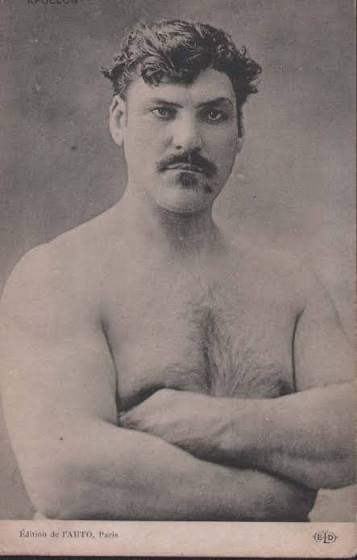
Louis Uni, better known to the world as Apollon the Mighty, was one of those men.
More than a century after he made his name bending iron, wrestling opponents, and lifting weights that most men could barely move, his legacy is still sitting in gyms and strongman competitions around the world.
It's called Apollon's Axle.
And if you've ever tried to clean a heavy axle bar, you know exactly why his name deserves a place in the Iron Library.
A Giant from Southern France
Louis Uni was born in 1862 in Marsillargues, a small town in southern France.
Long before there were professional strongman leagues, television competitions, or social media clips of massive lifts, men like Uni earned their living through physical performance.
Strength was entertainment.
The circus was their arena, the audience was their judge, and a man's reputation could be built or destroyed in front of a crowd.
According to accounts preserved by strength historian Edmond Desbonnet, Uni was just 14 years old when he ran away from home to join a traveling Italian circus.
Most boys that age were still figuring out what they wanted to do with their lives. Uni apparently already knew.
He wanted to be a strongman.
His first adventure didn't last long. The police reportedly found him performing with the circus and returned him to his father.
But the iron had already gotten into his blood.
As he grew older, Uni developed into an imposing athlete, with the sort of size and natural strength that made people stop and stare. He eventually adopted the name Apollon, after the Greek god Apollo.
It was a fitting stage name for a man whose physique reminded contemporary writers of the gladiators of antiquity.
When Strength Was a Spectacle
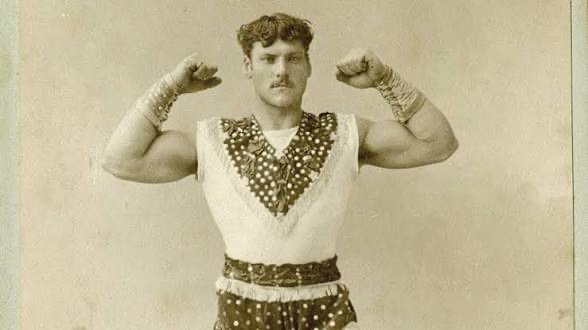
By the late 1880s, Apollon had established himself as one of France's most recognizable professional strongmen.
He was not simply a weightlifter.
He was a wrestler, a circus performer, and an entertainer who understood that the audience wanted more than a number on a barbell.
They wanted to see something that looked impossible.
Apollon gave it to them.
He performed feats with heavy dumbbells, thick-handled weights, and awkward iron implements. He wrestled formidable opponents, toured internationally, and even operated a Paris entertainment venue called Concert Apollon.
His wrestling career was real, and so were the losses. In 1892 he faced Ernest Roeber in New York and lost. Years later, he competed against the great Russian wrestler Ivan Poddubny.
That is worth remembering.
The old-time strongmen were not invincible characters from a comic book. They were working athletes, taking on challengers, traveling from town to town, and earning their living with their bodies.
Some nights they won. Some nights they lost.
But the strongest performers gave people a reason to remember their names.
And Apollon certainly did that.
A Grip That Became Legendary
If there was one physical quality that separated Apollon from many of his contemporaries, it was his tremendous hand strength.
Desbonnet described him raising a 500-pound, church-bell-shaped weight with one hand while steadying himself with the other hand on a nearby rail. This was a reported exhibition feat, not a modern judged one-hand deadlift. Another story tells of a challenge involving a 226-pound dumbbell with a handle approximately 2⅜ inches thick.
That is a serious piece of iron.
According to Desbonnet's account, another strongman had managed to raise the dumbbell to about knee height. Apollon took his turn and reportedly pulled it much higher before the thick handle slipped from his grasp.
Think about that for a moment.
A 226-pound dumbbell is no joke under ordinary circumstances. Put a handle that thick on it, and suddenly the challenge becomes as much about the hands as the back and legs.
For anyone who trains grip, the difference is immediately understandable.
You can have all the pulling power in the world, but if your hands can't hold the weight, the lift is over.
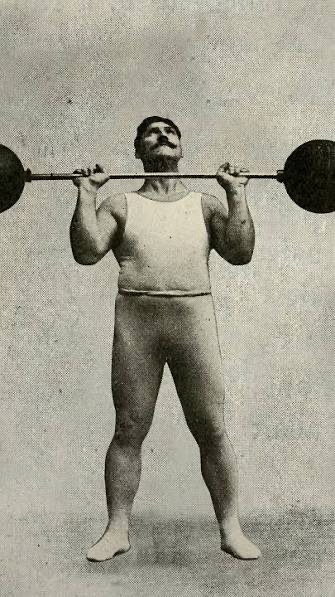
One of Apollon's best-known barbell performances reportedly took place in Lille in December 1892.
Using a globe-ended barbell weighing approximately 155 kilograms, or 341 pounds, he was said to have cleaned and jerked the weight overhead before performing an additional balancing display.
It is the kind of story that sounds almost too good to be true.
And with old-time strength history, some caution is always necessary. We have accounts written by contemporaries and later historians, but not the standardized judging, calibrated equipment, and video evidence we expect today.
Still, there is no question that Apollon was an extraordinary strength athlete.
His reputation wasn't built around a single trick.
It was built through decades of performances, challenges, wrestling matches, and feats of strength.
But the piece of equipment that would carry his name into the next century was unlike an ordinary barbell.
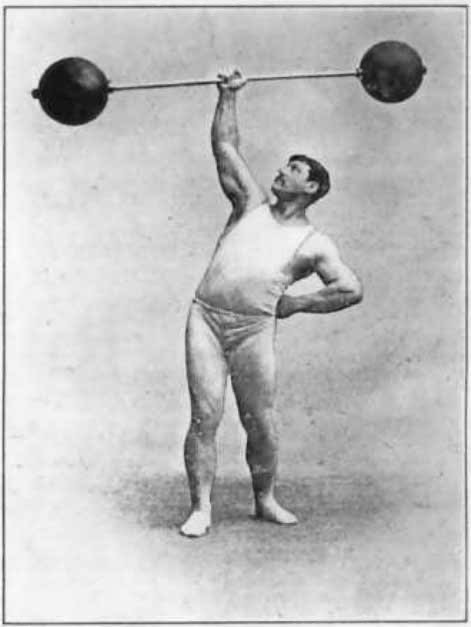
Apollon's Wheels: A Railroad Axle Becomes a Legend
Sometime around the early 1890s, Apollon acquired a set of railway wheels connected by a thick steel axle.
Instead of using a conventional barbell, he had what amounted to a piece of railroad equipment.
The original apparatus weighed approximately 366 pounds, or 166 kilograms.
The axle is commonly described as roughly 1.93 inches thick, much thicker than the gripping portion of a standard Olympic barbell. Published dimensions vary; IronMind has cautioned that not all of the frequently repeated measurements match the original implement.
And unlike an Olympic bar with revolving sleeves, the wheels were fixed to the axle.
That detail is important.
A modern Olympic bar is designed to allow its sleeves to spin during a clean or snatch. The rotation helps the lifter turn the bar over without forcing the entire loaded weight to rotate in the hands.
Apollon's Wheels offered no such luxury.
The handle was thick, smooth, and unforgiving.
There was no aggressive knurling to bite into the skin. No revolving sleeves to help with the turnover.
Just a heavy piece of iron that demanded exceptional strength and control.
It became one of the most famous challenge implements in strength history.
But here's where the story gets interesting.
Did Apollon actually clean and jerk his famous railway wheels overhead?
Many modern retellings say he did. It is an appealing story, and it has been repeated for generations.
The historical evidence is not nearly as clear.
Strength historians have pointed out that surviving records do not firmly establish that Apollon completed a clean and jerk with the original 366-pound wheels.
That doesn't mean he never lifted them.
It means we should distinguish the legend from what the surviving records can establish.
And frankly, the story doesn't need any exaggeration.
The original wheels were difficult enough to become a challenge for some of the greatest weightlifters who ever lived.
The Men Who Took on Apollon's Wheels
After Apollon's era, the railway wheels continued to test elite lifters.
In 1930, French Olympic champion Charles Rigoulot successfully lifted the original apparatus.
In 1949, American weightlifting champion John Davis managed to clean and jerk the wheels in Paris.
Then, in 1954, Norbert Schemansky added his name to the history of the implement, famously jerking the wheels overhead three consecutive times.
These were not ordinary gym lifters.
They were among the finest weightlifters of their generations.
And the fact that Apollon's old railway wheels remained a serious challenge for athletes of that caliber tells you everything you need to know about the implement.
The weight itself was impressive, but it wasn't just the weight.
It was the combination of diameter, smooth steel, fixed wheels, and the mechanics of getting such an awkward object from the floor to the shoulders.
That's the beauty of old-time strength equipment.
Sometimes the challenge isn't how much weight you can put on a perfectly engineered barbell.
Sometimes the challenge is figuring out how to lift the damn thing in the first place.
From the Circus to the Modern Strongman Arena
Fast-forward about a century, and Apollon's name was still attached to one of the most demanding tests of grip and overhead strength.
In 1994, IronMind introduced its Apollon's Axle, a modern thick-handled bar designed to recreate the essential challenge of the original railway wheels.
The idea was simple.
Take away the rotating sleeves. Make the gripping surface approximately two inches thick. Give lifters a smooth, stubborn piece of steel.
Then see what happens.
Today, axle bars are familiar equipment in strongman gyms and competitions.
One of the most recognizable events is the axle clean and press.
Competitors must bring a heavily loaded axle from the ground to their shoulders and then drive it overhead.
Because the bar is so thick, many athletes use a continental clean, bringing the axle to the stomach or belt area before working it up to the rack position.
That technique is very different from a conventional Olympic clean, but it makes sense when dealing with an implement that doesn't rotate.
Then comes the press.
And by that point, the lifter has already fought a battle just to get the weight into position.
Great modern strongmen, including Žydrūnas Savickas, helped make heavy axle pressing one of the signature displays of the sport.
But the axle is not only an overhead event.
It has also become one of the most respected implements in grip competition.
The Double-Overhand Axle Deadlift
For grip enthusiasts, the double-overhand axle deadlift is a special kind of misery.
The rules are straightforward.
Take a thick, smooth axle bar, load it with weight, and pick it up using a double-overhand grip.
No lifting straps.
No mixed grip.
No hook grip under IronMind's official record rules.
Just your hands against the steel.
The bar wants to roll out of your fingers, and the thicker diameter makes it difficult to wrap your hands securely around it.
It's a pure test of supporting grip strength.
In 2022, Carl Myerscough lifted an astonishing 237.5 kilograms, or approximately 524 pounds, on IronMind's Apollon's Axle using a double-overhand grip, setting a world record reported by IronMind.
That's the kind of grip strength that would have earned a standing ovation in an old-time strength hall.
And it shows how far athletes have pushed a challenge rooted in the nineteenth century.
The equipment may have changed, but the basic question remains the same.
Can your hands hold it?
The Price of a Lifetime of Strength
Apollon's career was not without hardship.
One of the most dramatic incidents came during an automobile stunt in Vichy, France, in 1913.
The idea was for Apollon to restrain two automobiles pulling away from him.
It was the kind of spectacle that suited the era, when strongmen were constantly searching for bigger, more dangerous demonstrations.
But this time, the stunt went terribly wrong.
He suffered serious injuries, including damage to the muscles of his arms.
It is a sobering reminder of the risks these performers took long before modern safety standards and carefully controlled competition environments.
Apollon continued to be associated with traveling strength exhibitions in his later years.
He died in 1928, leaving behind a career that had spanned decades of extraordinary changes in physical culture.
By then, the world of strength was moving toward more organized weightlifting and athletic competition.
The old circus strongman era was beginning to fade.
But Apollon's name refused to disappear.
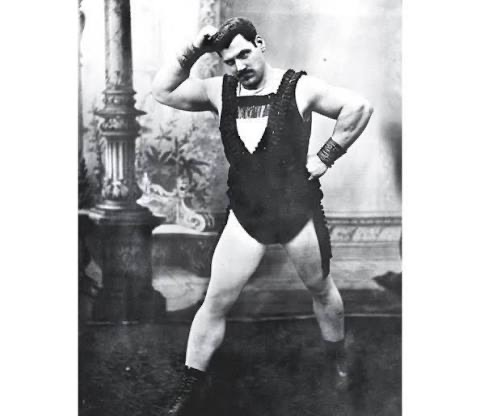
The Iron Never Forgets
There's something special about the fact that a French strongman born in 1862 can still influence how people train today.
Louis Uni never saw a modern strongman competition.
He never watched athletes load an axle bar with calibrated plates under bright arena lights.
He never saw someone pull more than 500 pounds on a thick bar in a modern grip contest.
But he would have understood the challenge immediately.
He knew what it meant to grab an awkward piece of iron and make it move.
He knew the difference between looking strong and demonstrating strength.
And he knew that a memorable feat could outlive the man who performed it.
That's why Apollon belongs in the Grip & Grub Iron Library.
Not simply because of the weights he lifted or the stories people told about him.
But because more than a century later, lifters are still testing themselves against the same fundamental challenge.
A thick bar. A heavy load. Two hands.
And the question that has followed strength athletes for generations:
Have you got the grip to lift it?
The Grip & Grub Iron Library — preserving the stories, the lifters, and the iron that built strength history.
Sources & Photo Notes
- Edmond Desbonnet — Apollon, The Emperor of Athletes, translated and annotated in Iron Game History (1997)
- David Horne — Louis Uni: historical grip-strength accounts and bibliography
- IronMind — Apollon’s Wheels, Apollon’s Axle: Setting the Record Straight (2009)
- USAWA — The Apollon Wheels (2009)
- IronMind — Apollon’s Axle rules and world records
- IronMind — Carl Myerscough’s 237.5 kg record, reported December 2022
- Rogue Legends — Apollon documentary
Historical feats are described as reports where standardized judging and independent verification are unavailable. Sources disagree about whether Uni cleaned and jerked the original railway wheels. Modern axle bars and replicas are different implements, and rules vary by organization.
All five archival photographs were supplied for this article. Dates, photographers and pictured barbell loads have not been confirmed. The cover retains its visible Paris publisher imprint. The lifting photographs are illustrative portraits, not proof of a specific record. Open any photo to view the complete supplied image.