
Nutrition & Supplements
Creatine: What It Does, How Much to Take, and When to Take It
A straightforward guide to daily creatine, dosing, timing, and what to take it with.
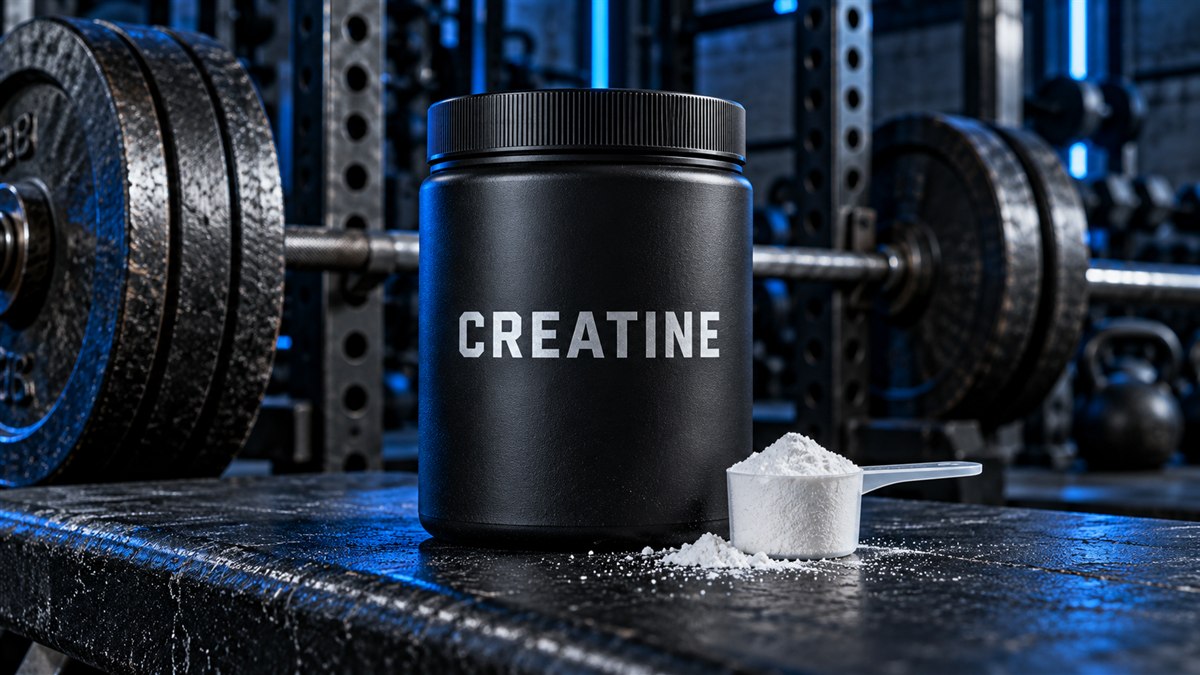
The practical take.
- What it may help with
- Support repeated high-intensity efforts and the training that builds strength.
- What the evidence supports
- Creatine monohydrate has substantially stronger performance evidence than many optional supplements.
- Joel’s approach
- For most adults, 3–5 g daily is the common research-based approach; my simple default is 5 g. Consistency comes first.
Creatine is one of the most studied supplements for strength, power, and training performance. Its routine can be simple: choose creatine monohydrate and take it consistently.
Timing, loading, and mixing options deserve context, but they matter less than maintaining muscle creatine stores. Here is what I would prioritize, along with the safety and evidence limits.
What is creatine?
Creatine is a naturally occurring compound your body produces and also gets from foods such as red meat and fish. Most is stored in skeletal muscle.
Through the phosphocreatine system, it helps regenerate ATP, the immediate energy source used during short, high-intensity efforts such as heavy lifts, grip training, sprinting, and repeated hard sets.
That does not mean a sudden 50-pound increase in your deadlift. An extra rep or better-maintained power can improve training quality over time.
Why take creatine?
The strongest evidence for creatine is still around strength, power, muscle and training performance.
Creatine can help support:
Strength
Creatine supplementation has consistently been shown to help improve strength gains when combined with resistance training.
Muscle growth
Part of this comes from increased water inside the muscle cell, but over time creatine can also help support actual muscle growth because you're able to train harder and accumulate more quality work.
Power and explosive performance
Creatine is especially useful for repeated high-intensity efforts, which obviously matters in strength sports.
Training volume
Being able to squeeze out an additional rep or maintain performance across more sets doesn't sound dramatic, but that is exactly the kind of thing that adds up over months and years.
Recovery between repeated efforts
Creatine helps replenish phosphocreatine stores, which matters when you're repeatedly performing high-output work.
And research on creatine is expanding beyond muscle.
There is growing interest in its possible effects on brain function, cognition, memory, sleep deprivation and neurological health.
I wouldn't take creatine solely because someone online claims it is a miracle brain supplement.
But the research outside of strength performance is definitely interesting.
Which type of creatine should you take?
Creatine monohydrate is my choice.
It has decades of research behind it, is inexpensive, and is widely available. Creatine HCl, buffered creatine, nitrate, ethyl ester, and proprietary blends often cost more; the evidence has not convinced me that they outperform plain monohydrate.
How much creatine should you take?
For most adults:
3–5 grams per day is enough.
I personally like 5 grams per day as a simple default.
You don't need to pull out a calculator every morning.
You don't need to measure it down to the tenth of a gram.
Just take it consistently.
What about bigger athletes?
This is where things get a little more interesting.
A 130-pound person and a 270-pound strength athlete obviously don't have the same amount of muscle mass.
Larger athletes have a larger total creatine pool.
For someone who is significantly larger or carries a lot of muscle, somewhere around:
5–10 grams per day
can be reasonable.
Andrew Huberman has talked about adjusting creatine intake based on body size and has suggested amounts approaching 10 grams per day for people over 200 pounds.
I don't think that means everyone over 200 pounds suddenly needs 10 grams.
Five grams still works.
But for larger strength athletes, I don't have a problem with using more than 5 grams.
For most people reading this:
Take 5 grams every day and stop stressing about it.
Do women need less creatine?
Not necessarily.
This is something that gets repeated online without much evidence behind it.
Women generally do not need some completely different creatine protocol just because they're women.
For most women:
3–5 grams per day is a very reasonable amount.
Female physiology and creatine metabolism are becoming a much larger area of research, especially related to hormonal changes, aging and menopause.
But based on the research we currently have, there isn't a good reason to automatically cut a woman's dose in half.
A 5-gram daily serving is perfectly reasonable for many women.
When is the best time to take creatine?
Creatine gradually increases muscle stores rather than acting like an acute stimulant. A consistent daily intake matters more than the exact hour; 5 grams every day eventually saturates those stores and then helps maintain them.
My routine
I take it after training with a meal or shake because that is easy to remember, not because research has established a 30-minute creatine window. On rest days, I use whichever meal fits my schedule.
Should you take creatine before or after training?
Studies comparing pre-workout and post-workout use have not established a major advantage for either. The results do not justify changing a routine you can follow consistently.
What should you take creatine with?
Water works. A meal containing carbohydrates and protein may increase creatine retention somewhat through the insulin response, but a special sugar drink is unnecessary.
A protein shake, normal meal, or fruit are convenient options. You do not need to add 100 grams of sugar to make creatine work.
Do you need to load creatine?
Loading can saturate muscle stores faster, but it is optional. A traditional approach is 20 grams per day for 5–7 days, split into four 5-gram servings, followed by a maintenance dose.
Taking 5 grams per day without loading reaches saturation more gradually. That is my preference: a simpler routine with less risk of stomach discomfort or a rapid increase in scale weight. Loading may appeal when an event is approaching and faster saturation matters.
Should you cycle creatine?
There is no good reason to cycle creatine to reset tolerance; it is not a stimulant. Taking it for eight weeks and stopping for four lowers muscle stores rather than maintaining them.
Should you take creatine on rest days?
Yes. Use your normal daily amount on rest days, during a deload, and when traveling. You are maintaining muscle stores between workouts.
Does creatine make you gain weight?
Usually, yes.
But understand what is happening.
Creatine increases water storage inside muscle cells.
That can cause your body weight to go up.
Some people may gain a couple of pounds fairly quickly.
That's not the same thing as gaining body fat.
You're increasing intracellular water.
For strength athletes, that isn't necessarily a bad thing.
A fuller, better-hydrated muscle cell is generally something we want.
If you're in a sport with strict weight classes, however, this is something worth considering.
Someone trying to make weight needs to understand how their individual body responds.
Does creatine dehydrate you?
This is an old myth.
Creatine pulls water into muscle cells, but that doesn't mean it dehydrates your entire body.
Research has not supported the idea that normal creatine supplementation increases dehydration or muscle cramping in healthy athletes.
That said, you still need to hydrate.
If you're training hard, sweating, competing outdoors or doing long events, hydration and electrolytes matter regardless of whether you use creatine.
Creatine isn't an excuse to ignore basic hydration.
Is creatine bad for your kidneys?
This question comes up constantly.
In healthy people, creatine taken at normal recommended doses has a very strong safety record.
One thing people sometimes misunderstand is blood testing.
Creatine can cause serum creatinine levels to increase slightly.
Creatinine is one marker doctors use when assessing kidney function.
That doesn't automatically mean creatine damaged your kidneys.
It can simply be a result of increased creatine intake and metabolism.
If you use creatine and get blood work done, tell your healthcare provider that you take it.
If you already have kidney disease or another medical condition involving kidney function, that is different.
Talk with your healthcare provider before starting supplementation.
What about creatine for teenagers and kids?
This is an area where I think people should be more cautious.
Creatine has been studied in teenagers, including athletes, but the research isn't nearly as extensive as it is in adults.
There is also a difference between:
A mature 17-year-old athlete training seriously for performance
and
a 9-year-old who just started youth sports.
Those are not the same situation.
I would not casually give creatine to young children just because an adult strength athlete takes it.
For older teenage athletes who are training seriously, eating properly, sleeping enough and working with knowledgeable adults, creatine may be appropriate.
But that is something I would discuss with a pediatrician, sports dietitian or qualified sports medicine professional.
Kids should not be skipping the basics because they think supplements are the shortcut.
The foundation is still:
- Enough food
- Enough protein
- Fruits and vegetables
- Hydration
- Sleep
- Proper training
- Recovery
Creatine comes after that.
What about brain benefits?
This is one of the more interesting areas of current creatine research.
Your brain also uses ATP.
The brain also uses creatine.
Researchers are studying creatine for things like:
- Memory
- Cognitive performance
- Sleep deprivation
- Mental fatigue
- Aging
- Neurological health
There is some promising research here.
That doesn't mean I would start mega-dosing creatine because someone on TikTok said it will turn your brain into a supercomputer.
But it does make creatine even more interesting than we once thought.
For years, most lifters looked at creatine strictly as a muscle supplement.
The future of creatine research could end up being much broader.
My simple creatine protocol
My default is 5 grams of creatine monohydrate daily. The dose discussion above explains why 5–10 grams per day can be reasonable for a very large strength athlete; it is not an automatic requirement based on body weight.
Attach it to a meal or shake you already have each day. Loading, cycling, special blends, and a $60 tub of “advanced creatine” are not prerequisites.
The bottom line
Creatine can support a strength program, but training, adequate protein, sleep, and recovery still do the larger job. Get those foundations in place and use the practical routine above.
— Joel