
Nutrition & Supplements
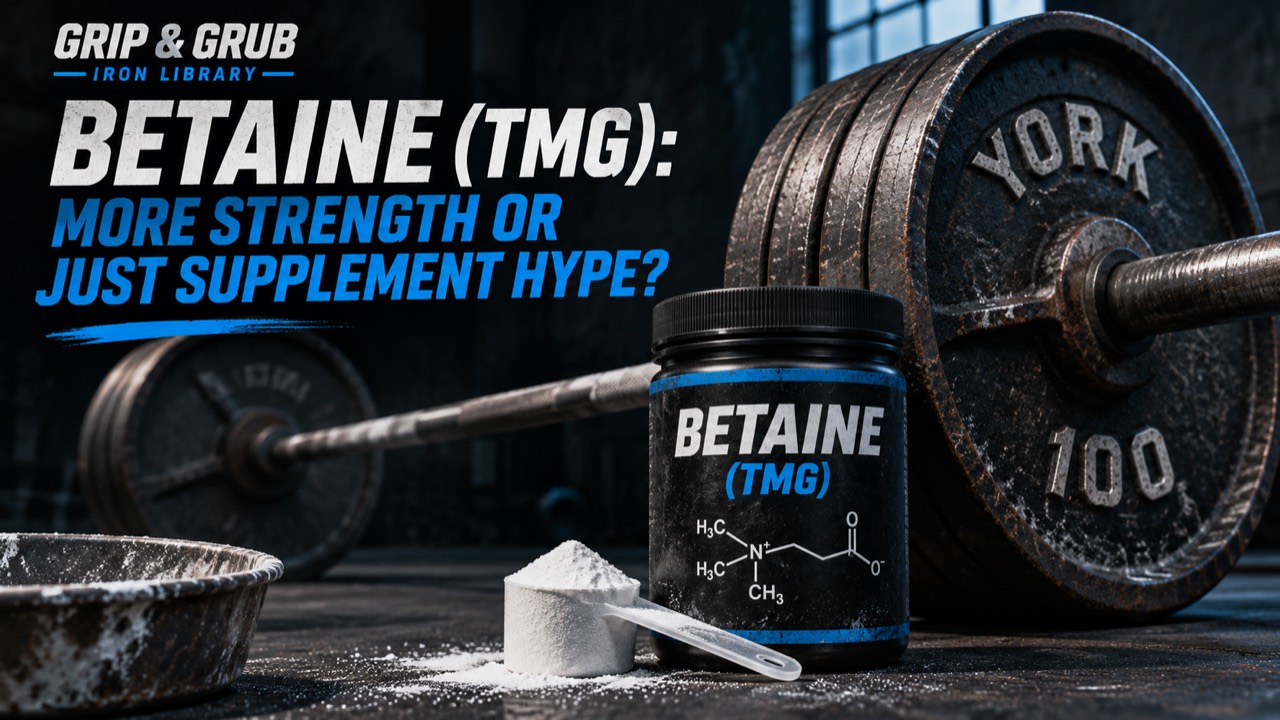
Betaine (TMG): More Strength or Just Supplement Hype?
The research on this lesser-known supplement is interesting. But can it really help you move more weight?
The practical take.
- What it may help with
- Investigate a possible small strength or power benefit after the essentials are covered.
- What the evidence supports
- Pooled lower-body findings are encouraging, but studies are small and other outcomes are inconsistent.
- Joel’s approach
- The commonly studied 2.5 g daily is a research amount, not a guaranteed advantage; track actual training if you try it.
If you spend enough time reading pre-workout labels, every ingredient starts sounding like it’s going to add 50 pounds to your squat. Betaine, also called TMG, is one of those ingredients that deserves a closer look.
There’s some legitimate science here. It might help strength and power. But let’s not confuse promising with proven.
What is betaine (TMG)?
TMG stands for trimethylglycine, also called betaine anhydrous. You get it from foods like beets, spinach, and wheat products, and your body can make it from choline.
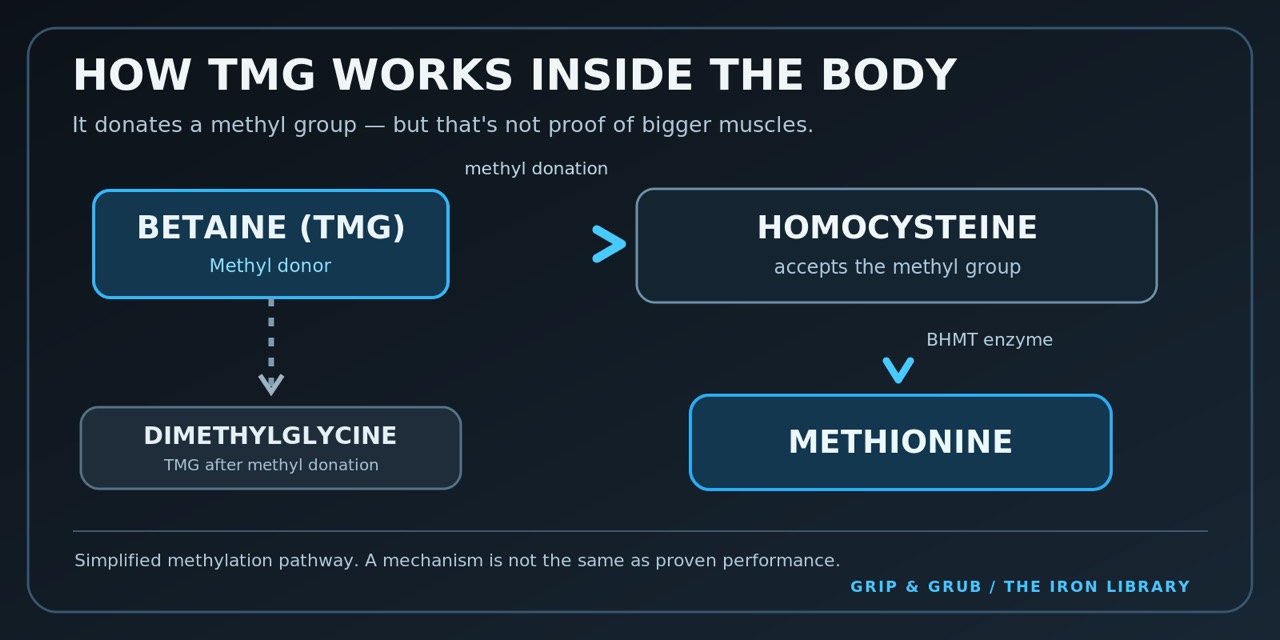
It has two main jobs. First, it helps your cells manage water balance. Second, it donates methyl groups that help convert homocysteine into methionine, an amino acid involved in several normal metabolic processes.
In gym terms, think of TMG as part of the maintenance crew inside the muscle, not a turbo button you hit before a heavy single.
The biology makes sense. Whether it translates into bigger lifts is the question.
Read the pathway as text
Betaine (TMG) is a methyl donor. Through the BHMT enzyme, it donates a methyl group to homocysteine, helping convert it into methionine. After methyl donation, betaine becomes dimethylglycine.
This is a simplified methylation pathway. Explaining the mechanism does not prove that supplementation builds more muscle or improves lifting performance.
Will it actually make you stronger?
A 2024 review combined 17 human studies involving 317 people. Overall, researchers found a statistically significant improvement in maximal strength, particularly lower-body strength. Vertical jump also looked promising after one lower-quality study was excluded.
That’s worth paying attention to if your training involves squats, deadlifts, jumps, and heavy lower-body work.
But results weren’t consistent for upper-body strength, muscular endurance, or sprint power. And most of these studies were small and relatively short.
My translation: TMG may give some lifters a small edge. Nobody has proven it’s adding 20 pounds to your squat next month.
Read the research results as text
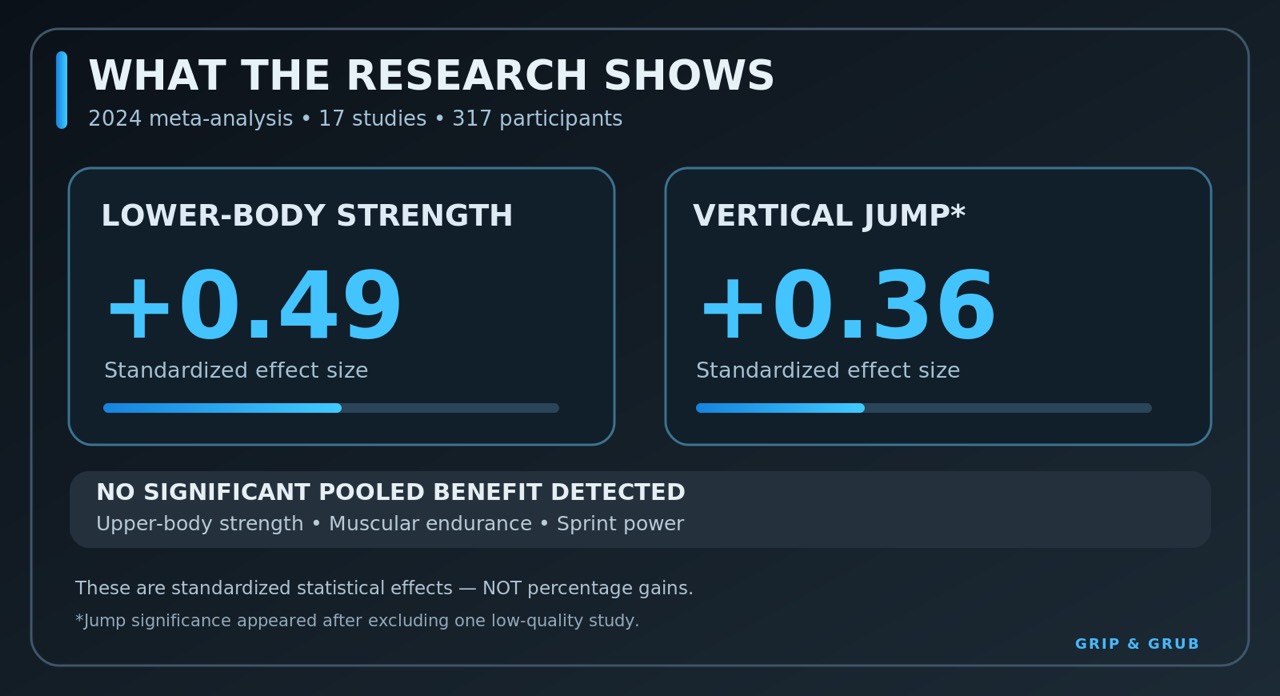
The 2024 meta-analysis included 17 studies and 317 participants.
- Lower-body strength: standardized mean difference +0.49 (95% confidence interval 0.01 to 0.98).
- Vertical jump: standardized mean difference +0.36 (95% confidence interval 0.03 to 0.69), significant after excluding one low-quality study.
- No significant pooled benefit detected: upper-body strength, muscular endurance, or cycling sprint power.
These are standardized statistical effects, not percentage gains, pounds added to a lift, or a guarantee of an individual response. Read the review.
What about muscle growth, testosterone, and creatine?
This is where supplement marketing gets ahead of the research.
A few small studies have shown changes in hormones or workout performance. That is not the same as proving TMG raises testosterone long-term or builds more muscle.
A broader review found no consistent body-composition benefit.
Dr. Kyle Gillett discussed betaine with Andrew Huberman as something that might be worth considering alongside creatine, especially in certain situations.
But one direct comparison—a 10-day study in untrained participants—found that creatine improved muscle phosphocreatine and performance while betaine did not match it, and the combination showed no clear added benefit.
I’m not replacing my creatine with TMG, and I wouldn’t tell anyone else to do that based on the current evidence.
My simple TMG protocol for strength athletes
If you want to experiment with it, here’s the practical approach used most often in the research:
- Form: Betaine anhydrous / TMG, not betaine HCl, which is a different supplement sold for digestion.
- Dose: 2.5 grams daily is a commonly studied amount, not an established optimal dose for every strength athlete.
- Timing: Split it into 1.25 grams twice a day, with meals if you prefer. There is no proven magic pre-workout window.
- Training and rest days: Take it consistently, not just on heavy days.
- Evaluate: Give it roughly 4–8 weeks while keeping your training consistent. Track your main lifts, reps, and how hard your sets feel. That’s a practical trial period, not a guaranteed time to results.
More isn’t automatically better. Studies using 5 grams haven’t established a reliable advantage over 2.5 grams.
Any downsides?
TMG is not completely risk-free.
Some studies, especially at higher doses, found increases in LDL and total cholesterol. Digestive discomfort can happen, and the long-term effects of supplementation in athletes aren’t well established.
If you have elevated cholesterol or other medical concerns, talk with a qualified healthcare professional before adding it. If you compete in drug-tested sports, choose a third-party-tested supplement.
My take
Betaine is interesting. It isn’t essential.
If your training, protein intake, sleep, and creatine are already handled, TMG could be something to test.
The evidence for a possible lower-body strength benefit is better than the testosterone or muscle-growth hype.
But if you’re skipping meals, sleeping five hours, and changing your program every week, another scoop of powder isn’t fixing that.
Earn the basics first. Then decide if the extras are worth your money.
— Joel
Research & References
- Zawieja et al. (2024), Journal of Sports Sciences — Chronic betaine supplementation and exercise performance: systematic review and meta-analysis
- Zawieja et al. (2023) — Randomized CrossFit trial on performance and hormones
- Ashtary-Larky et al. — Systematic review of betaine and body composition
- Huberman Lab — Dr. Kyle Gillett, Tools for Hormone Optimization in Males (Essentials rerelease, July 2026)
- del Favero et al. — Creatine versus betaine randomized trial
- Systematic review and meta-analysis of cardiovascular markers
Educational content only. Supplements do not replace individualized medical advice.