
Nutrition & Supplements
Alpha-GPC: More Focus, More Strength, or Just Pre-Workout Hype?
Can this popular brain-boosting supplement actually help you lift heavier, train harder, and stay focused? Let’s look at the science.
The practical take.
- What it may help with
- Explore a possible focus benefit while keeping expectations for bigger lifts realistic.
- What the evidence supports
- Attention findings are promising, strength results are mixed, and caffeine has a stronger performance evidence base.
- Joel’s approach
- Make training and nutrition the foundation; weigh the unresolved long-term safety questions before experimenting.
Walk into any supplement store, and you’ll find pre-workouts promising insane focus, explosive power, and better performance. One ingredient showing up more often is Alpha-GPC.
You’ve probably heard Andrew Huberman talk about it for improving focus and cognitive performance. But does it actually help you move more weight, or is this another supplement riding the hype train?
I dug into the research, and here’s what I found.
What is Alpha-GPC?
Alpha-GPC is a form of choline that helps your body produce acetylcholine, a neurotransmitter involved in memory, attention, and muscle activation.
Your nervous system uses acetylcholine to communicate with your muscles. Without that communication, you’re not moving anything.
That’s where the theory gets interesting. If Alpha-GPC supports acetylcholine production, could it improve focus, muscle activation, and strength?
Sounds good on paper. But we need to see what actually happens in the gym.
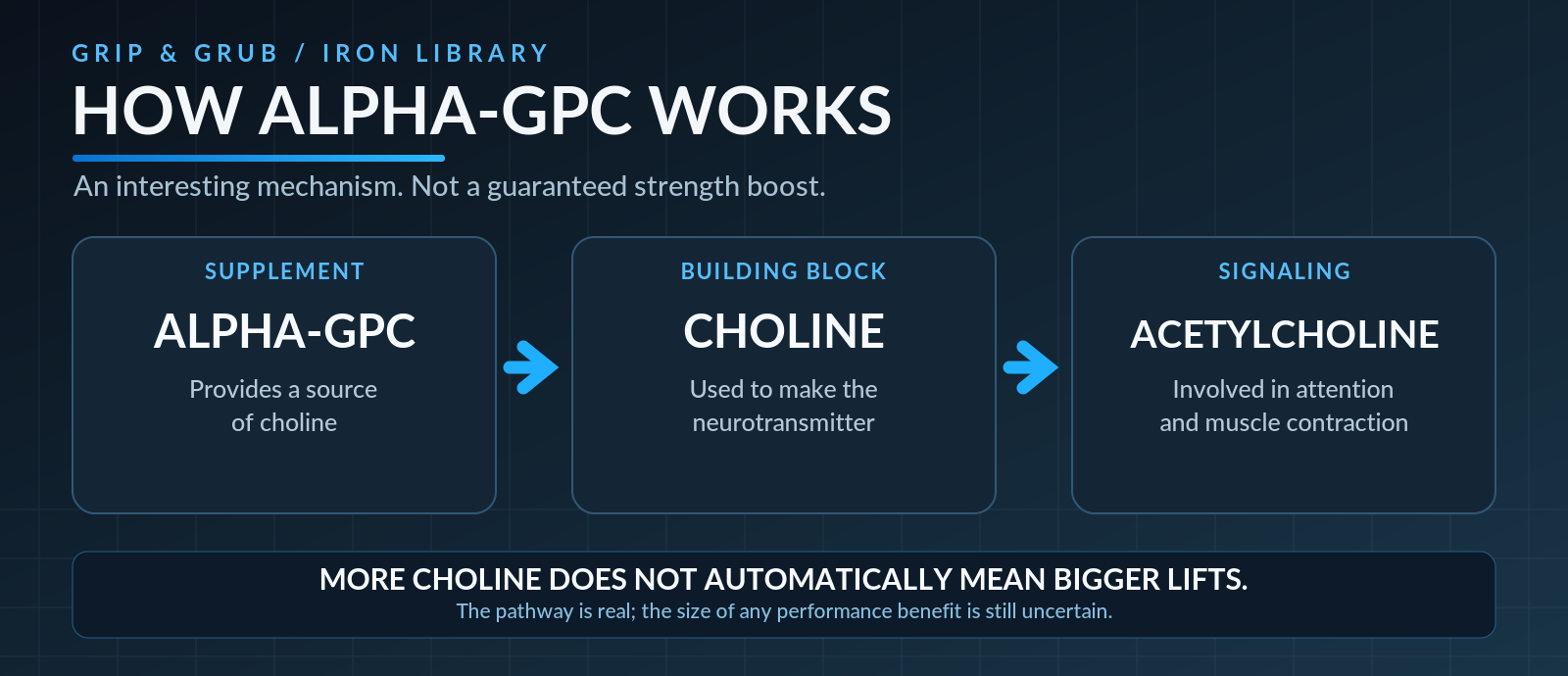
Read how Alpha-GPC works as text
Alpha-GPC provides a source of choline. Your body uses choline to make the neurotransmitter acetylcholine, which is involved in attention and muscle contraction.
More choline does not automatically mean bigger lifts. The pathway is real; the size of any performance benefit is still uncertain.
Does it actually make you stronger?
A few small human studies have shown promising results.
A 2015 trial involving 13 men found improved lower-body isometric force after six days of Alpha-GPC supplementation. A 2017 study found improvements in certain jumping-performance measurements, but not clear differences in isometric strength or its psychomotor test.
However, a 2024 study involving 20 resistance-trained men found something interesting:
Alpha-GPC improved certain measures of focus and attention, but it didn’t significantly improve jumping performance or bench-press throw performance.
That’s an important distinction. Just because something helps your brain perform better on a test doesn’t mean you’re suddenly pulling another 50 pounds off the floor.
The research on strength and power is still mixed, and most studies are relatively small.
And the often-quoted “14%” claim? It came from a seven-person conference abstract about peak bench-press force; the power result wasn’t statistically significant. That’s not a 14% bigger bench press.
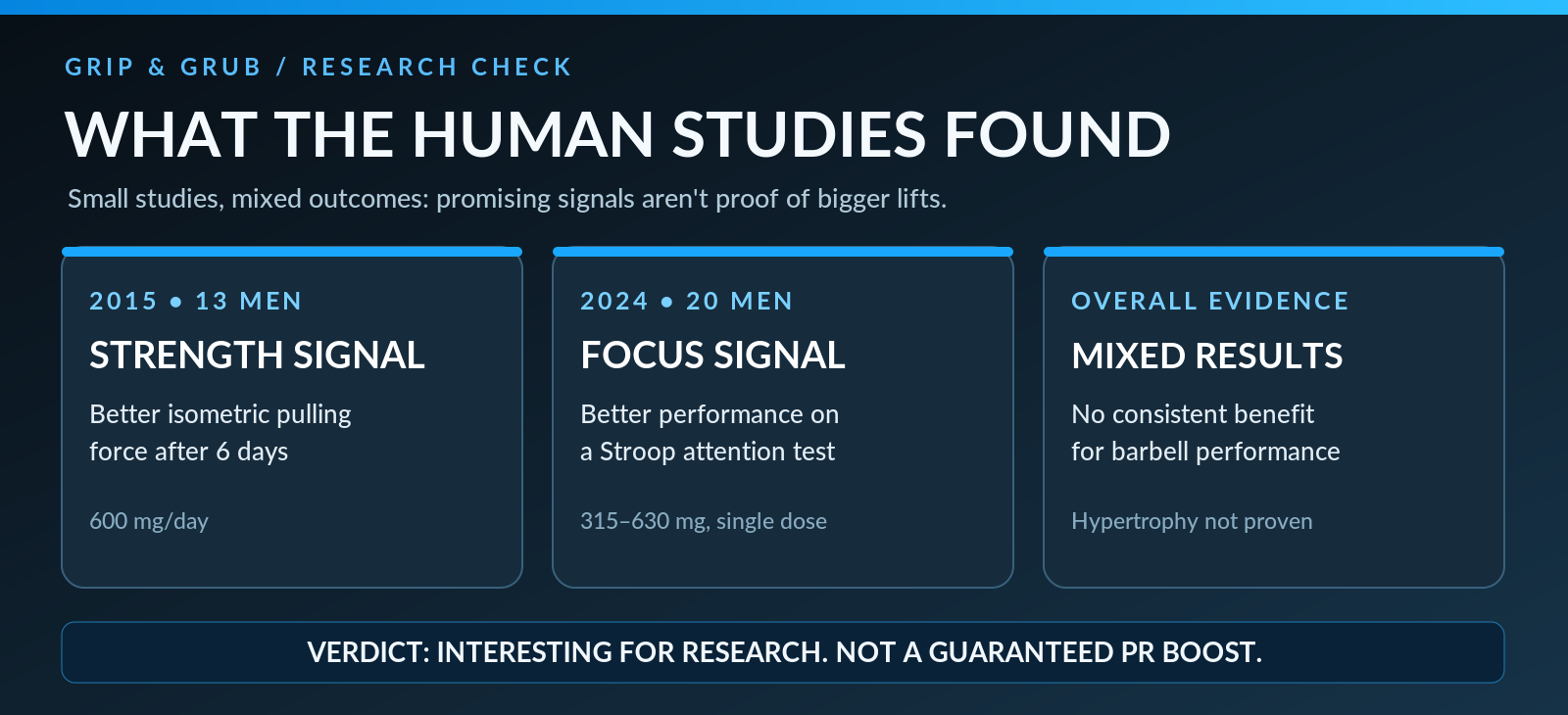
Read the study comparison as text
- 2015, 13 men: better isometric pulling force after six days of 600 mg per day. This was a laboratory force test, not proof of a bigger barbell lift.
- 2024, 20 men: better performance on a Stroop attention test after single doses of 315–630 mg. No clear overall improvement in physical performance was found.
- Overall evidence: small studies and mixed outcomes. Hypertrophy is not proven, and a personal-record boost is not guaranteed.
Alpha-GPC vs. caffeine
Here’s where things get interesting for anyone taking pre-workout.
Caffeine has decades of research supporting improvements in alertness and several measures of strength, power, and muscular endurance. Effects vary by person and task; sleep disruption and side effects still matter. The ISSN position stand gives that evidence useful context.
Alpha-GPC has some promising research on attention and focus, but significantly less evidence for physical performance.
They work through different mechanisms, but that doesn’t automatically mean combining them creates some magical pre-workout formula.
If you’re looking for a proven performance enhancer, caffeine still has the stronger scientific backing. Alpha-GPC might offer something different, but the research isn’t strong enough to call it a replacement or a guaranteed upgrade.
Athlete action plan: dose, timing & what to know
If you’re considering Alpha-GPC, here’s what the research tells us.
- Form: Alpha-GPC, also called choline alfoscerate.
- Dose studied: Small human performance trials have tested approximately 250–630 mg, often discussed as roughly 300–600 mg. This is a research range, not an established safe or optimal recommendation.
- Timing studied: Roughly 30–90 minutes before activity. There’s no proven ideal pre-workout window.
- Daily use: There’s no established long-term performance protocol or proven benefit to cycling it.
- Stacking: Combining Alpha-GPC with caffeine hasn’t been convincingly shown to produce additional strength or power benefits.
- Quality: If you compete in a drug-tested sport, choose supplements independently tested for banned substances.
My advice? Don’t start stacking supplements just because a pre-workout label makes them sound incredible.
Know what you’re taking, what the research actually supports, and whether the potential benefit is worth the risk.
What about the stroke concerns?
This is something I wouldn’t ignore.
A large 2021 observational study from South Korea found that adults aged 50 or older prescribed Alpha-GPC had a higher rate of stroke than people who weren’t prescribed it.
After matching and statistical adjustments, researchers reported approximately 43% higher relative hazard of stroke among users. That is a relative association, not a 43-percentage-point increase in someone’s absolute risk.
That does not prove Alpha-GPC caused the strokes. The study involved older adults, many with existing health concerns. It wasn’t a controlled trial involving healthy lifters taking occasional pre-workout doses.
But it’s enough to raise questions about long-term safety.
There are also questions involving TMAO, a compound produced through certain gut-microbe metabolic pathways. A small human study found that Alpha-GPC could increase TMAO levels. That does not prove it causes cardiovascular disease, and a biomarker alone does not establish clinical risk.
Huberman has discussed garlic supplements in relation to TMAO concerns, but there’s no good evidence that garlic prevents any possible Alpha-GPC-related stroke risk. Podcast commentary is separate from clinical evidence.
We don’t have enough long-term safety data to pretend there’s nothing to worry about.
Anyone with cardiovascular risk factors, a history of stroke, or medication use should speak with a qualified healthcare professional before considering it.
My take
Alpha-GPC is interesting, especially for mental focus.
There are a few promising strength and power studies, but not enough consistent evidence for me to call it a must-have supplement for strength athletes.
And with the unanswered cardiovascular questions, I’m not convinced routine long-term use is worth recommending just to chase a possible small performance advantage.
If I have to choose where to spend my supplement money, I’m prioritizing the basics: creatine, adequate protein, proper nutrition, and sleep.
Those have a much stronger foundation. Remember, just because an ingredient sounds impressive on a label doesn’t mean it’s going to put more plates on the bar.
Train hard. Recover harder. Let the science do the talking.
— Joel
Research & References
- Huberman Lab (2022) — Focus Toolkit: Tools to Improve Your Focus & Concentration. Podcast commentary and personal protocols; not a controlled trial.
- Kerksick (2024) — Acute Alpha-Glycerylphosphorylcholine Supplementation Enhances Cognitive Performance in Healthy Men. Randomized crossover trial.
- Bellar et al. (2015) — The effect of 6 days of alpha glycerylphosphorylcholine on isometric strength. Small randomized crossover trial.
- Marcus et al. (2017) — Evaluation of the effects of two doses of alpha glycerylphosphorylcholine on physical and psychomotor performance. Alpha-GPC, caffeine and placebo comparison.
- Lee et al. (2021) — Association of L-α Glycerylphosphorylcholine With Subsequent Stroke Risk After 10 Years. Observational cohort, JAMA Network Open.
- Guest et al. (2021) — International Society of Sports Nutrition position stand: caffeine and exercise performance. Evidence review and position stand.
- Böckmann et al. (2022) — Differential metabolism of choline supplements in adult volunteers. Small randomized crossover metabolism study.
- Ziegenfuss et al. (2008) — Alpha-GPC and acute growth hormone, force, and power. Seven-person conference abstract; preliminary evidence.
This article is for educational purposes and does not replace individualized medical advice.