
Legends & History
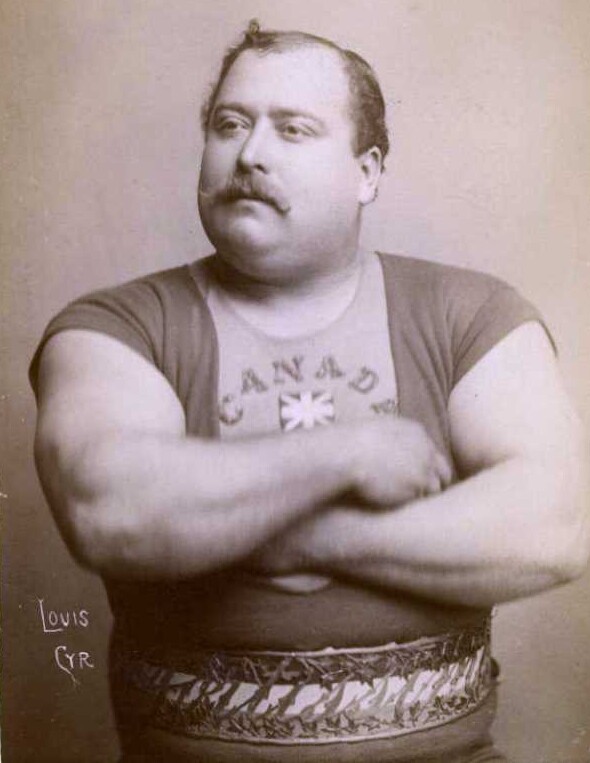
Louis Cyr and the Strength Behind the Legend
The Canadian strongman, his 517-pound stone, and the feats that made his name last.
The practical take.
- Why it matters
- Cyr’s stones, dumbbells and backlifts connect public strength exhibitions with modern strongman.
- The historical context
- Reported historical feats are worth understanding on their own terms and apparatus.
- Joel’s approach
- Bring that curiosity into modern stone and awkward-object training.
There are certain names you need to know if you care about strength history. Louis Cyr is one of them.
His name comes up whenever people debate the strongest men who ever lived. Usually, somebody mentions a backlift of more than 4,000 pounds, and the conversation takes off from there. But that number only tells you a small part of his story.
What interests me about Cyr is the range of what he did. Heavy dumbbells. Awkward stones. Barrels. Huge loads supported across his back. Horses pulling against his arms. His career belongs in the history of several kinds of strength we still train and compete in today.
Like the Thomas Inch story, this one deserves a closer look. I want to understand the man, the equipment, and the actual feats behind the reputation. A good strength story gets better when you understand what happened.
From Quebec to the mills of Massachusetts
Louis Cyr was born on October 10, 1863, in Saint-Cyprien-de-Napierville, Quebec. His baptismal name was Cyprien-Noé. He grew up in a large farming family, and in 1878 the family moved to Lowell, Massachusetts, seeking work and better living conditions. There, he adopted the name Louis, which was easier to pronounce in English. [1]
Lowell was an industrial city, and Cyr worked in its textile mills. Parks Canada describes him handling heavy cotton crates and doing work normally assigned to two men. In 1882, he married Mélina Comtois. Their daughter, Émiliana, would also become part of the family's strength story. [1]
His early life puts his strength in context. There were heavy things to move because the work required it. That does not mean manual labor alone explains an athlete as exceptional as Cyr, but it helps explain the world in which his ability became useful and noticeable.
The popular stories about his youth include lifting a farmer's wagon out of the mud and winning a contest by lifting a horse. Strength historian Josh Buck cautions that this familiar origin story is highly romanticized. I would treat those episodes as part of the Cyr tradition rather than repeat every detail as settled fact. [2]
The 517 pound stone that helped launch his career
One of the feats I most wanted to understand was Cyr's lift of a natural stone weighing 517 pounds, approximately 234.5 kilograms.
In 1883, at just 19 years old, Cyr reportedly lifted that stone from the ground to his shoulder in Lowell, Massachusetts. The Maison Louis-Cyr museum recounts the lift before a crowd of about 4,000 and says the rock was weighed at a general store. The Dictionary of Canadian Biography identifies that store as Olivier Gaudette's. This was an early feat that helped establish his reputation. [8][13]
Think about that movement. Picking up a heavy stone is already demanding. Getting it high enough to settle onto a shoulder adds another challenge. You have to find purchase on an irregular surface, keep the object close enough to control, and work around whatever shape the rock gives you.
For me, this is one of the most compelling parts of Cyr's story. The object itself becomes part of the test. Two stones of the same weight can feel very different because of their shape and the places available to grip them.
The 2013 movie dramatizes this lift. Historian Marc-André Robert describes a scene in which Cyr accepts the challenge after an insult against French Canadians. That is how the film tells the episode; the specific dialogue and confrontation should be kept separate from the historical account of the lift. [10]
There is also a modern connection. At Fortissimus in 2008, Derek Poundstone loaded a commemorative Louis Cyr stone onto a 30-inch platform, becoming the only competitor in that event's field to complete the lift. Organizers initially reported its weight as 517 pounds. A subsequent weighing in 2009 recorded 530 pounds, about 240.4 kilograms, and the stone was given both Cyr's and Poundstone's names. [14]
That was a different stone and a different finishing height from Cyr's reported shoulder lift. It does not establish an exact repeat of the 1883 feat. What it does show is how an old strength story can inspire a demanding modern competition event.
Cyr's 517-pound stone belongs near the beginning of his story. Long before the famous backlift numbers, an awkward rock helped make people pay attention.
A working man becomes a professional strongman
In 1883, Cyr began touring as a strength performer under a promoter named Mac Sohmer. The arrangement was exploitative, and Cyr left it. He also worked as a police officer in Sainte-Cunégonde, now part of Montreal. By 1885, he was back on the road with a troupe managed by Gustave Lambert. [3]
His breakthrough came in 1886, when he defeated David Michaud in Quebec City and gained recognition as Canada's strongest man. Quebec's heritage register credits him with a 2,371-pound backlift during that contest—approximately 1,075 kilograms. [3]
This was a different strength world from the one we know today. Public challenges, theater performances, newspaper publicity, and circus appearances helped establish a reputation. Recognition as the strongest man in the world did not come through the modern World's Strongest Man competition.
By 1890, Richard K. Fox and his New York publication, the National Police Gazette, were promoting Cyr's claim to that title. Cyr traveled to Britain in 1891–92 to demonstrate his strength and pursue challenges against European athletes. [3]
That is a major jump: from moving loads for a paycheck to earning a living because people wanted to see what he could move.
The huge backlift everyone remembers
The most famous figure attached to Louis Cyr is 4,337 pounds, or approximately 1,967 kilograms, commonly dated to 1895. The National Library of Canada's historical profile repeats that figure while acknowledging that his career preceded consistent modern record keeping. [4]
First, we need to understand the movement.
A backlift involved getting underneath a supported platform, placing the back against it, and raising the load clear of its supports over a short distance. W. A. Pullum's retrospective account describes Cyr using a low stool for his hands while extending his arms and legs beneath the platform. [5]
That makes it a very different event from picking a barbell up from the floor. Calling it a 4,337-pound deadlift changes the achievement into something he was not doing.
The exact maximum also deserves care. Buck's article collects several conflicting backlift figures. Its editorial note cites David P. Willoughby's concern that the platform and the people on it were often not actually weighed; Willoughby estimated Cyr's best at roughly 3,900–4,000 pounds. [2]
I am comfortable saying that Cyr became famous for extraordinary backlifting, with 4,337 pounds as the best-known reported figure. I would not call that number a modern, independently verified record.
To me, the mechanics make the feat more interesting. You have to consider the supports, body position, clearance, and way the load is distributed. Understanding those details gives you something useful to picture instead of just an enormous number.
The dumbbell that connects Cyr to modern strongman
Cyr's famous one-arm overhead lift is generally reported at 273¼ pounds, approximately 124 kilograms, during his British visit in 1892. [6]
That is an enormous dumbbell. It also raises a familiar question from the Thomas Inch article: what does “lifted it” actually mean?
Rogue's account describes Cyr bringing the dumbbell to his shoulder with two hands, then push-pressing it overhead with one. Parks Canada describes a one-arm clean followed by a press. Sources also differ over the precise date and terminology. [1][6]
The responsible description is a reported one-arm overhead lift of about 124 kilograms. I would not quietly turn it into an undisputed one-hand clean and strict press.
Modern strongman has kept that connection alive. Rogue built a 274-pound Cyr replica for the 2014 Arnold Strongman Classic. [6]
That is one reason I enjoy this history. An implement can carry a name across generations and give today's athletes a physical connection to an earlier era. But comparisons still need the same questions: which dumbbell, which technique, and which rules?
His hands were part of the story
For Grip & Grub, the gripping feats deserve attention of their own.
An archived French-language record list credits Cyr with a one-hand lift of 987 pounds, approximately 448 kilograms, and a one-finger lift of 553 pounds, approximately 251 kilograms. Importantly, it describes these as lifts several inches off the ground. It also credits him with putting a roughly 433-pound barrel of cement to his shoulder with one hand. [7]
Those are historical reported figures. They should not be presented as modern federation records with today's standardized equipment and judging.
The finger lift has an additional problem: accounts differ about both the weight and the finger used. Buck repeats a 545-pound middle-finger claim, while Pullum describes a little-finger lift with a different reported weight. [2][5]
I would describe Cyr as famous for extremely heavy finger lifting and explain the disagreement. Naming one exact finger and number with total confidence would make the story cleaner than the evidence allows.
For anyone who trains grip, the larger point is easy to appreciate. Different implements ask different things of the hand. A thick handle, a ring attached to a load, and an awkward barrel do not test exactly the same ability. The attachment and setup belong in the description of the feat.
Holding back four horses
One of Cyr's most memorable demonstrations involved restraining four horses, two on each side. The Dictionary of Canadian Biography places repeated performances of this feat at Montreal's Sohmer Park in September 1891. [8]
Pullum's account describes ropes ending in loops through which Cyr passed his arms, with a ring held between his hands. That detail matters: this was a braced resistance feat involving an apparatus, not simply somebody grabbing four reins. [5]
It is also not possible to convert the horses' combined body weight directly into the force Cyr resisted. Their traction, effort, direction of pull, and the setup all affect that force.
Still, it is easy to understand why audiences remembered it. An overhead weight gives you a number to judge. Horses trying to pull a man apart give you a scene you can feel.
For me, this is one of the clearest examples of why strength became public entertainment. The audience did not need to know lifting terminology to understand the challenge.
Cyr and Sandow
Eugen Sandow's name inevitably enters the conversation. Both men became major figures in the strength and physical-culture world, and a contest between them would have been a huge attraction.
But the Dictionary of Canadian Biography states that Cyr and Sandow never competed against each other because they failed to agree on the conditions. [8]
That distinction matters. Cyr challenging Sandow is not the same thing as Cyr defeating him.
I also would not assign a motive we cannot establish. Unaccepted challenges can involve rules, money, scheduling, promotion, or disagreements about the events. The claim that one man was simply afraid of the other needs more than an unused invitation.
It is tempting to use a famous name to make another athlete's reputation bigger. Cyr's own performances give us plenty to discuss.
The circus and the family business
Cyr's strength became a touring business. His career included the Cyr Brothers company, appearances with major American circuses, and eventually a circus operated with fellow strongman Horace Barré. [3]
What stands out to me is how closely athletic performance and earning a living were tied together. A crowd had to buy tickets. The act had to travel. A reputation had to remain interesting enough for the next town.
That environment is worth remembering when reading old publicity. A poster's job was to sell the performance. A newspaper challenge could be a sporting proposal and an advertisement at the same time.
Cyr also represented something larger than his own business. French-Canadian societies honored him with the Fortissimo belt in 1891, recognizing his role in promoting French Canada. [8]
His success gave people a public figure whose physical ability reflected something they valued in their own community. That helps explain why his memory has lasted well beyond the original performances.
The movie about Louis Cyr
Watch the full Louis Cyr movie on YouTube
The film is Louis Cyr: L'homme le plus fort du monde, released in 2013, directed by Daniel Roby, and starring Antoine Bertrand. It adapts Paul Ohl's biography, Louis Cyr, une épopée légendaire. [9]
The film's official classification synopsis emphasizes the difficult circumstances of his youth, his illiteracy, and the emotional vulnerability behind his public strength. [9]
That is a useful angle for this story. Somebody can become famous for what their body can do while still struggling with parts of life that a heavy lift cannot fix.
The movie also needs to be read as a dramatization. Historian Marc-André Robert notes that it moves the four-horse hold into a climactic position even though the historical event occurred before Cyr's departure for London. His review also argues that the film leaves out an important part of Cyr's role as a representative of French Canada. [10]
I like including the movie as a way into the history. It gives readers another route to meet the man and his world. But a scene's dialogue, timing, or dramatic placement should not become historical evidence by itself.
The later years
Cyr's health declined while he was still relatively young. Parks Canada identifies back pain and Bright's disease among the problems associated with his retirement. He died in Montreal on November 10, 1912, aged 49. [1]
His final public contest against Hector Décarie in 1906 is often told as a simple passing of the torch. Historian Serge Gaudreau's examination makes the event more complicated: the contest used a points system, ended in a draw, and drew complaints from some spectators and newspapers. Cyr nevertheless endorsed Décarie as his successor. [11]
That ending matters because it keeps the human being in the story. His reputation remained enormous, but the body behind it had limits.
We do not need to invent a final unbeatable performance to respect what he accomplished.
A name that still belongs in strength
What stands out to me about Louis Cyr is how young he was when he started doing things that people would still be talking about more than a century later. At 19, he was already lifting a 517-pound stone to his shoulder. That feat alone gives you a reason to remember his name.
But his story kept growing. The heavy dumbbells, barrels, backlifts, and horse holds gave audiences different ways to see his strength. It is easy to understand why people wanted to watch him and why his community took such pride in what he accomplished.
There is something I enjoy about seeing his name attached to a modern strongman event. When Derek Poundstone lifted the commemorative Cyr stone at Fortissimus, that history became part of the competition. A story from 1883 had given another generation of athletes a challenge worth taking on.
That is why I wanted to tell Louis Cyr's story here. If you enjoy stones, grip, heavy dumbbells, or the history of strongman, he is a man worth knowing. His career ended more than a century ago, and we are still talking about what he could lift.
Sources & Further Reading
Historical weights are retained in pounds with rounded kilogram conversions. The article distinguishes reported feats from records verified under modern rules. Film discussion is based on its published synopsis and historical review; it does not claim a viewing of the complete film.
- Parks Canada — Louis Cyr 1863–1912. Government historical overview.
- Josh Buck — Louis Cyr and Charles Sampson: Archetypes of Vaudevillian Strongmen. Iron Game History, December 1998. Includes editorial qualifications about the backlift.
- Government of Quebec — Cyr, Louis. Heritage biography.
- National Library of Canada — Louis Cyr. Archived Canadian Heroes in Fact and Fiction profile, 1998.
- W. A. Pullum — Recollections of Louis Cyr. Retrospective account reproduced by Conor Heffernan. Contains errors and discrepancies; used with attribution for apparatus descriptions, not as sole authority for basic biography.
- Rogue Fitness — 2014 Arnold Strongman Classic The Cyr Dumbbell. Equipment maker's account of the replica and historical lift.
- Les records de Louis Cyr. Archived French-language exhibit record list hosted by Library and Archives Canada. Hosting does not resolve disagreements over historical verification.
- Paul Ohl — Louis Cyr, Dictionary of Canadian Biography. Current biography and indexed extracts, including the horse holds, Sandow negotiations, and Fortissimo belt.
- Government of Quebec — Louis Cyr film classification and synopsis. Film credits, year, and adaptation context.
- Marc-André Robert — Louis Cyr ou le pari de l'histoire. Historical review, July 24, 2013.
- Serge Gaudreau — La saga des héritiers de Louis Cyr. Historical analysis of Cyr's successors and the 1906 contest, July 15, 2013.
- Maison Louis-Cyr. Museum in his former family home in Saint-Jean-de-Matha, with exhibitions on his life, era, and feats.
- Maison Louis-Cyr — Louis Cyr biography. Museum account of the 1883 stone lift.
- IronMind — It Is Done Welcome The Cyr Poundstone 1883 Stone, June 16, 2009; and Derek Poundstone's Name Added to Louis Cyr Stone at Fortissimus, May 31, 2009. Contemporary reports carrying statements from the event organizers about the lift and corrected stone weight.
For a deeper research project: Paul Ohl's Louis Cyr, une épopée légendaire; Ben Weider's The Strongest Man in History: Louis Cyr, Amazing Canadian; and Cyr's Mémoires de l'homme le plus fort du monde, originating in interviews published by La Presse in 1908. These are further-reading recommendations, not a claim that their full texts were consulted for this draft.