
Legends & History
Thomas Inch and the ‘Unliftable’ Dumbbell
The man, the myths, and the grip challenge that outlived the showman.
The practical take.
- Why it matters
- A thick handle and a rolling dumbbell turn a simple pickup into a distinctive grip challenge.
- The historical context
- The original heavy bell, replicas and demonstration bells need separate descriptions.
- Joel’s approach
- Judge the setup and finishing position when comparing your own grip work.
If you’re into grip training, you’ve probably heard of the Thomas Inch dumbbell. If you haven’t, the challenge sounds pretty straightforward: pick up a roughly 172-pound dumbbell with one hand.
Then you see the handle.
The Inch dumbbell has become one of the most recognizable challenges in grip strength. But the history behind it is just as interesting as the lift itself. There’s a British strongman, some famous challengers, several different dumbbells, and stories about hidden nails and weight being emptied out.
I wanted to look into all of it. Who was Thomas Inch? What made his dumbbell so difficult? And how much of what we hear today is history versus a story that got better every time someone told it?
Who was Thomas Inch?
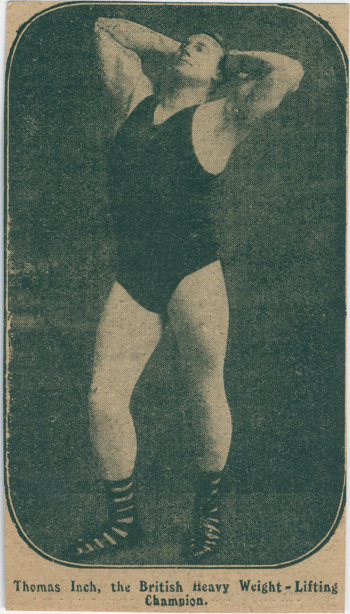
Thomas Inch was born in Scarborough, England, on December 27, 1881, and became known as the Scarborough Hercules. He lived until December 12, 1963, dying at 81. Grip historian David Horne published transcriptions of his birth and death certificates, giving us a solid starting point for the man behind the name. Biographical records
Before getting into the rumors, I think Inch deserves credit for something: he was an accomplished strongman.
He won the British heavyweight weightlifting championship in 1910. The competition included one-hand and two-hand lifts, which looked different from the Olympic lifting we know today. Edward Aston beat him the following year, but that doesn’t erase the championship. 1910 championship, 1911 competition
Inch also made a career out of teaching people how to train. He published books, promoted exercise equipment, and helped popularize adjustable weights. His writing covered boxing, running, skipping, and general athletic preparation alongside lifting. He worked with boxers including Gunner Moir and Bombardier Billy Wells. Equipment history, Training background
That part can get lost when we only talk about the dumbbell. He was an athlete, a teacher, and a businessman who understood how to get people’s attention.
And that dumbbell got plenty of attention.
What makes the dumbbell so hard to lift?
The famous heavy bell is generally listed at 172 pounds, 9 ounces, or about 78.3 kilograms. Its handle is short and thick, with commonly reported diameters around 2⅜ to 2½ inches, depending on the source and whether we’re talking about the original or a replica. Historical specifications, Measurement discussion
That handle makes a huge difference.
You can’t wrap your fingers around it like a normal dumbbell. As you pull, you also have to control its tendency to roll out of your hand. Being strong enough to move the weight doesn’t necessarily mean you can keep hold of it.
Grip athlete Ben Edwards described lifting a replica while using his other hand to stop the rotation, even though he was still well short of lifting it unassisted. That helps explain why rotation comes up so often in discussions about the Inch. Edwards’ account
There’s another detail we need to keep straight: what does “he lifted it” actually mean?
Did someone barely break it off the floor? Stand up with it? Clean it to the shoulder? Put it overhead?
Those are different achievements. Using two hands to get it to the shoulder before pressing it is also different from cleaning it with one hand.
Keep that in mind whenever you hear an incredible Inch dumbbell story.
The famous challengers—and the different bells
The stories surrounding Inch include some major names in old-time strength.
Arthur Saxon supposedly tried and failed. Edward Aston reportedly questioned which dumbbell Inch was using. Another account says Maxick backed out of a challenge because of uncertainty over the bell he would have to lift. These stories survive in later historical accounts, but they don’t all come with the same quality of evidence. Challenge accounts
That question about which dumbbell is a big part of this history.
Several bells are associated with Inch. A commonly repeated list includes weights around 75, 140, 153, and 172 pounds, although the exact inventory and dates are disputed. Multiple-bell history
Having different weights doesn’t automatically mean he was cheating. But it does mean we shouldn’t assume every picture or performance shows the famous heavy bell.
Take the well-known 1939 film. David Horne points out end caps or collars on the filmed dumbbell that he says aren’t present on the original 172-pound bell. That’s a specific reason to question what we’re watching. His estimates of how much the filmed bell weighed, however, were estimates—not a weigh-in. Film analysis
For me, that’s a stronger reason to question the footage than simply saying, “He made it look too easy.”
| Bell | What the accounts describe | What to keep separate |
|---|---|---|
| Original heavy bell | Generally listed at 172 pounds, 9 ounces, about 78.3 kilograms, with a short, thick handle. | A floor lift, clean, and overhead lift are different feats. |
| Replicas | Modern versions let more athletes attempt the challenge, including Mark Henry's 2002 clean and press. | Original and replica handle measurements vary by source; a replica lift should be identified as such. |
| Demonstration and film bells | Several lighter bells are associated with Inch. Horne identifies end caps or collars in the 1939 film that he says the original lacks. | The filmed bell's weight estimates were not a weigh-in. Not every picture or performance establishes use of the heavy original. |
What about the nail and the disappearing weight?
These were two of the stories I wanted to dig into.
First, the nail.
The basic rumor is that Inch used a nail, pin, or similar attachment to keep the dumbbell from rotating out of his hand. Different versions describe different setups, including a projecting nail or a pin connected to a wrist brace.
An older grip-history discussion also preserves a story involving a ring in the handle. That same discussion offers another explanation for the reported hole: it was a vent left from manufacturing. Neither explanation comes with enough documentation to settle the question. Historical discussion
Could stopping the rotation help someone lift the bell? Yes.
Does that prove Inch used a hidden device? No.
That’s the distinction I want to keep clear. The nail story is an interesting theory, but it remains unverified. A hole in a handle, by itself, doesn’t tell us what it was used for.
Then there’s the story that he let sand, shot, or some other weight out before lifting it.
I haven’t found reliable documentation showing him doing that with the original 172-pound dumbbell. Later discussions describe the filmed prop as hollow or adjustable, but that still doesn’t show him secretly emptying it. Discussion of the film bell
Lighter duplicates, adjustable equipment, and the original heavy bell can easily get mixed together as a story gets passed around. We have to keep those things separate.
There’s enough here to question some of the performance claims. There isn’t enough to confidently say every rumored trick actually happened.
How the challenge outlived the showman
Eventually, other lifters put dents in the “unliftable” reputation.
David P. Willoughby’s account describes successful attempts in Aberdeen in 1956, including Henry Gray bringing the bell to chest height. That isn’t an overhead lift, but it matters when someone claims nobody else could move it. Willoughby’s account
Replicas gave more people a chance to train for the challenge. Bruce White’s published records include a one-hand deadlift with a 172-pound replica in 1983. Bruce White’s records
Then came Mark Henry on June 22, 2002.
At the Oldetime Barbell & Strongman Association banquet, Henry cleaned and pressed an Inch replica. IronMind reported the lift that same day as a first. The distinction matters: this was the clean-and-overhead achievement with a replica, not the first time anyone had picked an Inch bell off the floor. Report of Henry’s lift
That’s what I like about this history. We can debate Inch’s performances, question the stories, and try to sort out which bell was which. But the challenge itself is still there.
Knowing all the rumors won’t make that thick handle any easier to hold.
Thomas Inch made the dumbbell famous. The lifters still trying to pick it up are keeping the story going.