Training & Recovery
Soreness, Fatigue, or Injury? Knowing When to Push and When to Adjust
Understand soreness, performance trends and symptoms that deserve assessment. Practical training decisions for lifters and strongman athletes.
The practical take.
- What it may help with
- Review symptoms, movement and comparable performance together. Soreness alone is not a workout score or diagnosis.
- What the evidence supports
- Pain scores, warm-up improvement and successful reps cannot rule out injury. Coaching examples are not rehabilitation prescriptions.
- Joel’s approach
- Keep reps controlled, adjust provoking work and seek assessment when warranted. Immediate-care symptoms take priority.
You trained legs yesterday. Today, the stairs have become a personal enemy. Does that mean you had an incredible workout? Maybe. It might also mean you did a pile of unfamiliar work your legs were not ready for.
Now picture a different session. Nothing is particularly sore, but every warm-up feels heavy, your technique is slipping, and the weight you normally own is winning the argument.
Both situations tell you something. Neither tells you everything.
Soreness is feedback. It is not your workout score, your muscle-growth meter, or a diagnosis. The useful question is what you should do next.
And my rule stays the same: you never want to miss reps in training. Choose work you can complete with the intended technique. Adjust before the session turns into a string of failed attempts.
One accidental miss does not erase your progress. It is information. Use it instead of demanding a rematch with the same weight.
The quick lift
- Sore does not automatically mean injured. Not sore does not automatically mean recovered.
- Watch symptoms, movement, and performance together.
- One rough session can justify adjusting today. Repeated problems deserve a wider look.
- Feeling better during warm-ups does not rule out injury.
- Strongman events count when you modify training.
- Some symptoms need assessment. A few need immediate medical care—not another warm-up set.
Three different questions—not three perfect boxes
Soreness, fatigue, and injury can overlap. An injured athlete can feel tired. A sore athlete can still perform well. A lifter with little soreness can be poorly recovered.
| What you notice | What it might tell you | What it does not prove |
|---|---|---|
| Delayed muscle tenderness after unfamiliar work | A typical soreness response is possible | How much damage occurred or muscle will grow |
| Familiar loads consistently feel harder | Readiness has changed | The cause is definitely training fatigue |
| Localized pain repeatedly triggered by a movement | That movement or area needs attention | Which tissue is involved |
| A pop with sudden weakness, bruising, or loss of function | A significant injury is possible | The diagnosis without assessment |
Pain is real, but pain intensity is not a direct measurement of structural damage. The International Association for the Study of Pain recognizes that biological, psychological, and social factors influence the experience. That is a reason to assess the whole picture, not dismiss somebody's pain. [1]
Soreness is a lousy trophy
Delayed-onset muscle soreness—DOMS—often follows unfamiliar exercise, particularly demanding eccentric work: the lowering or lengthening part of a movement. It develops after training, commonly becomes most noticeable over the following one to three days, and usually improves over subsequent days. The timing varies. [2]
A new exercise, extra loading repetitions, or a return after time off can leave you surprisingly sore. That does not make those sessions more productive than the familiar work you recover from comfortably.
A controlled eccentric-exercise study found poor relationships between soreness and other markers of muscle damage. A later systematic review and meta-analysis also found that soreness was poorly associated with subsequent strength loss. [3], [4]
Translation: how sore you feel and how impaired you are do not necessarily match.
Soreness is useful when it tells you that a dose was unusually demanding or that discomfort is changing your movement. It is less useful when you use it to decide whether yesterday “counted.”
A small study following ten young men through resistance training found that the early protein-synthesis response, when muscle damage was greatest, was not related to eventual hypertrophy. That relationship appeared later as damage diminished. This does not make all muscle damage bad; it does undermine the idea that you should chase damage to grow. [5]
Being unable to sit on the toilet is not a hypertrophy measurement.
Read the logbook and the athlete
A review of 56 studies found that subjective measures—including fatigue, mood, and stress—often responded to training-load changes more sensitively than commonly used objective measures. How you feel belongs in the discussion. [6]
So does what you can do.
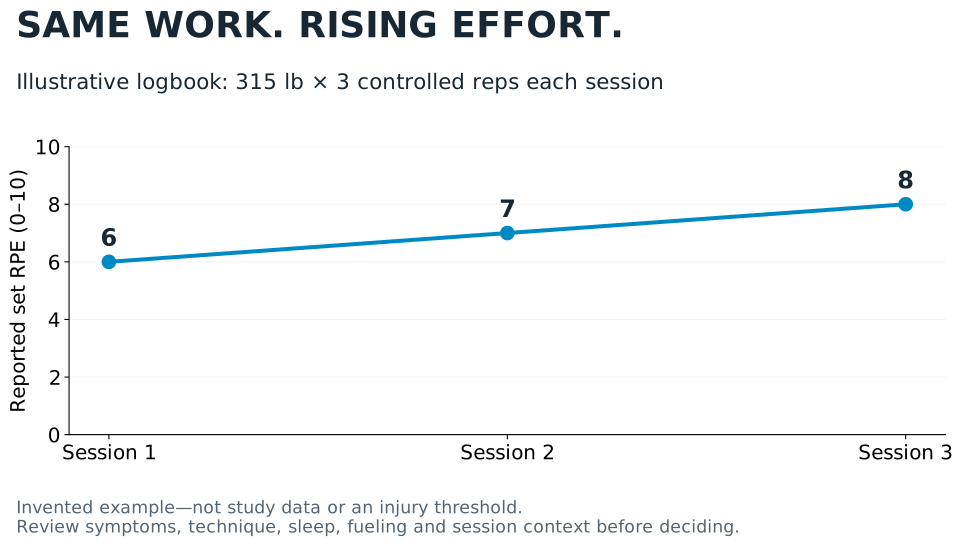
Track familiar submaximal work, the effort it requires, movement quality, and the context around the session. Compare your own performance under reasonably similar conditions.
A farmer's run on rough concrete with unfamiliar handles is not the same test as a run on smooth turf with your usual equipment. A squat after hard events is not the same as a fresh squat.
View full-size figure 1 · PNG version
| Pattern | Practical response |
|---|---|
| One poor session | Adjust the day and watch what follows |
| Several declining sessions across lifts | Review total work, sleep, fueling, illness, and life demands |
| One movement repeatedly causes pain or changes technique | Modify that movement and consider assessment |
| Persistent unexplained problems despite backing off | Investigate beyond the training program |
This is coaching guidance, not a diagnostic scoring system. Good performance does not rule out injury, either. Finishing a set is not medical clearance.
“It loosens up” is not the whole answer
A gradual warm-up can help you observe how comfortable movement feels. It is not permission to repeatedly load a suspected acute injury until you get the answer you wanted.
Watch the whole response: during the session, afterward, and the following morning. Does discomfort rise with each set? Are you shifting away from one side? Is normal function worse later?
Tendon problems can involve morning stiffness, activity-related symptoms, and worse pain the day after exercise. AAOS describes those patterns in Achilles tendinopathy. [7]
And pain settling is not always proof of healing. AAOS notes that the pain of a distal biceps rupture may subside quickly even though the tendon remains detached. [8]
If you felt a pop and developed sudden weakness or bruising, a quieter pain signal does not cancel that event.
When adjusting and continuing can make sense
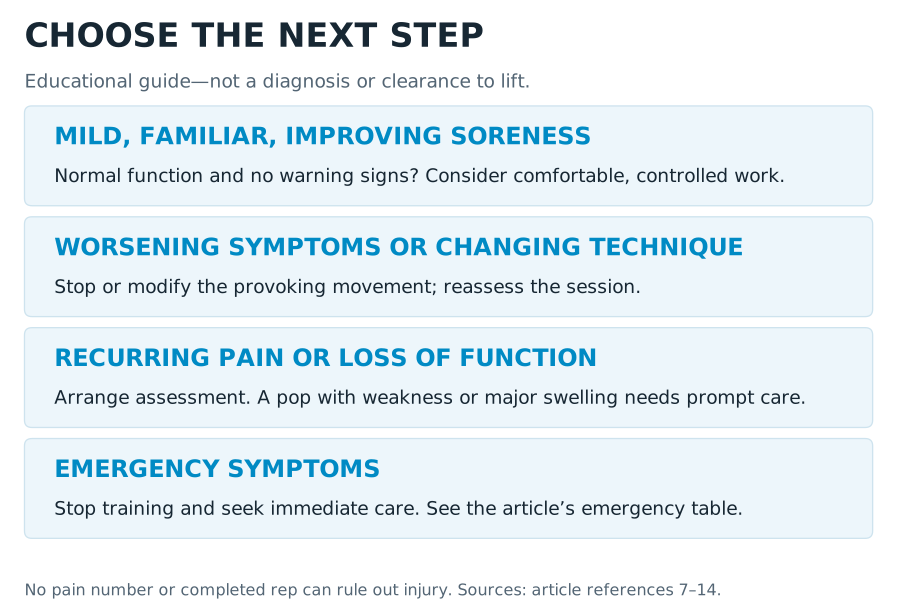
For mild, familiar muscle soreness that is improving, with normal daily function and no concerning symptoms, comfortable training may be reasonable. Keep it controlled. You do not have to prove you can survive the original plan.
Possible adjustments include fewer sets, less weight, a tolerable variation, training an unaffected area, or replacing hard work with comfortable activity. Stop the provoking movement if symptoms increase or execution changes.
View full-size figure 2 · PNG version
Complete rest is not the answer to every persistent painful condition. In a randomized study of 38 people with diagnosed Achilles tendinopathy, continuing tendon-loading sport under a monitored rehabilitation program did not demonstrate worse outcomes than temporarily stopping those activities. [9]
That does not give every lifter a universal “pain under 5 out of 10 is safe” pass. A diagnosed tendon problem under rehabilitation is different from new pain with an unknown cause. Follow the plan appropriate to the condition.
No missed reps. No injury tests disguised as training.
Enter the set expecting to complete the prescribed work with the intended execution. If the warm-up changes that expectation, change the working weight.
Do not max out to check whether you are recovered. Do not repeat a failed attempt to prove nothing is wrong. Do not let somebody shouting behind you make the decision for your shoulder.
My no-missed-reps rule is a coaching standard. It is not a scientific claim that every accidental miss causes injury. The point is to select useful work and make adjustments before technique or control falls apart.
Success might mean completing the planned session. It might mean doing three clean sets instead of five. It might mean stopping the movement and getting assessed. The long-term goal is still getting stronger.
Strongman: count all the work hitting the problem
You cannot reduce elbow loading by skipping curls while keeping heavy stones, sandbags, and every pulling event unchanged.
Look at implement weight, total distance, picks, loading reps, holding time, and grip demands. Changing the name of the exercise does not remove its physical demands.
| Situation | Coaching adjustment to consider |
|---|---|
| Ordinary leg soreness with normal movement | Shorter, comfortable work rather than an exhausting medley |
| General performance decline across events and lifts | Reduce total workload and review recovery |
| Recurring pain during picks or loading | Stop or modify the provoking work; arrange assessment if recurring or limiting |
| Sudden pop with weakness or loss of function | Stop and seek prompt medical assessment |
These are decision examples, not injury-specific rehabilitation prescriptions. A replacement exercise is useful only if it is actually tolerable.
When to get assessed
Arrange sports-medicine or physical-therapy assessment for recurring localized pain that changes technique, limits training, or fails to improve with sensible modification. You do not need to wait until you cannot train at all.
Seek prompt medical assessment for worsening pain, substantial swelling or bruising, inability to bear weight or use the area normally, or a pop accompanied by sudden weakness, deformity, or loss of function. Fever or feeling unwell with a painful swollen area also warrants urgent medical advice. [10]
A strongman-specific example is a painful pop around the elbow followed by weakness or bruising during a stone or tire movement. A distal biceps injury is one possibility. Get assessed instead of testing it with another attempt. [11]
Symptoms that need immediate medical care
These situations are uncommon compared with ordinary soreness, but they should be clearly separated from routine training decisions.
| Symptom pattern | Action |
|---|---|
| Back pain with new bladder/bowel dysfunction, saddle-area numbness, or significant symptoms in both legs | Seek emergency assessment [12] |
| Severe, escalating limb pain out of proportion to the event, especially with tense swelling | Seek emergency assessment for possible acute compartment syndrome; do not wait for numbness [13] |
| Tea- or cola-colored urine, unexpectedly severe muscle pain, or profound weakness after exertion | Seek immediate medical care for possible rhabdomyolysis; all symptoms need not be present [14] |
| An injured limb that is deformed, cold, discolored, or newly numb | Seek emergency assessment [10] |
Rhabdomyolysis symptoms can appear hours or days later. Normal-looking urine does not rule it out. Do not assume unusually severe symptoms are just dehydration and attempt to manage them with extra water alone. [14]
If emergency symptoms are present, use emergency services when needed. These lists are escalation guidance, not a complete diagnostic checklist.
Your athlete action plan
View full-size figure 3 · PNG version
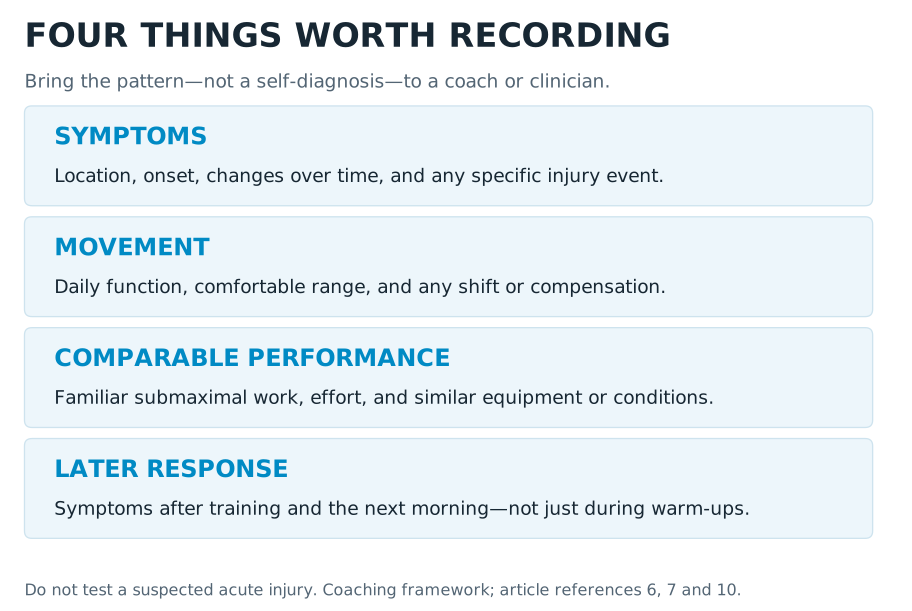
- Describe the problem. Where is it, when did it begin, and was there a specific incident?
- Check function. Consider normal daily movement and comfortable submaximal work when appropriate. Do not test a suspected acute injury.
- Compare the pattern. Look at similar sessions, symptoms afterward, and the following morning.
- Choose the next step. Continue tolerable work, adjust the session, arrange assessment, or seek immediate care according to the symptoms.
- Keep reps successful. You do not owe the program a failed attempt.
You do not need to fear every ache. You also do not need to turn every ache into a toughness contest. Train with enough judgment to keep building.
Sources and evidence notes
This is general training education, not a diagnosis or an individual rehabilitation plan. Monitoring tables and workout examples are coaching applications; no pain score or performance threshold universally separates safe training from injury.
- IASP. Revised definition of pain. https://www.iasp-pain.org/publications/iasp-news/iasp-announces-revised-definition-of-pain/
- From Routine Blood Tests to Metabolomics: A Contextual Framework for Interpreting Biomarkers of Training Load, Recovery, and Metabolic Stress in Athletes. https://pmc.ncbi.nlm.nih.gov/articles/PMC13414043/
- Nosaka et al. Delayed-onset muscle soreness does not reflect the magnitude of eccentric exercise-induced muscle damage. https://pubmed.ncbi.nlm.nih.gov/12453160/
- Appropriateness of indirect markers of muscle damage following lower limbs eccentric-biased exercises: A systematic review with meta-analysis. https://pmc.ncbi.nlm.nih.gov/articles/PMC9282447/
- Damas et al. Resistance training-induced changes in integrated myofibrillar protein synthesis are related to hypertrophy only after attenuation of muscle damage. https://doi.org/10.1113/JP272472
- Saw et al. Monitoring the athlete training response: subjective self-reported measures trump commonly used objective measures. https://pubmed.ncbi.nlm.nih.gov/26423706/
- AAOS. Achilles Tendinitis. https://www.orthoinfo.org/diseases--conditions/Achilles-tendinitis
- AAOS. Why Does My Arm Look Like Popeye's? https://www.orthoinfo.org/en/diseases--conditions/ortho-pinion-why-does-my-arm-look-like-popeyes/
- Silbernagel et al. Continued sports activity, using a pain-monitoring model, during rehabilitation in patients with Achilles tendinopathy. https://pubmed.ncbi.nlm.nih.gov/17307888/
- NHS. Sprains and strains. https://www.nhs.uk/conditions/sprains-and-strains/
- Hospital for Special Surgery. Distal Biceps Tendon Tear: Causes, Symptoms and Treatments. https://www.hss.edu/health-library/conditions-and-treatments/distal-biceps-tendon-tear
- NHS. Back pain. https://www.nhs.uk/conditions/back-pain/
- AAOS. Compartment Syndrome. https://www.orthoinfo.org/diseases--conditions/compartment-syndrome/
- CDC. Signs and Symptoms of Rhabdomyolysis. https://www.cdc.gov/niosh/rhabdo/signs-symptoms/index.html