Training & Recovery
Deloads: When Backing Off Helps You Get Stronger
Plan smarter deloads, recognize fatigue, reduce volume and effort, and manage strongman event work while keeping reps clean and successful.

The practical take.
- What it may help with
- Reduce training stress when the pattern of performance and recovery calls for it. Keep reps clean and successful.
- What the evidence supports
- Research is limited. Complete cessation, reduced training and competition tapers are different; sample percentages are coaching starting points.
- Joel’s approach
- Review familiar loads, effort, sleep and event work. Choose a useful reduction, then reassess without repaying skipped sets.
You know the workout. The warm-ups feel like working sets. Your working sets feel like somebody welded the plates to the floor. You add more caffeine and tell yourself you need to get tougher.
Maybe you need to get better at recovering.
Training hard matters. So does being ready to benefit from that training. A deload gives you a temporary reduction in work so you can return to productive lifting. It is a tool, not a mandatory holiday every fourth week—and not a magic trick that turns seven easy days into twenty pounds on your deadlift.
My rule: you never want to miss reps in training. Pick work you can complete with good execution. Build strength through successful reps.
That is a coaching standard, not a claim that one accidental miss ruins your progress. If you miss, use the information. Adjust the load or end the set. Do not keep taking the same failed attempt because your ego wants a different answer.
The quick lift
- A deload reduces training stress. You can keep training while doing less.
- Watch performance and recovery together. One uninspired Monday does not tell the whole story.
- Reduce sets, effort, load, or training frequency according to what needs recovering.
- Keep reps clean. A deload has no room for missed reps, grinders, or surprise PR attempts.
- Strongman events count. Light deadlifts followed by brutal yoke runs are still a hard week.
- Exact deload schedules and percentages are coaching choices, not settled scientific laws.
What are we actually deloading?
A 2023 expert-coach consensus described deloading as temporarily reducing training stress to manage fatigue and improve readiness for subsequent training. Useful framework. It does not prove one schedule works best for everyone. [1]
| Approach | Main job |
|---|---|
| Deload | Prepare for the next stretch of productive training |
| Competition taper | Prepare to perform on a particular competition day |
| Complete training break | Stop training temporarily |
| Rehabilitation | Restore capacity while managing an injury |
These can overlap, but they are not interchangeable. A tired lifter, an athlete four days from a contest, and someone with a painful shoulder may need different plans.
What does the research actually say?
Deloading has a stronger coaching tradition than experimental research base. Two studies help explain why the details matter.
The 2024 study tested a full week off. Thirty-nine resistance-trained men and women followed a nine-week program. One group stopped resistance training during the middle week. Continuous training produced greater lower-body strength improvements, while muscle growth, power, and local endurance were broadly similar. The break did not demonstrate a psychological advantage either. [2]
That challenges the idea that a scheduled week off automatically improves results. It does not show that an exhausted strongman should push through another brutal event session. A full break is also different from keeping the lifts and reducing the work.
The 2026 study tested reduced training. Nineteen untrained men trained their limbs under different conditions over eight weeks. During weeks four and eight, the deload condition used fewer sets and only one weekly session. Researchers found no statistically significant differences between conditions in muscle growth or 10-repetition-maximum improvements. [3]
Encouraging, but small. Beginners doing curls and leg extensions are not experienced strongmen moving a heavy yoke. Opposite-limb designs also cannot neatly isolate whole-body recovery, and no significant difference does not prove exact equivalence.
The honest conclusion: lighter periods can fit into productive training. We have not established that routine deloads produce superior long-term gains for every lifter.
Do not sell “muscle resensitization” or an automatic nervous-system reset as a proven bonus.
Planned or reactive? Use a plan that can listen
A planned deload is on the calendar. A reactive deload responds to how training is going.
A survey of 246 competitive strength and physique athletes who currently used deloads found that 47.2% planned them proactively, 13.4% used an autoregulated approach, and 39.4% combined approaches. Their average deload lasted about six days and occurred roughly every six weeks. Only nine participants were strongman athletes. These are descriptions of practice, not evidence of an optimal schedule. [4]
| Approach | Useful when | Watch out for |
|---|---|---|
| Planned | A hard block, travel, or work stress is predictable | Taking unnecessary breaks from productive training |
| Reactive | You track training honestly and can adjust the schedule | Waiting until everything falls apart |
| Combined | You want structure with room for judgment | Treating a checkpoint as an automatic command |
My preference is a recovery checkpoint. Review how the block is going, then decide whether you need a lighter session, a lighter week, or no change. That is coaching judgment, not a scientifically crowned winner.
If the calendar says week four and you are moving well, progressing, and recovering, the number four is not a medical condition. If week three has you dragging through every session, the calendar does not get the final vote either.
Tired, bored, or actually struggling to recover?
Motivation is worth listening to. It is not the only vote.
A review of 56 studies found that subjective measures such as perceived fatigue, stress, and mood often tracked training-load changes more sensitively than commonly used objective measures. How you feel belongs in the logbook. [5]
Use it alongside actual lifting. Track familiar loads, effort, sleep, soreness, pain, and outside stress. Compare with your own normal—not somebody else's recovery score.
View full-size figure 1 · PNG version
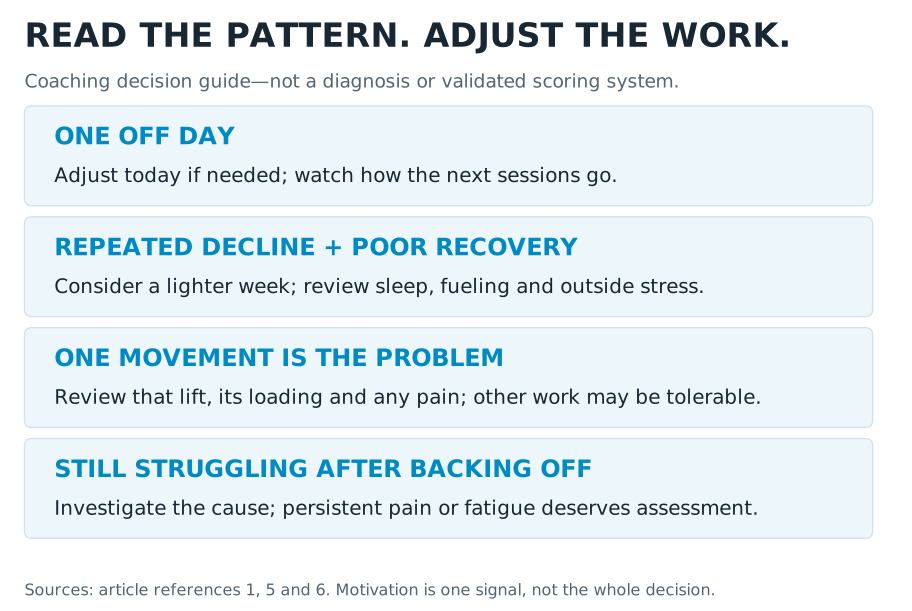
One bad day might justify adjusting that session. Several declining sessions, familiar loads feeling harder, and poor recovery make a stronger case for reducing the week. If only one movement is affected, investigate that movement instead of automatically shutting down everything.
And stop calling every rough workout “overtraining.” The ECSS/ACSM consensus describes a more complex condition involving persistent underperformance and exclusion of other causes. No single marker diagnoses it. Persistent unexplained fatigue, pain, or declining performance deserves proper assessment, especially when reducing training does not help. [6]
Cut the work without turning it into another test
“Intensity” can mean two different things:
Load: how heavy the weight is relative to your maximum.
Effort: how close you take the set to failure.
Light weight taken to failure can still be exhausting. Acute resistance-training research shows that stopping further from failure can reduce fatigue and speed recovery. That supports leaving reps in reserve; it does not identify an exact deload prescription. [7]
Here is a coaching starting point—not a universal research-proven dose:
| Variable | Possible adjustment |
|---|---|
| Duration | About one week, then reassess |
| Working sets | Reduce by roughly 30–50% |
| Working weight | Keep manageable loads or reduce usual working weights about 10–20% |
| Effort | Leave approximately 3–5 good repetitions in reserve |
| Sessions | Keep shorter sessions or remove a day when useful |
| Exercises | Familiar, comfortable movements |
| Extra work | Remove exhausting finishers, forced reps, and maximal attempts |
You do not have to apply every adjustment at once. A lifter overloaded by accessory volume might mainly cut sets. Someone feeling beat up everywhere may need fewer sessions and lighter weights too. A 2026 practical review likewise describes multiple ways to lower training stress rather than one mandatory formula. [8]
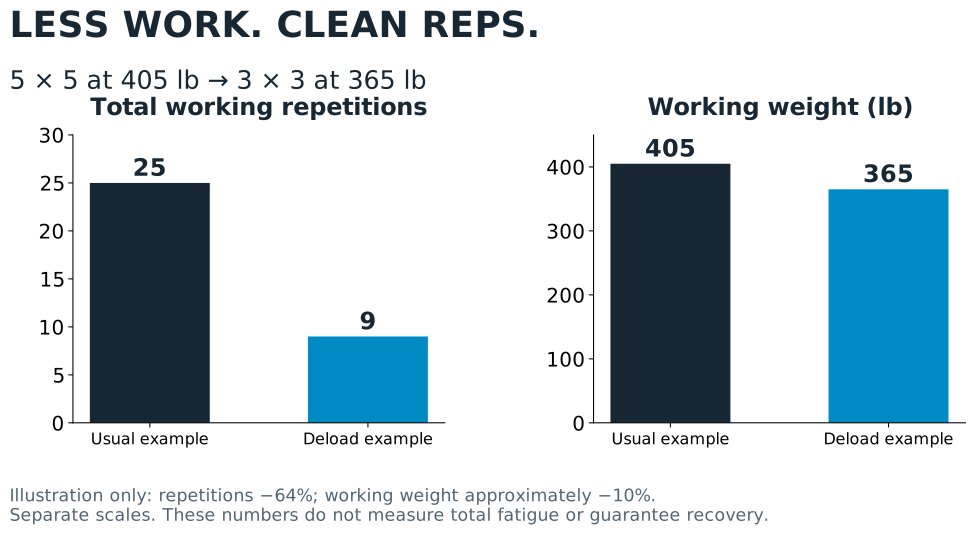
Here is an intentionally substantial reduction for illustration:
Usual squat work: 5 sets of 5 at 405 pounds.
Possible deload: 3 sets of 3 at 365 pounds, only if those reps feel comfortable and controlled.
View full-size figure 2 · PNG version
The rep reduction here is larger than the general starting range because both sets and reps per set decrease. That can be appropriate when you deliberately need a bigger reduction. If the suggested weight still feels rough, lower it. The example does not outrank the athlete.
No missed reps. Especially this week.
You should enter a training set expecting to complete the prescribed reps with the intended technique. That applies during normal training too.
Heavy work can be demanding without turning every session into a max-out. Leave the failed attempts for the highlight reels you are not trying to make.
On a deload, choose loads that make success obvious. Stop before technique deteriorates. If a warm-up feels unexpectedly difficult, adjust before the working set. A missed rep is a reason to reassess, not an invitation to add ammonia and repeat it four times.
This is my training philosophy. Research on failure is not identical to research on accidental missed attempts, and it does not establish that one miss automatically causes injury or erases adaptation. The point is to manage the session so misses are not part of the plan.
Strongman: deload the implements too
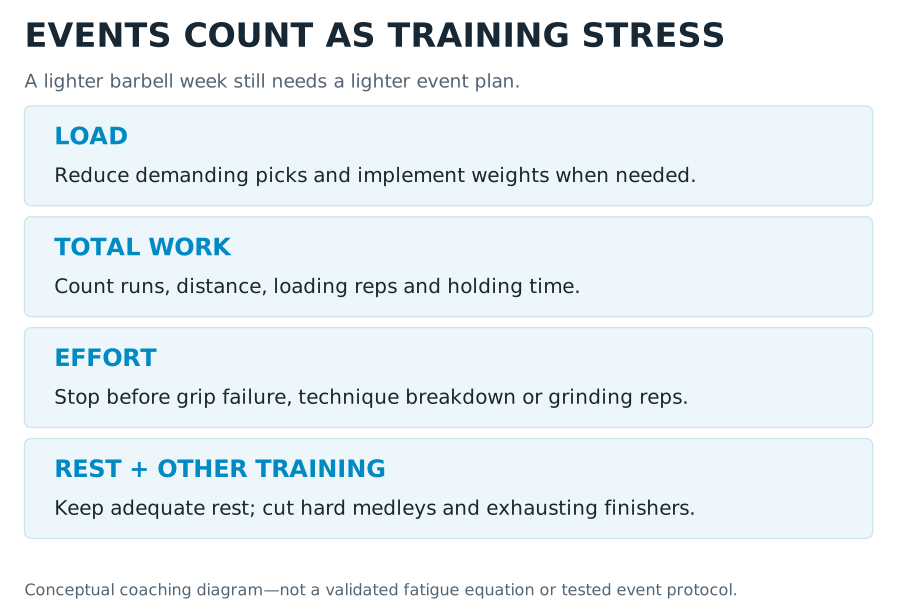
You cannot recover from a heavy week by hiding another heavy week on Saturday.
Count picks, loads, distance, holds, rest periods, and grip demands. A lighter implement can still produce a brutal session when you double the distance and cut the rest.
| Event | Possible deload change |
|---|---|
| Yoke | Fewer short, comfortable runs; omit maximal picks |
| Farmer's walk | Less load and distance; stop well before grip gives out |
| Stones or sandbags | Fewer loads with manageable implements |
| Log or axle | Fewer clean-and-press reps; no grinders |
| Truck pull or hard sled work | Omit or substantially reduce hard efforts |
| Grip work | Reduce heavy holds and maximal attempts |
| Conditioning | Comfortable activity if tolerated; reduce hard intervals and medleys |
These are practical applications, not protocols validated in strongman trials. Preserve useful technique practice without making recovery compete with another exhausting event day.
View full-size figure 3 · PNG version
A contest taper is a separate job
Competition preparation needs its own timeline. A powerlifting review described volume reductions around 30–70% over one to two weeks, with load managed to preserve readiness and a short cessation period before competition. That is tapering guidance, not a mandatory recipe for every deload. [9]
A survey of 454 strongman athletes reported an average taper volume reduction of approximately 45.5%, with training stopping around 3.9 days before competition. Those numbers describe what athletes reported doing; they do not prove an ideal taper. [10]
Your final hard event session and your final easy technique session do not have to occur on the same day. Plan the taper around the contest and your response to training.
Come back ready. Do not repay the skipped sets.
Judge the deload by how normal training feels afterward: more manageable effort, better execution, and enough readiness to train productively. A PR is not required.
Do not cram missed volume into the following week. It was removed on purpose. Resume at a manageable workload and build from there.
If the same program repeatedly buries you, change the program. Look at normal volume, effort, events, conditioning, sleep, fueling, and life demands. A light week cannot permanently fix a workload you never recover from.
The athlete action plan: review the pattern, choose the smallest useful reduction, keep successful reps, count event work, and reassess when normal training resumes.
Train hard. Complete your reps. Give yourself enough room to come back and do it again.
Sources and research notes
Research supports the underlying fatigue-management principles more strongly than any exact deload schedule. All sample percentages, readiness decisions, and event modifications above are coaching guidance. This article provides general training education, not an individual rehabilitation plan.
- Bell et al. (2023). Integrating Deloading into Strength and Physique Sports Training Programmes: An International Delphi Consensus Approach. https://doi.org/10.1186/s40798-023-00633-0
- Coleman et al. (2024). Gaining more from doing less? The effects of a one-week deload period during supervised resistance training on muscular adaptations. https://pubmed.ncbi.nlm.nih.gov/38274324/
- Pancar et al. (2026). Effects of deload periods in resistance training on muscle hypertrophy and strength endurance in untrained young men using a randomized within subject design. https://pubmed.ncbi.nlm.nih.gov/41730991/
- Bell et al. (2024). Deloading Practices in Strength and Physique Sports: A Cross-sectional Survey. https://doi.org/10.1186/s40798-024-00691-y
- Saw et al. (2016). Monitoring the athlete training response: subjective self-reported measures trump commonly used objective measures. https://pubmed.ncbi.nlm.nih.gov/26423706/
- Meeusen et al. (2013). Prevention, diagnosis, and treatment of the overtraining syndrome: ECSS/ACSM joint consensus statement. https://pubmed.ncbi.nlm.nih.gov/23247672/
- Pareja-Blanco et al. (2017). Acute and delayed response to resistance exercise leading or not leading to muscle failure. https://pubmed.ncbi.nlm.nih.gov/26970332/
- A Practical Approach to Deloading: Recommendations and Considerations for Strength and Physique Sports. Strength & Conditioning Journal (2026), 48(4), 413–423. https://doi.org/10.1519/SSC.0000000000000910
- Travis et al. (2020). Tapering and Peaking Maximal Strength for Powerlifting Performance: A Review. https://pubmed.ncbi.nlm.nih.gov/32917000/
- Winwood et al. (2018). Tapering Practices of Strongman Athletes. https://pubmed.ncbi.nlm.nih.gov/29373426/