
Legends & History
Paul Anderson — The Man Who Redefined Strength
1932–1994 | Olympic Gold Medalist | World Champion | The Dixie Derrick
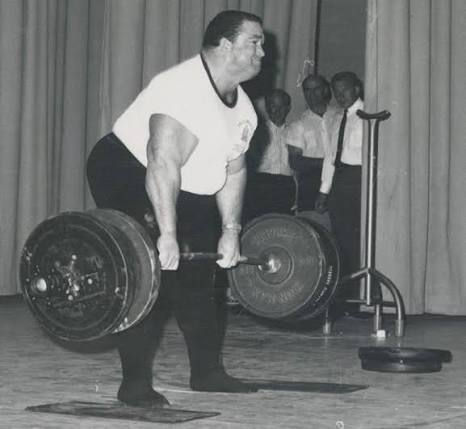
Before modern strongman competitions, million-dollar gyms, calibrated plates, and social media lifting records, there was Paul Anderson.
A 5'9", 350-pound powerhouse from Georgia who was moving weights most people couldn't even comprehend in the 1950s.
Anderson wasn't just another big guy who could squat. He was a world champion, an Olympic gold medalist, and arguably one of the strongest human beings ever to walk the planet.
Some of his lifts became legendary. Others are still debated today.
Either way, the numbers are absolutely ridiculous.
From homemade weights to world champion
Born in Toccoa, Georgia, in 1932, Anderson battled a kidney condition known as Bright's disease during childhood.
He eventually earned a football scholarship to Furman University but discovered that his real talent wasn't on the football field. It was underneath a barbell.
After leaving college, Anderson connected with legendary deadlifter Bob Peoples and started developing his strength using homemade equipment.
We're talking concrete-filled safes, improvised weights, and whatever heavy objects he could find.
No fancy machines. No performance-tracking apps. Just heavy iron and hard work.
By 1952, he was already performing a reported 660-pound squat at a weightlifting competition.
And he was just getting started.
The American who shocked the Soviets
During the Cold War, international weightlifting was serious business. The Soviet Union was a powerhouse, and lifting was about more than medals. It was national pride.
In 1955, Anderson traveled to Moscow and became the first man credited with pressing more than 400 pounds overhead in international competition.
Think about that for a second.
More than 400 pounds pressed overhead in the competition clean and press, decades before today's lifting platforms.
The Russians reportedly called him Chudo Prirody — a wonder of nature.
Later that year, Anderson won the World Heavyweight Championship in Munich, Germany, defeating the competition by an enormous margin.
The rest of the world had officially been put on notice.
1956 Olympics — three attempts to make history
The 1956 Melbourne Olympics should have been a walk in the park for Anderson.
Instead, he became seriously ill with strep throat and a high fever before competing.
Weakened and lighter than normal, he found himself battling Argentina's Humberto Selvetti for the gold medal.
Coming into the clean and jerk, Anderson was behind.
He needed 413 pounds (187.5 kg) to stay alive.
First attempt: Miss.
Second attempt: Miss.
Third attempt: Success.
Anderson finished with a 500 kg (about 1,102-pound) three-lift total—press, snatch, and clean and jerk—tying Selvetti. Because Anderson weighed less, he took home Olympic gold.
Imagine being sick, having the entire competition come down to one final lift, and still finding a way to get it done.
That's a different level of mental toughness.
The legendary strength numbers
This is where the story gets crazy.
Outside of Olympic weightlifting, Anderson became famous for strength feats that still get discussed in gyms today.
- 436-pound clean and jerk: World-record performance in 1955.
- 700 pounds for eight squats: Recalled by strength historian Terry Todd, who watched the exhibition in Dallas in 1964.
- 800 pounds for eight squats: Claimed by Anderson himself.
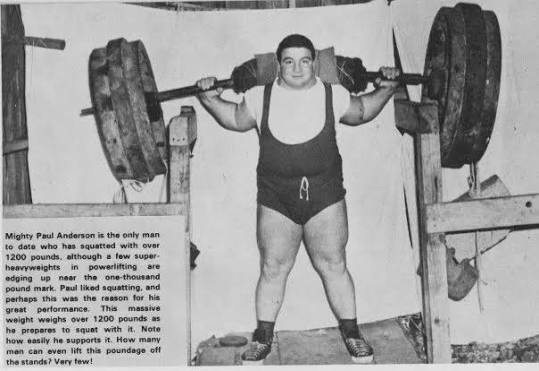
- 1,200-pound squat: One of his most famous unofficial claims.
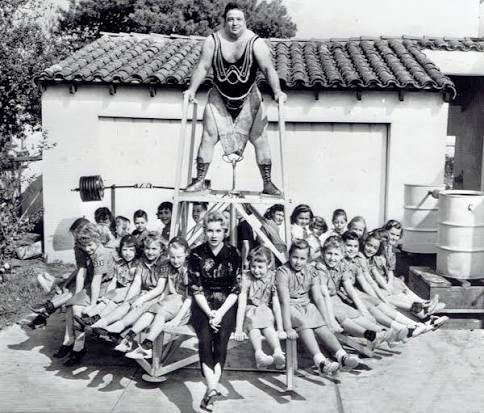
- 6,270-pound backlift: A legendary 1957 exhibition feat involving lifting a heavily loaded platform with his back.
Now, I'm a huge fan of old-school strength history, but we have to separate competition records from exhibition lifts.
The 1,200-pound squat was never established under modern competition standards, and the 6,270-pound backlift wasn't anything like a conventional deadlift or squat.
Does that mean Anderson wasn't ridiculously strong?
Absolutely not.
His Olympic results, world records, and eyewitness accounts of heavy squats speak for themselves.
How did Paul Anderson train?
What interests me most about Anderson isn't just how much weight he lifted. It's how he built that strength.
His training was built around progressive overload, tremendous squat strength, heavy partial movements, and getting comfortable with weights most people wouldn't dream of touching.
He used homemade equipment, trained through different ranges of motion, and emphasized basic movements rather than constantly chasing new exercises.
There's a lesson here for modern strength athletes.
You don't need 30 different machines and a complicated program to get strong.
You need consistency, progressive overload, good technique, recovery, and a willingness to put in years of work.
That doesn't mean we should copy every extreme method Anderson used. Training has come a long way since the 1950s.
But the fundamentals haven't changed nearly as much as people think.
A legacy bigger than lifting
Following his Olympic victory, Anderson became a professional strongman, traveling and performing exhibitions.
But one of his greatest accomplishments had nothing to do with a barbell.
In 1961, Anderson and his wife, Glenda, established the Paul Anderson Youth Home in Vidalia, Georgia, to help troubled young men.
He spent years using his strength, public appearances, and speaking engagements to support that mission.
Anderson continued battling kidney disease later in life and passed away on August 15, 1994, at the age of 61.
His legacy lives on through Olympic weightlifting, powerlifting, strongman history, and the young people his work helped.
My take
It's easy to get caught up in modern world records, super suits, specialty bars, and whatever incredible lift is circulating online this week.
But sometimes I think we forget about the guys who helped build strength sports before any of that existed.
Paul Anderson was moving unbelievable weight with homemade equipment more than 70 years ago.
Was every legendary lift legitimate? Probably not every number can be proven.
Was he one of the strongest men of his generation, and quite possibly one of the strongest humans who ever lived?
I think the evidence makes a pretty convincing argument.
Paul Anderson didn't just lift heavy weights. He helped establish what we thought was humanly possible.
And that's why his name deserves to be remembered in the Iron Library.
Research & historical references
- Olympedia — 1956 Olympic Heavyweight Results
- New Georgia Encyclopedia — Paul Anderson (1932–1994)
- Today in Georgia History — Paul Anderson
- Stark Center / Iron Game History — Paul Anderson's 1953 Hip Lift
- Paul Anderson, A Greater Strength, autobiographical source.
- Terry Todd — Paul Anderson, Iron Game History, August 1994 — includes Todd’s eyewitness account of the 700-pound squat set.
- Paul Anderson Memorial Park — Biography — family and training history.
- Schelfhout & Fair — The Goodwill Weightlifting Tours of 1955 — research on the Moscow tour.