Training & Recovery
Deep Sleep vs. REM: Which One Actually Builds Muscle?
Growth Hormone, Nervous-System Recovery, and Why Your Sleep Tracker Doesn't Tell the Whole Story
The practical take.
- What it may help with
- All sleep stages contribute to the night. Deep sleep, REM and lighter sleep support overlapping body and brain functions.
- What the evidence supports
- Athlete stage averages are descriptive, and older wearable stage estimates have limits. Neither establishes a stage target for extra muscle growth.
- Joel’s approach
- Joel prioritizes enough total sleep, a full consistent night and actual training performance over chasing a perfect sleep-stage score. Persistent symptoms deserve evaluation.
You wake up, check your watch, and see you only got 45 minutes of deep sleep. Now you're convinced your recovery is shot and today's squat session is going to suck.
But does that number actually tell you how well your muscles recovered?
Not even close.
There's a lot of talk about deep sleep, REM sleep, growth hormone, and recovery scores. Some of it is backed by science. Some of it is just fancy-looking bro science on a wristband.
What Actually Happens When You Sleep?
Your body moves through different sleep stages throughout the night. They all have a job.
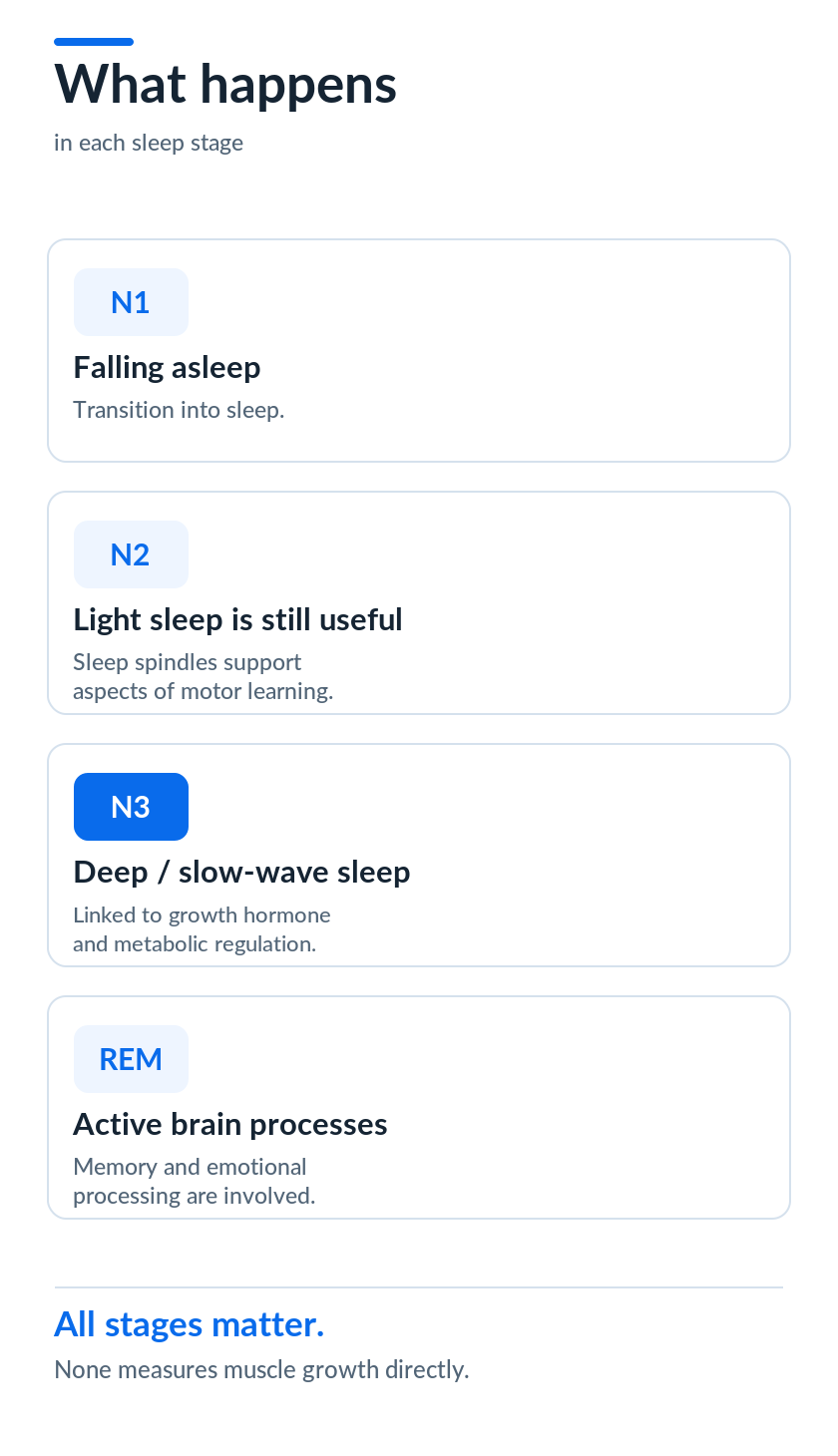
- N1: The transition from being awake to being asleep.
- N2: Light sleep, but not wasted sleep. Brain activity called sleep spindles is linked with memory and learning movements.
- N3 (deep sleep): Slow-wave sleep, strongly linked with a major growth-hormone pulse and important metabolic processes.
- REM: The stage associated with vivid dreams and important brain processes, including aspects of memory and emotional regulation.
The stages work together. Your body doesn't pick one and throw the others in the trash.
Read the graphic in text
N1 is the transition from wakefulness into sleep. N2 is light sleep; its spindles are linked with aspects of motor learning.
N3 is deep slow-wave sleep, linked with growth-hormone pulses and metabolic regulation. REM involves active brain processes, including aspects of memory and emotional regulation.
Functions overlap and all stages contribute. No individual stage directly measures muscle growth or recovery.
Deep Sleep and Growth Hormone: What's Real?
Here's the part the gym crowd loves. Deep sleep and growth hormone really are connected. In healthy young men, a major growth-hormone pulse often happens early in sleep, around slow-wave sleep.
That's legitimate physiology. But it doesn't mean 20 extra minutes of deep sleep equals 20% more gains.
A controlled study that disrupted deep sleep found worse insulin sensitivity, even though total sleep time was largely preserved. That's evidence deep sleep matters to your body. It wasn't a study showing bigger biceps or a higher deadlift after increasing N3.
Growth hormone showing up during deep sleep doesn't mean your watch can measure muscle growth.
What About REM and Nervous-System Recovery?
REM sleep plays a role in brain function, including aspects of memory and emotional processing. That matters when you're trying to show up focused, learn skills, and execute a lift under pressure.
But here's something interesting: N2 sleep matters for motor learning, too. Research links N2 sleep spindles with remembering learned movement sequences.
So the idea that deep sleep repairs muscles while REM exclusively repairs your nervous system is way too simple.
If you're a powerlifter, strongman, or grip athlete, you want the whole night—not just one stage.
How Much Deep Sleep Should Athletes Get?
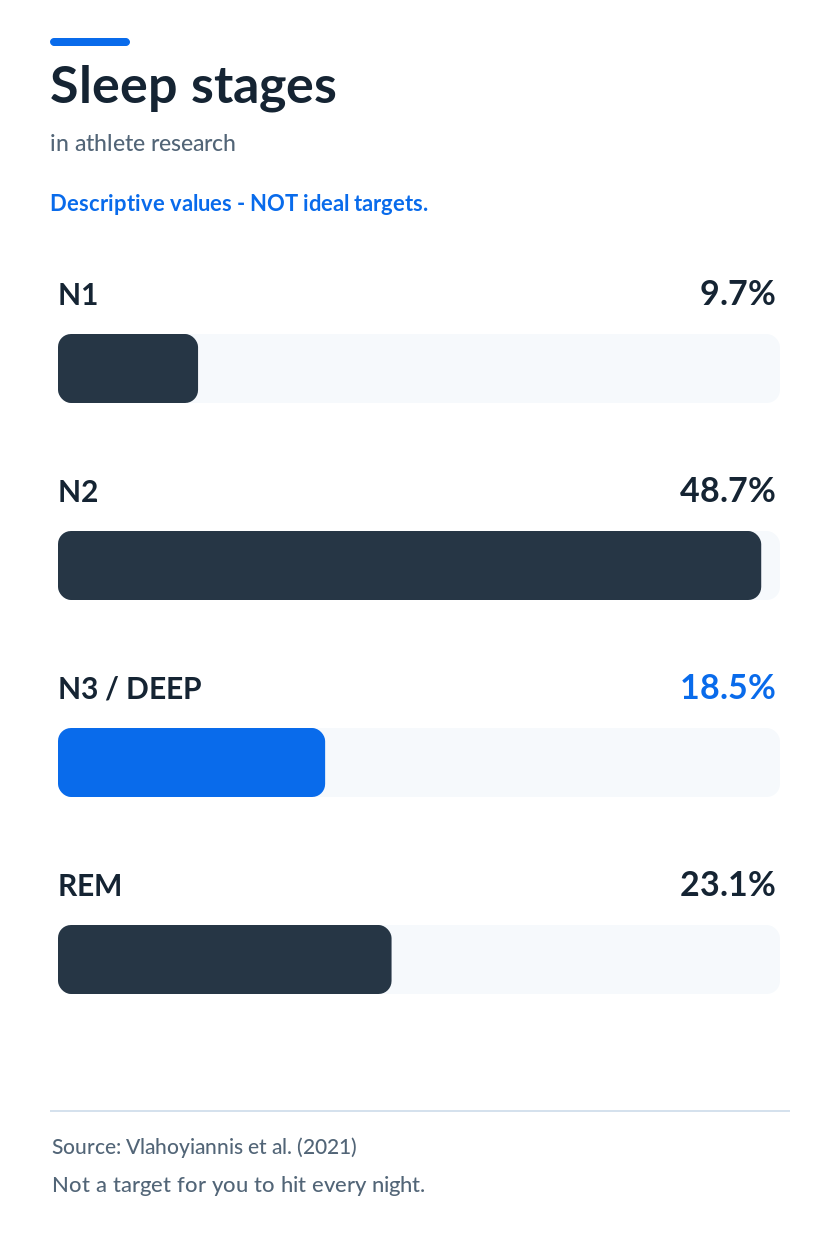
A 2021 systematic review reported the following descriptive breakdown from available sleep-architecture studies involving athletes:
Read the graphic in text
A 2021 systematic review reported descriptive athlete sleep-stage proportions: N1 9.7%, N2 48.7%, N3/deep 18.5%, and REM 23.1%.
These are observations from selected research samples, not optimal targets or a prescription for individual lifters. Source: Vlahoyiannis et al., DOI 10.1016/j.jshs.2020.03.006.
Roughly 18.5% was N3 deep sleep and 23.1% was REM. But that doesn't mean you need to hit those exact percentages every night. Age, training, sleep history, and normal night-to-night variation all affect sleep architecture.
And remember, REM periods often get longer toward morning. If you're routinely cutting sleep short, you may be cutting off part of your normal sleep cycle.
Can You Trust Your Sleep Tracker?
This is where I think people get carried away.
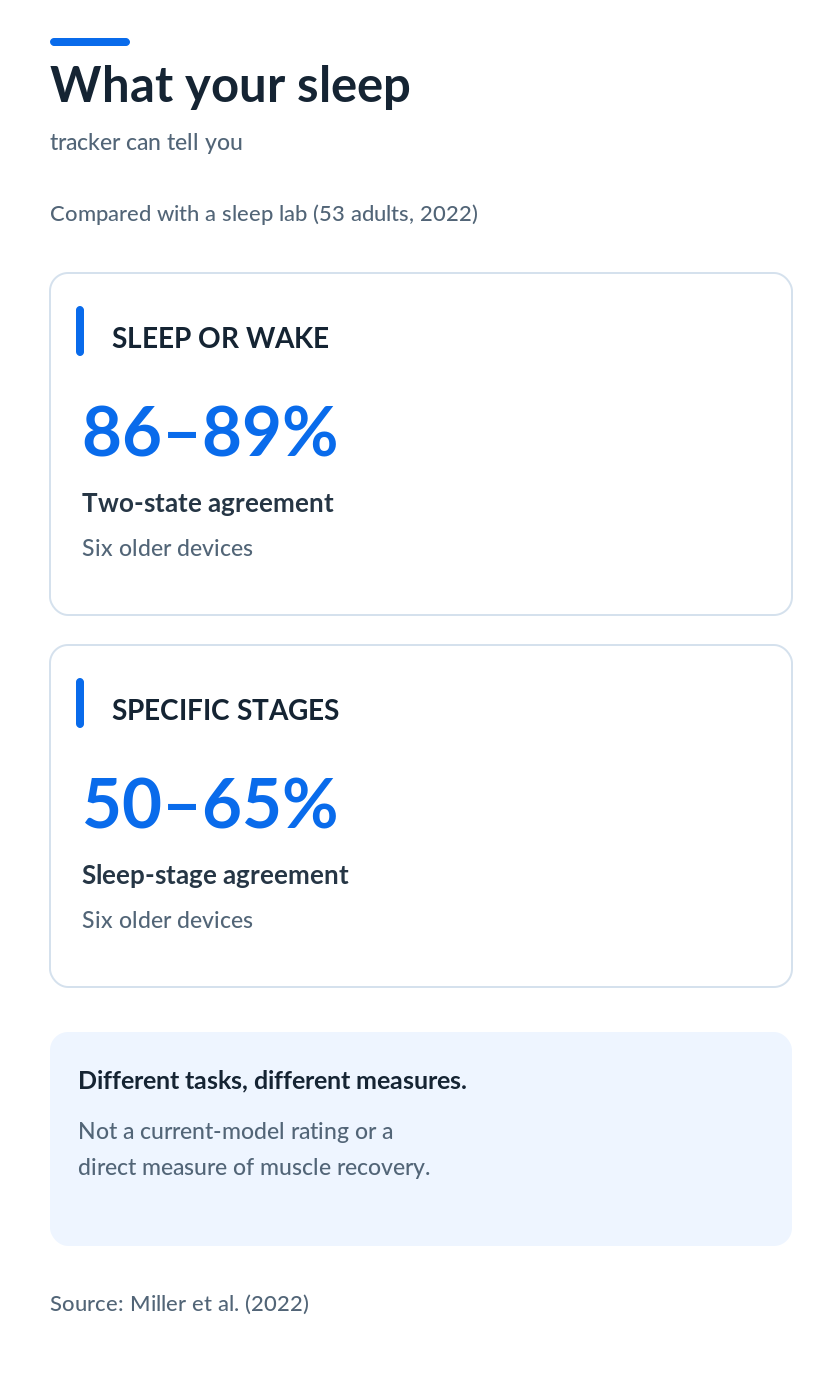
A 2022 laboratory study compared six consumer wearables with a full sleep study in 53 adults. The devices agreed with the lab about sleep versus wake roughly 86–89% of the time. But agreement on specific sleep stages was only about 50–65%.
Those were older device models, and newer trackers may perform differently. The point isn't that your watch is useless. It's that 45 minutes of “deep sleep” on your wrist is an estimate, not a muscle biopsy.
Read the graphic in text
In Miller et al. (2022), six older wearable devices were compared with polysomnography in 53 adults.
Agreement for sleep versus wake was roughly 86–89%. Agreement when classifying individual stages or wake was about 50–65%. These are two different classification tasks, not interchangeable accuracy scores.
These results describe the studied older devices and algorithms, not current-model ratings or a direct measure of muscle recovery. Source: DOI 10.3390/s22166317.
Use the trends if they're helpful. Don't let one ugly recovery score convince you that you're automatically going to have a bad workout.
My Athlete Sleep Protocol
Here's what I'd focus on instead of chasing a perfect sleep-stage score:
- Get enough total sleep. For hard-training adults, 8–9 hours of actual sleep is a reasonable starting target, adjusted to individual needs.
- Protect the full night. Don't make a habit of chopping off the last hour just to wake up earlier.
- Be consistent. Keep a realistic bedtime and wake-up schedule.
- Control what you can. Keep your room dark, cool, and quiet; be smart about late caffeine and alcohol.
- Watch your actual performance. Energy, focus, training quality, and ongoing fatigue matter more than obsessing over a single stage estimate.
And if you're chronically exhausted, snoring heavily, or waking up gasping despite enough time in bed, get evaluated instead of trying to hack a better deep-sleep number.
The Bottom Line
Deep sleep matters. REM matters. Even the lighter stages matter.
But we don't have evidence that forcing more N3 or REM gives you extra muscle growth or automatically adds pounds to your total.
Quit trying to win a sleep-score competition. Get your damn sleep and let your body do its job.
Train hard. Recover properly. Come back stronger.
Research & References
- Vlahoyiannis et al. (2021) — Deconstructing Athletes' Sleep: A Systematic Review
- Van Cauter & Copinschi (2000) — Interrelationships Between Growth Hormone and Sleep
- Tasali et al. (2008) — Slow-Wave Sleep and Glucose Regulation
- Conessa et al. (2023) — Sleep Spindles and Motor-Skill Learning
- Miller et al. (2022) — Validation of Six Wearable Sleep Trackers
- Walsh et al. (2021) — Sleep and the Athlete: Expert Consensus
General education for adult athletes, not individualized medical advice.