Training & Recovery
Does It Matter What Time You Go to Sleep?
The Truth About Bedtime, Growth Hormone & Muscle Recovery

The practical take.
- What it may help with
- Build a repeatable sleep schedule that allows enough comfortable, good-quality sleep around your training and life.
- What the evidence supports
- There is no proven universal hypertrophy bedtime or 10 PM–2 AM growth window. Wearable exercise-timing findings are associations, not a causal strength-training trial.
- Joel’s approach
- Keep bedtime and wake time consistent, use 8–9 hours as an individual starting target, and adjust late training or caffeine if your sleep suffers.
We've all heard it before. You need to be asleep before 10 p.m. if you want the best recovery and muscle growth.
But is that actually true? Or is it just another piece of bro science that's been passed around the gym for years?
If you're sleeping eight hours from midnight to 8 a.m., are you really missing out on gains compared to someone sleeping from 10 p.m. to 6 a.m.?
The answer might surprise you.
Is There a Perfect Bedtime?
Here's the deal. There's no solid scientific evidence that going to bed at 10 p.m. builds more muscle than going to bed at midnight.
What matters more is getting enough quality sleep and keeping your sleep schedule consistent.
Your body has an internal clock called your circadian rhythm. It helps regulate sleep, hormones, body temperature, and alertness.
Some people naturally function better earlier in the day, while others are night owls.
The best bedtime is one that works with your body and allows you to get enough sleep consistently.
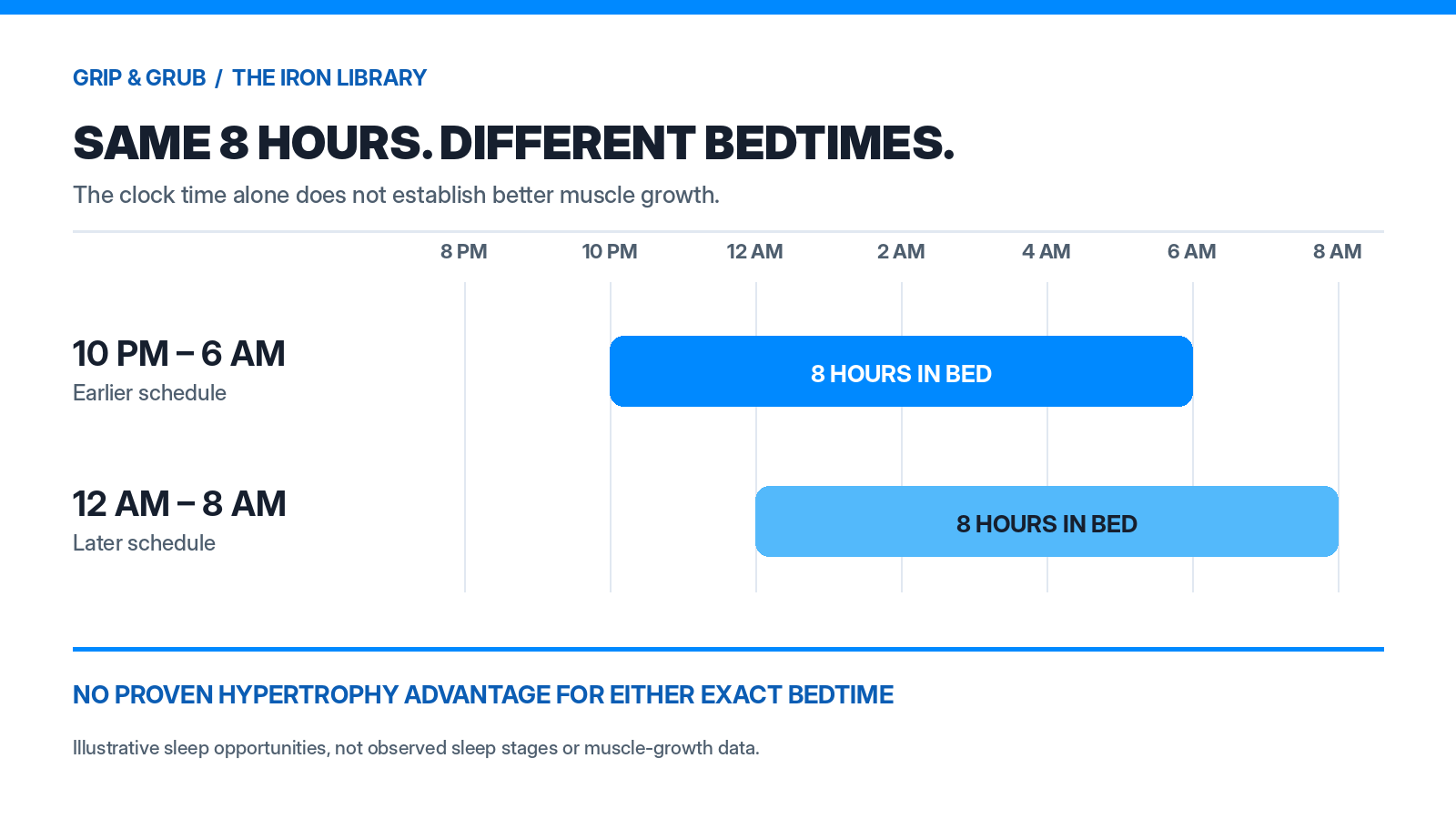
Read the graphic in text
Earlier schedule: 10 PM–6 AM. Later schedule: midnight–8 AM. Each provides eight hours in bed, not eight verified hours asleep.
No proven hypertrophy advantage for either exact bedtime. These are illustrative sleep opportunities, not observed sleep stages or muscle-growth data.
What About the Growth Hormone Window?
You've probably heard that the most important muscle-building sleep happens between 10 p.m. and 2 a.m.
Here's where that theory falls apart.
Your body releases a major pulse of growth hormone around the first period of deep sleep, particularly in men. That process is connected to sleep itself, not some magical clock on your bedroom wall.
Going to bed at midnight doesn't automatically mean you've missed your growth hormone release.
And while growth hormone plays a role in tissue repair, there's no good evidence that forcing yourself to bed at 10 p.m. produces more muscle growth.
Your muscles don't know what time your alarm clock says.
Why Sleep Consistency Matters
This is where the research gets interesting.
Studies have linked irregular sleep schedules with poorer sleep and several negative health outcomes.
Constantly going to bed at 10 p.m. during the week and 2 a.m. on weekends can throw off your body's normal rhythm.
Think of it like your training program.
You wouldn't randomly change your entire training schedule every day and expect everything to run perfectly.
Your sleep works better with some consistency, too.
That doesn't mean you need to be in bed at exactly 10:03 every night. Just try to keep a reasonably consistent bedtime and wake-up time.
Does Training Late at Night Hurt Recovery?
Not necessarily.
Research shows that evening exercise generally doesn't ruin sleep. But very intense workouts close to bedtime may cause problems for some people.
A 2025 study examining more than 4 million nights of sleep data found that strenuous exercise ending within approximately four hours of bedtime was associated with shorter and poorer sleep.
That doesn't prove late workouts caused the problems, but it's worth paying attention to.
If you're crushing heavy deadlifts at 9 p.m., slamming pre-workout, and trying to sleep at 10:30, don't be surprised if you're still wired.
If nighttime training is your only option, that's fine. Just pay attention to how it affects your sleep.
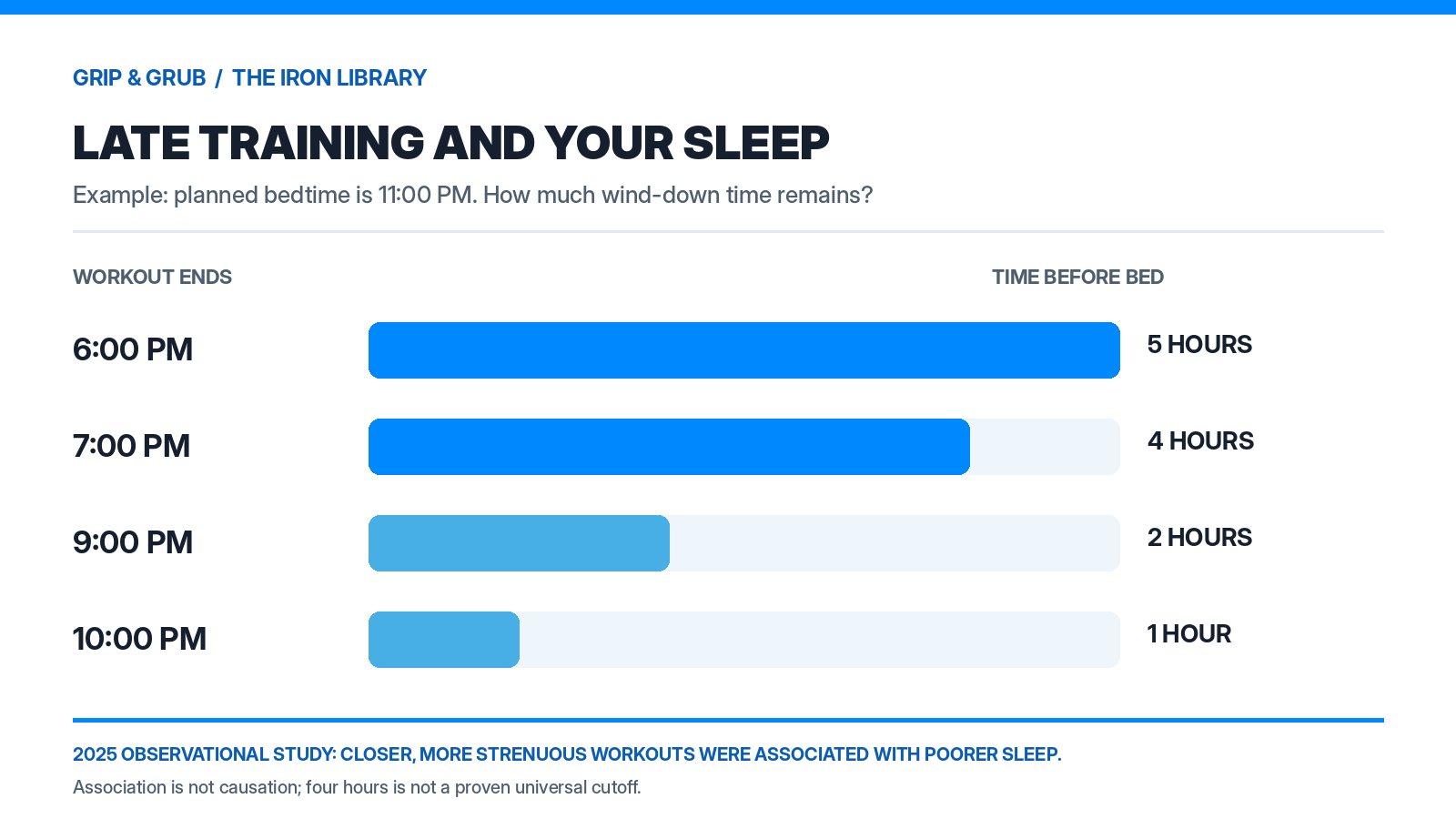
Read the graphic in text
For an example 11 PM bedtime: a 6 PM workout finish leaves five hours, 7 PM leaves four hours, 9 PM leaves two hours, and 10 PM leaves one hour before bed.
These are illustrative intervals. The 2025 observational study linked later, more strenuous exercise with poorer sleep; association is not causation, and four hours is not a proven universal cutoff.
My Athlete Sleep Timing Protocol
Here's how I'd approach sleep timing if you're serious about strength and recovery.
- Keep a consistent schedule. Try to go to bed and wake up around the same time each day.
- Get enough sleep. Aim for 8–9 hours as a starting target if you're training hard, adjusting for your individual needs.
- Get morning sunlight. Natural light helps your body regulate its internal clock.
- Watch late training sessions. If they interfere with sleep, try finishing strenuous workouts several hours before bed.
- Control the caffeine. That 6 p.m. pre-workout might be a bigger problem than the actual workout.
- Wind down before bed. Dim the lights, cool the bedroom, and give your body time to relax.
And if you're naturally a night owl who sleeps great from midnight to 8 a.m., there's no reason to force yourself into a 10 p.m. bedtime just because someone on social media told you to.
The Bottom Line
There's no magical bedtime that's going to unlock another 20 pounds on your bench press.
Sleep timing matters, but consistency, quality, and getting enough sleep matter more than chasing a specific hour on the clock.
We spend enough time obsessing over training splits, supplements, and recovery methods. Don't make sleep more complicated than it needs to be.
Find a schedule that works for your life, stick with it, and make sure you're actually recovering.
Train hard. Sleep consistently. Recover stronger.
Research & References
- Walsh et al. (2021) — Sleep and the Athlete: Expert Consensus Recommendations
- Sletten et al. (2023) — The Importance of Sleep Regularity
- Leota et al. (2025) — Dose-Response Relationship Between Evening Exercise and Sleep
- Stutz et al. (2019) — Effects of Evening Exercise on Sleep
- Bruggisser et al. (2023) — Best Time of Day for Strength and Endurance Training
- Wright et al. (2013) — Natural Light and the Circadian Clock
- Van Cauter, Plat & Copinschi (1998) — Interrelations between sleep and the somatotropic axis. Sleep. Background physiology for the growth-hormone discussion, not a trial of bedtime and muscle growth.
Educational information only. Sleep needs and schedules vary; this article does not replace individualized medical advice.