Training & Recovery
Can't Shut Your Brain Off? Stress, Sleep & Strength Recovery
Why You’re Exhausted but Still Awake—and How Athletes Can Wind Down
The practical take.
- What it may help with
- Writing tomorrow’s tasks down, comfortable breathing and gentle relaxation may help athletes wind down when competition worries keep the mind busy.
- What the evidence supports
- Survey responses are not diagnoses. Writing and breathing research is preliminary or mixed; structured CBT-I has stronger clinical evidence for persistent insomnia. No combined routine is proven to increase muscle or strength.
- Joel’s approach
- Joel experiments with a simple wind-down routine, protects sleep and caffeine habits, and seeks appropriate evaluation when insomnia, significant anxiety or breathing problems persist.
You can train your ass off, eat your protein, and be absolutely smoked after a long day. Then your head hits the pillow and your brain decides it's time to replay tomorrow's deadlift session, your competition attempts, and everything else you forgot to do.
You're physically exhausted, but mentally you're still at the gym.
That's a recovery problem worth addressing. And no, another sleep supplement isn't automatically the answer.
Why Athletes Can't Shut Their Brains Off
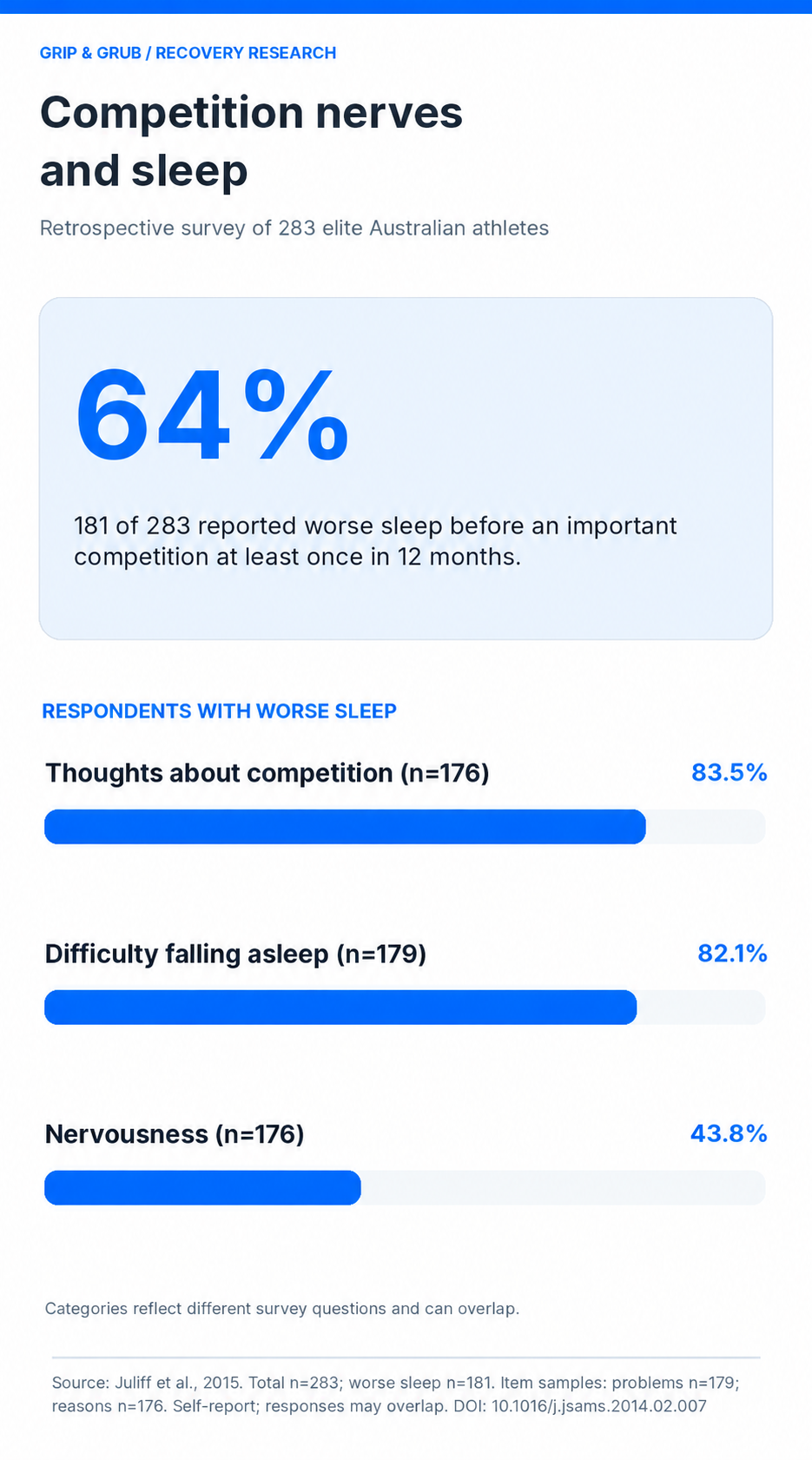
A 2015 study surveyed 283 elite Australian athletes. About 64% said they'd slept worse before an important competition at least once in the previous year.
Among the athletes who reported worse sleep, 83.5% pointed to thoughts about the competition, 82.1% reported trouble falling asleep, and 43.8% identified nervousness. These were self-reported experiences, not medical diagnoses.
It's easy to see how that happens. You're thinking about your opener, your body weight, your equipment, or whether the training you've done will pay off.
Read the graphic in text
Juliff et al. (2015): in a retrospective survey of 283 elite Australian athletes, 181 (64%) reported worse sleep before an important competition at least once during the previous 12 months.
Among respondents reporting worse sleep, 147 of 176 (83.5%) identified thoughts about competition and 77 of 176 (43.8%) identified nervousness. For the separate sleep-problem question, 147 of 179 (82.1%) reported difficulty falling asleep. The overall worse-sleep figure was 181 of 283 (64%). Question-specific sample sizes differ; responses overlap and are self-reported, not clinical diagnoses.
Tired Doesn't Always Mean Ready to Sleep
There's a term called pre-sleep cognitive arousal. Basically, your body wants to shut down while your brain keeps running through problems and what-ifs.
And yes, hard training can be part of the picture. A 2024 review of overreaching in endurance athletes found a small decline in objectively measured sleep efficiency during heavy training blocks. But that doesn't mean every lifter who can't sleep is overtrained.
Stress, late caffeine, competition nerves, travel, and plain old life can all play a part.
What Actually Helps?
Get tomorrow out of your head. In a small 2018 sleep-lab study, 57 adults spent five minutes writing either future tasks or completed tasks. The to-do-list group fell asleep faster. That's encouraging—not proof a notebook cures insomnia.
Try slow, comfortable breathing. A 2026 review of nine studies found improvements in some self-reported sleep outcomes, but objective sleep results were inconclusive. You don't need some ridiculous breath-holding contest. Just breathe comfortably and let your body settle.
Release some tension. Gentle progressive muscle relaxation or a quiet wind-down may help you stop carrying the day into bed. Don't aggressively tense an injured or sore muscle.
Know when the problem is bigger than a routine. For persistent insomnia, cognitive behavioral therapy for insomnia (CBT-I) has much stronger clinical evidence than general sleep tips. It's a structured treatment, not just being told to put your phone away.
Read the graphic in text
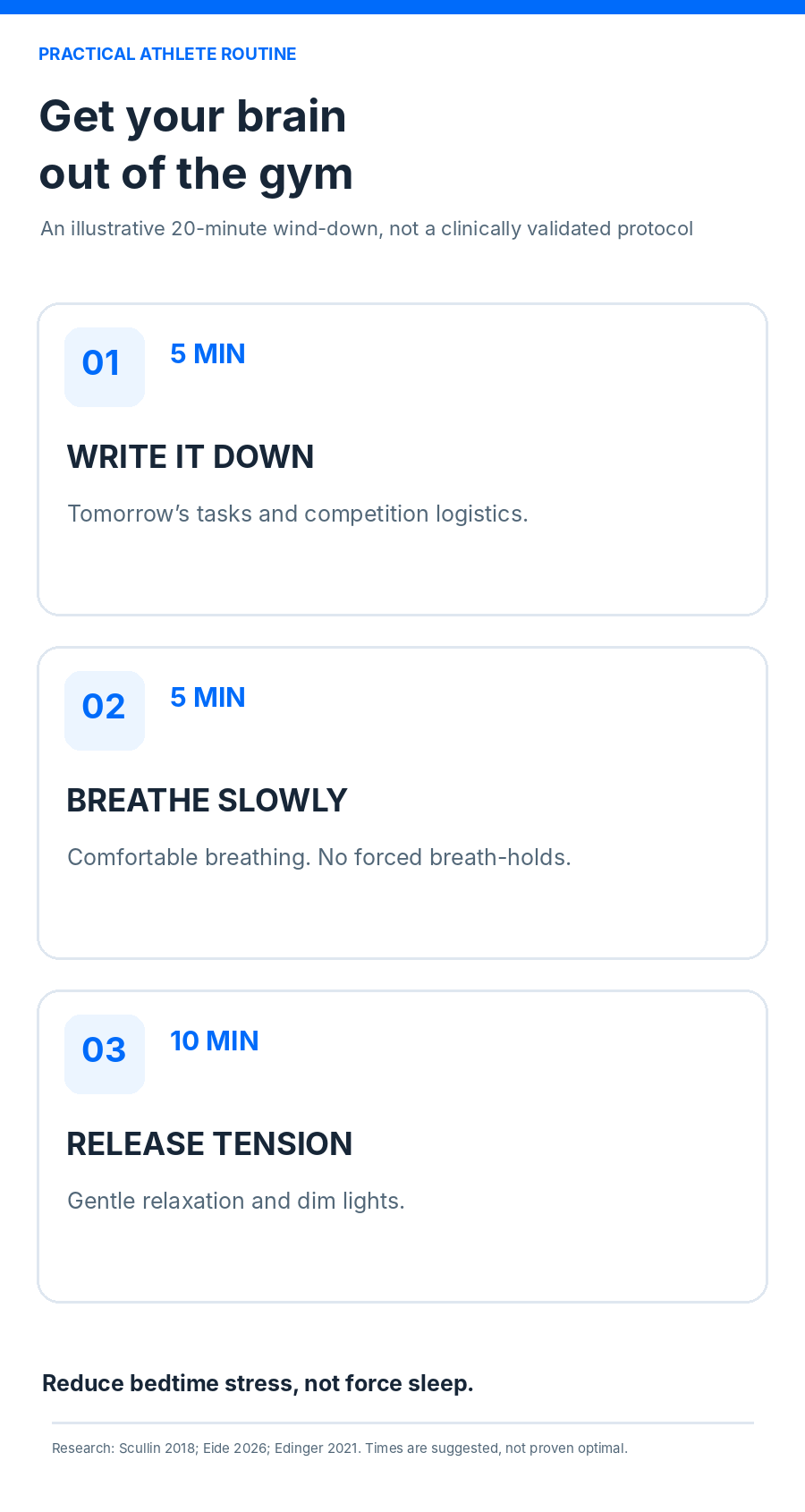
An illustrative 20-minute athlete wind-down experiment: five minutes writing tomorrow’s tasks, competition logistics and what can wait; five minutes of slow, easy, comfortable breathing without forced breath-holds; ten minutes of gentle relaxation, dimmer lights and time to settle.
The goal is to reduce unnecessary bedtime stress, not force sleep on command. Scullin (2018), Eide (2026) and Edinger (2021) provide research context. The timing and combination are practical suggestions, not a tested package, proven optimal duration or clinically validated protocol.
Don't Let Competition Nerves Turn Into Another Competition
You don't need to win sleep the night before a meet.
In fact, research in elite football and rugby players found that sleep was often more disrupted after competition than before it—especially following evening events.
If you find yourself wide awake thinking about your performance, don't start pounding new supplements or chasing a perfect sleep score. Get your plans handled earlier, keep your routine familiar, and judge your readiness by the bigger picture—not one restless night.
My Athlete Wind-Down Protocol
Here's what I'd try before spending another hundred bucks on sleep products:
- Five minutes: write it down. Training plans, tomorrow's tasks, competition logistics—get them out of your head and onto paper.
- Five minutes: slow things down. Comfortable, unforced breathing. No need to chase an exact heart-rate or HRV number.
- Ten minutes: release tension. Gentle relaxation, dimmer lights, and a quieter environment.
- Keep the basics in place. Consistent sleep opportunities, smart caffeine timing, and a room that's comfortable for sleeping.
- If it keeps happening, address it. Ongoing insomnia, significant anxiety, or breathing problems during sleep deserve appropriate evaluation—not an endless stack of bedtime hacks.
Read the graphic in text
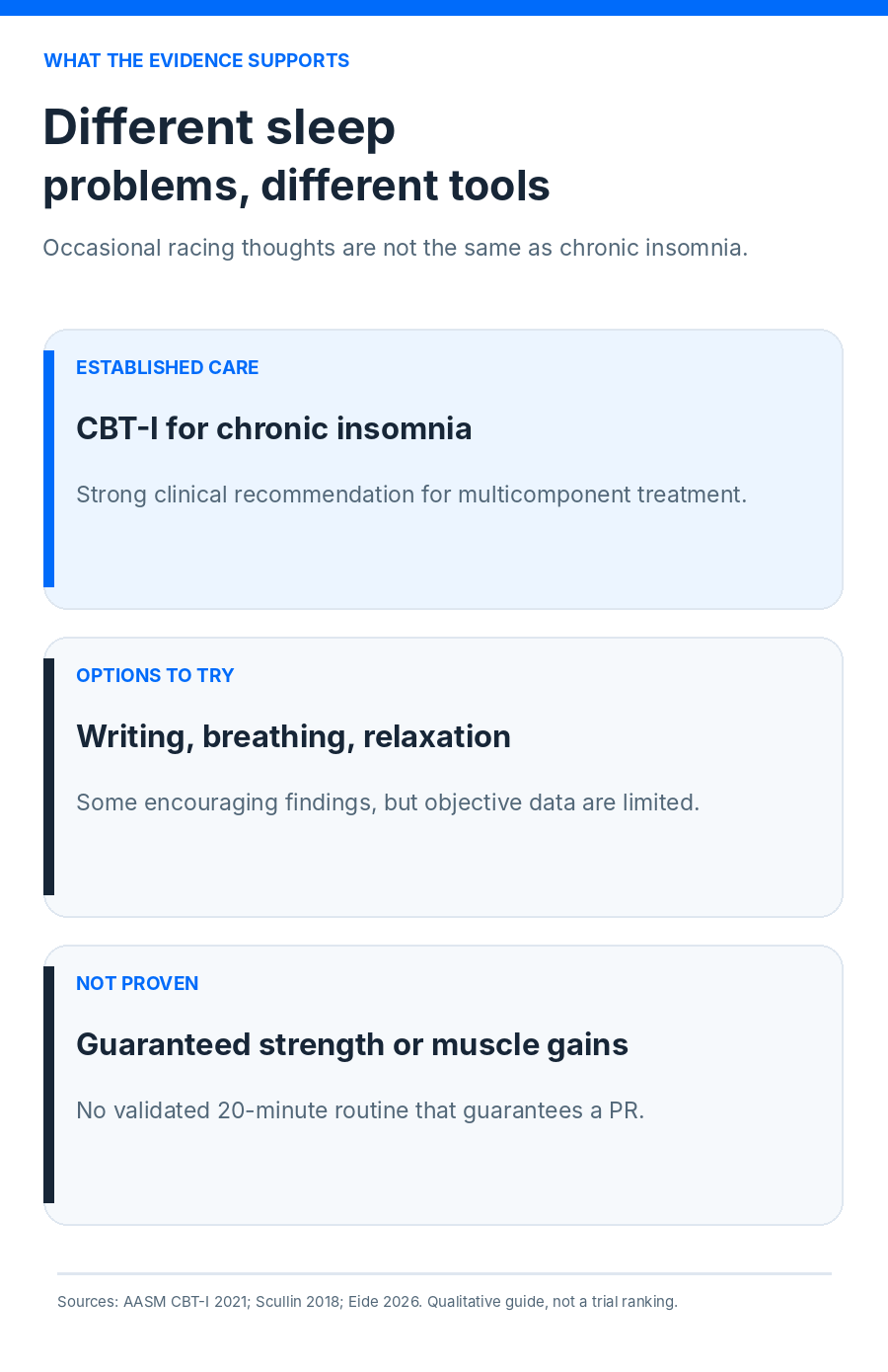
Established clinical care: the AASM guideline strongly recommends multicomponent cognitive behavioral therapy for insomnia (CBT-I) for adults with chronic insomnia. This is structured treatment, not generic sleep tips.
Optional strategies to try: writing a to-do list, easy breathing and relaxation have encouraging findings in some trials. Objective sleep benefits are mixed, limited or preliminary. Occasional racing thoughts are not the same as chronic insomnia.
There is no validated evidence that this 20-minute wind-down routine boosts hypertrophy, maximal strength or guarantees a personal record. This is a qualitative evidence guide, not a numerical efficacy analysis or a head-to-head treatment ranking. Sources: Edinger (2021), Scullin (2018) and Eide (2026).
The Bottom Line
I've said it before: recovery isn't just about more protein, supplements, or fancy equipment.
If you're lying in bed physically exhausted while your brain is planning the next six workouts, you've got another part of recovery to work on.
You don't have to eliminate every stressful thought. You just need a routine that makes it easier to leave the day behind—and enough time to actually sleep.
Train hard. Get your head out of the gym. Get your damn sleep.
Research & References
- Juliff et al. (2015) — Sleep disturbance before competition
- Scullin et al. (2018) — Writing a to-do list before bed
- Eide et al. (2026) — Slow breathing and sleep: systematic review
- Edinger et al. (2021) — AASM clinical guideline for CBT-I
- Murphy et al. (2024) — Overreaching and sleep: systematic review
- Sim et al. (2024) — Sleep before and after competition
- Walsh et al. (2021) — Sleep and the athlete
General education for athletes, not individualized medical advice.