
Nutrition & Supplements
Sodium Bicarbonate: More Reps, Less Fatigue, or a Bathroom Emergency?
Baking soda has evidence for some high-intensity efforts, but uncertain strength gains, substantial sodium exposure, and gastrointestinal risks.
The practical take.
- What it may help with
- A possible small benefit in selected sustained, high-intensity efforts; maximal strength and muscle growth benefits are not established.
- What the evidence supports
- Research varies by test and population. A significant combination effect versus placebo does not prove it beats either ingredient alone.
- Joel’s approach
- Large research protocols can bring substantial sodium exposure and stomach problems. Seek qualified guidance; do not experiment with bulk kitchen baking soda as a performance dose.
Read full guide & sources
Can plain old baking soda help you survive a brutal strongman medley—or will it just send you sprinting toward the restroom?
I've seen lifters spend serious money on pre-workouts with ingredient lists longer than a strongman entry form. Then somebody tells me that one of the better-researched performance aids is sitting in the baking aisle.
Yep. Baking soda.
The stuff you put in cookies apparently has a shot at helping you grind through an ugly set of reps. Before you start shaking a box of it into your water bottle, though, there's a catch big enough to ruin your entire training session.
I dug into Huberman Lab, the International Society of Sports Nutrition, and newer human trials. Here's what the science actually says.
What Is Sodium Bicarbonate—and How Does It Work?
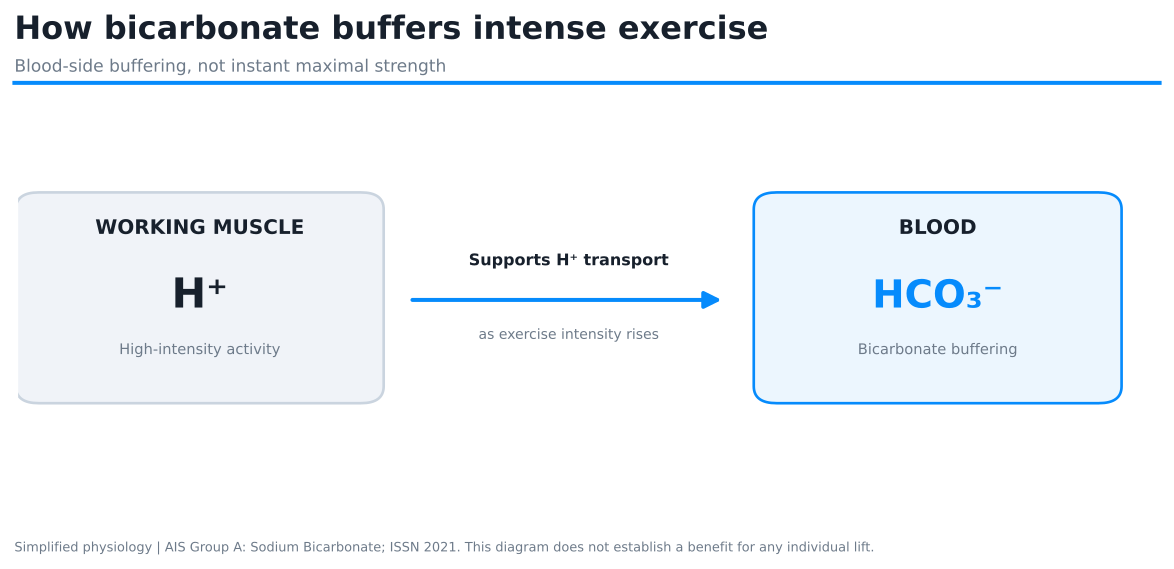
Sodium bicarbonate is NaHCO₃. Your body already uses bicarbonate to regulate acid–base balance. During sustained hard exercise, changes in hydrogen-ion levels contribute to fatigue. Higher bicarbonate availability in the blood can help your muscles move hydrogen ions out, which may help you maintain hard efforts a little longer.
Think of it as extra buffering capacity outside the muscle, not an instant horsepower upgrade.
It's different from beta-alanine, which builds muscle carnosine over weeks and helps buffer acidity inside muscle cells. And for the record, lactate isn't just some useless waste product that causes the burn—it's part of normal energy metabolism.
Does It Actually Improve Performance?
Sometimes, yes. The International Society of Sports Nutrition finds the strongest support for certain hard efforts lasting roughly 30 seconds to 12 minutes. That's more relevant to a nasty conditioning circuit than to one five-second max deadlift. [2]
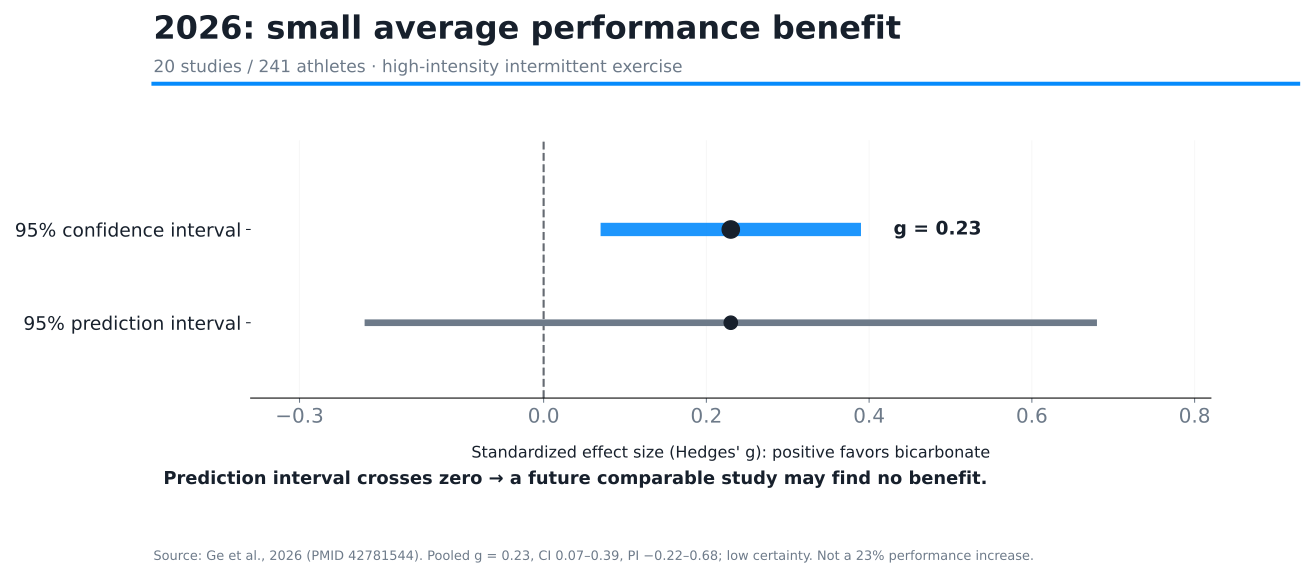
A 2026 meta-analysis of 20 studies with 241 team-sport athletes reported a small overall benefit for high-intensity intermittent exercise. The effect size was 0.23, but the evidence was low certainty, and the prediction interval included no benefit. That's an effect size—not a 23% boost. [4]
One 2023 trial in 19 resistance-trained men found modest improvements in bench-press repetitions and certain power or velocity measures—but not in biceps curls. [5]
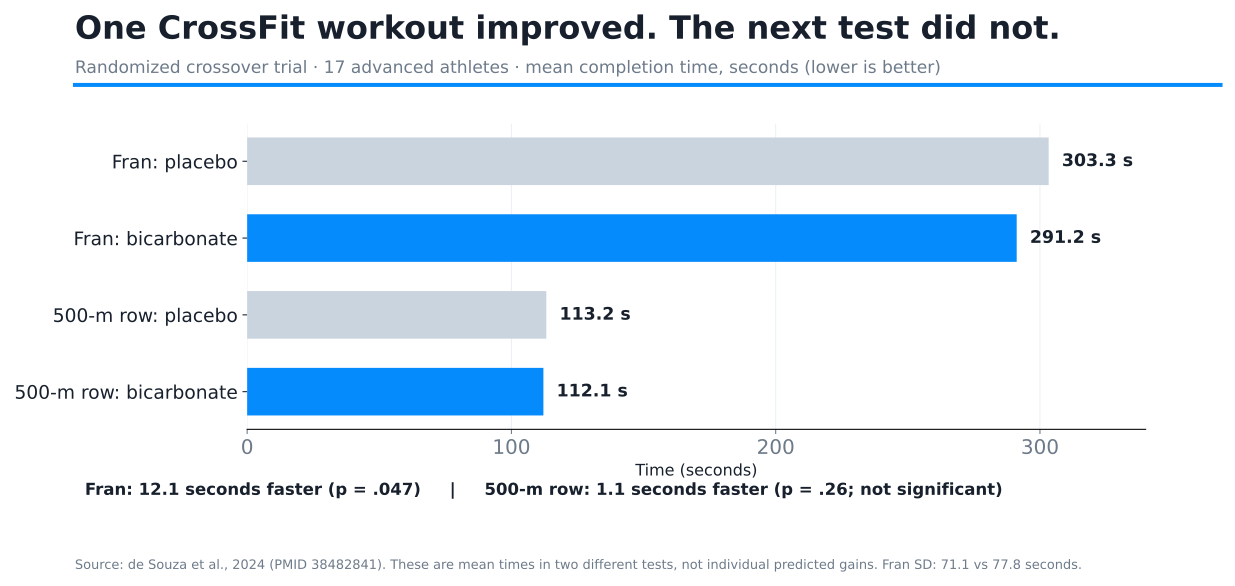
Then there's the 2024 CrossFit trial: 17 advanced athletes finished Fran about 12 seconds faster with bicarbonate than with placebo. Their subsequent 500-meter row didn't significantly improve. [6]
A separate 2025 lifting study found no reliable advantage in its chest-press and knee-extension testing after accounting for follow-up comparisons. [7]
My translation: Baking soda has legitimate science, but it's not a guaranteed PR in a box.
What About Strongman and Powerlifting?
This is where I get interested. A max log press isn't remotely the same as a two-minute loading medley.
- Max squat, bench, deadlift, or log: Little reason to expect a consistent benefit from bicarbonate.
- Deadlift for reps or short-rest drop sets: Potentially useful when fatigue starts piling up.
- Long loading medleys, repeated carries, or conditioning: Plausible applications, especially when the work stays hard for a minute or more.
- Muscle growth: No convincing evidence that bicarbonate directly builds more muscle.
We don't have good randomized studies testing it in actual strongman competitions. So don't turn plausible into proven. Better buffering also won't save an event when your grip, pacing, or technique is the real problem.
Baking Soda vs. Beta-Alanine: Better Together?
The two work on different sides of the muscle: bicarbonate helps blood-side buffering, while beta-alanine increases muscle carnosine over time.
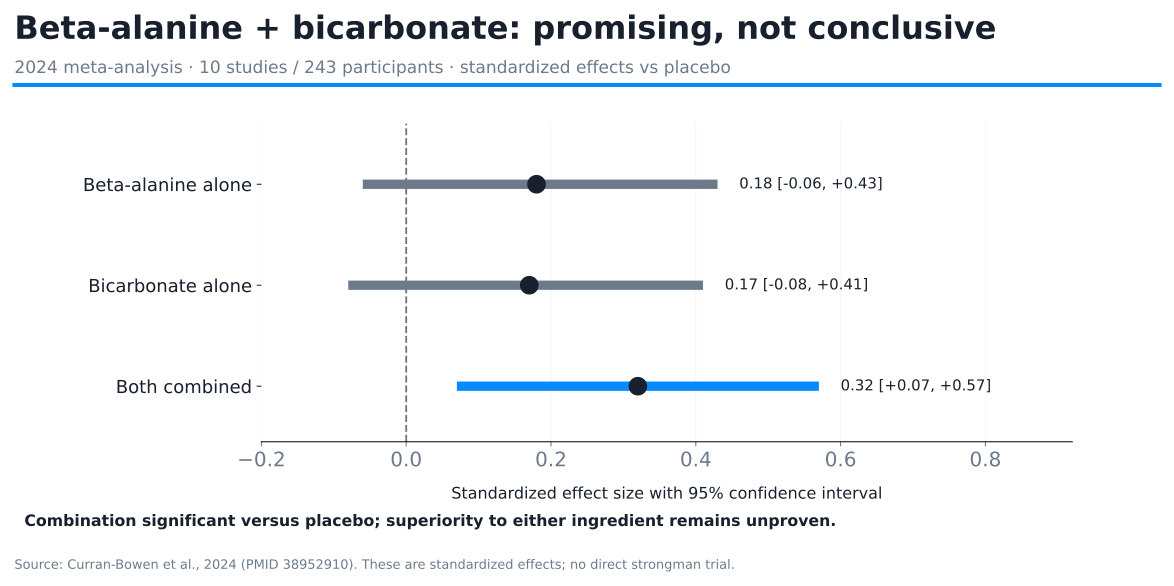
A 2024 meta-analysis of 10 studies (243 people) found a significant pooled benefit for the combination versus placebo, while the isolated ingredients were not individually significant in that particular analysis. That doesn't prove the stack is reliably better than either ingredient in a direct comparison—and it wasn't a strongman-specific study. [8]
Athlete Action Plan: Dose, Timing & Reality Check
Here's where I'm going to be more careful than your average pre-workout salesman.
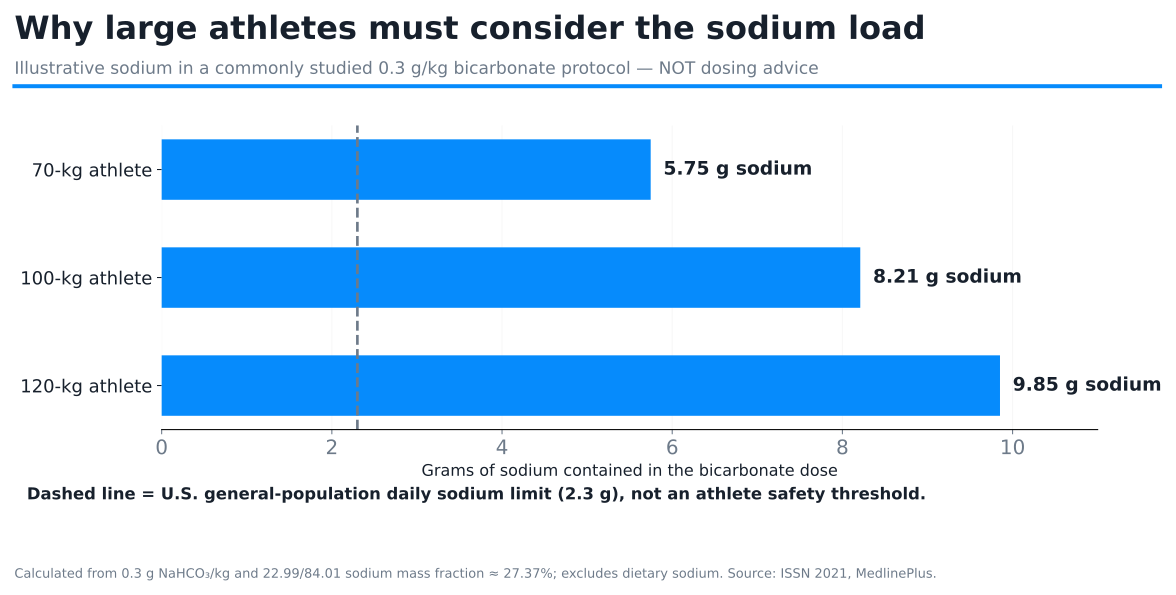
Researchers commonly test around 0.2–0.3 grams of sodium bicarbonate per kilogram of body weight, usually 60–180 minutes before the event. That's a description of research protocols, not my recommendation to start chugging baking soda. [2,3]
For bigger athletes, those amounts represent a massive sodium load. At the widely studied 0.3 g/kg level, a hypothetical 100-kilogram lifter would get roughly 8.2 grams of sodium from the bicarbonate alone, before counting meals. That's more than three times the general-population daily sodium limit, and it absolutely deserves professional guidance. [2,10]
Here's the decision framework I'd give an athlete:
- Match it to the event. A high-intensity medley makes more physiological sense than a max single.
- Talk with a sports dietitian or qualified healthcare professional before using a large loading protocol. The sodium exposure and your medical history matter.
- Never test a new supplement strategy on contest day. Digestive tolerance varies dramatically.
- Measure performance, not just chemistry. Event time, completed work, and repeatable reps count more than a higher bicarbonate reading.
- Don't forget the basics. Conditioning, nutrition, hydration, and recovery will do more for most athletes than another scoop of powder.
The Downside: A Bathroom Emergency
Here's the big catch: bloating, nausea, cramps, diarrhea, and vomiting can all happen, especially with large single doses.
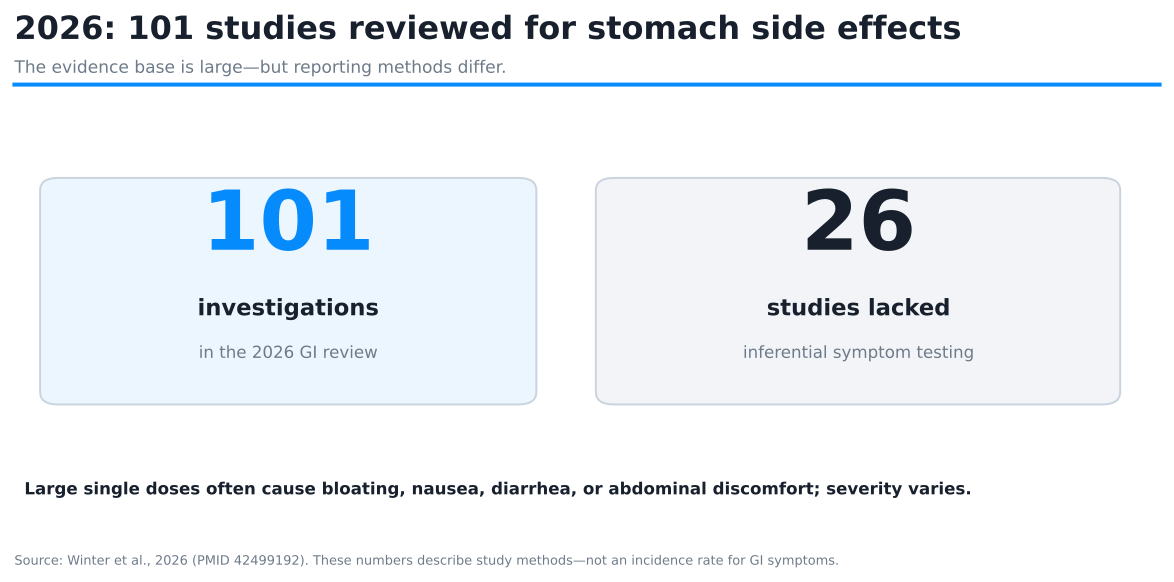
A 2026 review examined 101 investigations into these stomach issues. The researchers found that side effects are common enough to threaten practical usefulness, while studies varied greatly in how symptoms were measured. Twenty-six didn't use inferential statistical tests to compare GI symptoms. [9]
Research has explored split dosing, taking it with food, and specialized delivery systems to reduce symptoms. But none reliably eliminates the problem, and there isn't enough head-to-head evidence to name one perfect method. [2,9]
Large baking-soda ingestion can also cause serious electrolyte or acid–base disturbances. Anyone with kidney or heart problems, high blood pressure, sodium restrictions, or relevant medication use needs individualized medical advice. Do not experiment with bulk kitchen baking soda as a performance dose. [10]
My Take
Sodium bicarbonate isn't just bro-science. But it isn't a free performance upgrade, either.
For longer, brutal efforts—think a punishing strongman medley—there's a real physiological reason it might help. For a one-rep max, I'm not losing sleep over whether it's in my supplement cabinet.
And when the price of a slight performance edge might be spending your second event looking for a toilet, you better do your homework.
The goal is more work under the bar—not more time in the bathroom.
Train hard. Recover harder. Let the science do the talking.
— Joel
Research & References
- Huberman Lab / Andy Galpin (2022). How to Build Strength, Muscle Size & Endurance; sodium bicarbonate discussion at ~03:04:02. https://www.hubermanlab.com/episode/dr-andy-galpin-how-to-build-strength-muscle-size-and-endurance
- ISSN (2021). Position stand: sodium bicarbonate and exercise performance. https://pubmed.ncbi.nlm.nih.gov/34503527/
- AIS. Australian Institute of Sport: Sodium Bicarbonate (Group A). https://www.ausport.gov.au/ais/nutrition/supplements/group_a/performance-supplements2/bicarbonate
- Ge et al. (2026). 20-study / 241-athlete intermittent high-intensity meta-analysis. https://pubmed.ncbi.nlm.nih.gov/42781544/
- Varovic et al. (2023). Randomized bench-press and biceps-curl study. https://pubmed.ncbi.nlm.nih.gov/36752756/
- de Souza et al. (2024). Fran improved but not subsequent 500-m row. https://pubmed.ncbi.nlm.nih.gov/38482841/
- Williams et al. (2025). No significant post-hoc benefit in resistance-training test. https://pubmed.ncbi.nlm.nih.gov/41441411/
- Curran-Bowen et al. (2024). Meta-analysis of beta-alanine and bicarbonate combinations. https://pubmed.ncbi.nlm.nih.gov/38952910/
- Winter et al. (2026). Systematic review of gastrointestinal side effects across 101 investigations. https://pubmed.ncbi.nlm.nih.gov/42499192/
- MedlinePlus. Baking soda overdose and emergency precautions. https://medlineplus.gov/ency/article/002749.htm
Educational content only; not individualized medical advice.