Training & Recovery
Red Light Therapy: More Power, Less Soreness, Better Recovery?
What red and near-infrared light may offer strength athletes, where the evidence is mixed, and why device-specific dosing matters.
The practical take.
- What it may help with
- Explore a recovery tool with some promising but mixed exercise findings.
- What the evidence supports
- Results depend on treatment parameters; a panel’s minutes are not a universal research dose.
- Joel’s approach
- Follow device-specific dosing and eye-protection instructions, then judge meaningful training outcomes.
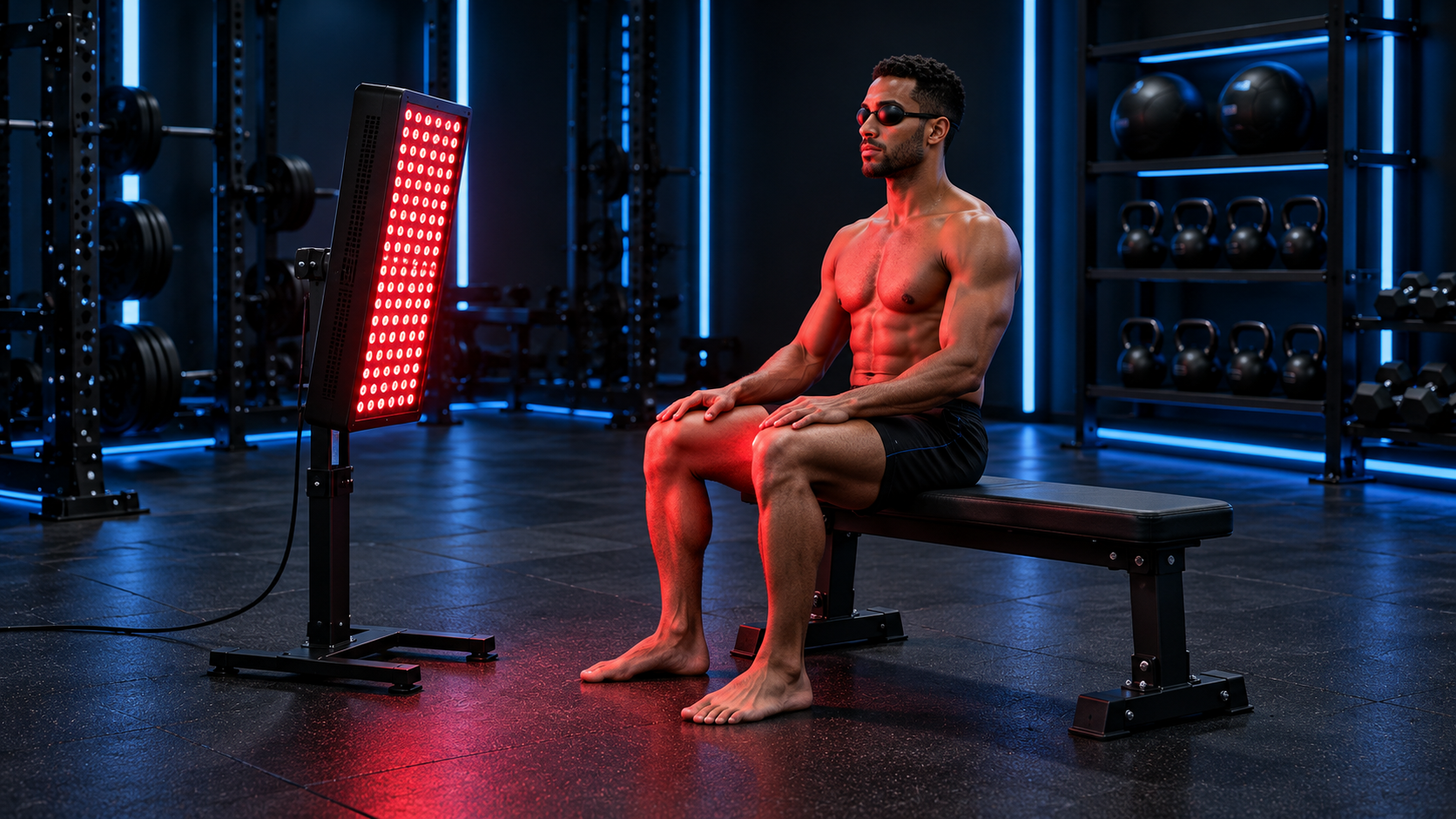
We've all seen the red light panels popping up in gyms, recovery centers, and athletes' homes. But is standing in front of a glowing red light actually doing anything for your gains, or is it another expensive fitness gimmick?
Turns out, there's some legitimate science behind it.
Red light therapy, technically called photobiomodulation, uses specific wavelengths of red and near-infrared light to stimulate cellular processes, particularly inside the mitochondria.
Think of mitochondria as your muscles' power plants. Red light therapy may help those power plants operate more efficiently, potentially improving performance and recovery.
Why should strength athletes care?
Research suggests a few potential benefits:
- Improved muscular endurance: Some studies show athletes squeezing out more repetitions before fatigue.
- Better recovery: May help manage exercise-induced muscle damage and oxidative stress.
- Less muscle soreness: Could reduce DOMS after those brutal training sessions, although research is mixed.
- Injury recovery: Early research suggests potential benefits for tissue healing and pain management.
Now, don't expect to add 50 pounds to your deadlift because you spent 10 minutes glowing like a radioactive tomato. But if it helps you recover a little better and get more quality work done, that's worth looking at.
What kind of red light works best?
Not all red lights are created equal.
For strength athletes, I'd look for a quality LED panel combining:
- Red light: 630–670 nm — Targets more superficial tissues.
- Near-infrared light: 810–850 nm — Penetrates deeper, making it particularly interesting for larger muscle groups.
Ideally, look for a panel with both, especially around 660 nm and 810–850 nm.
Near-infrared is what I'd prioritize when targeting quads, hamstrings, shoulders, and other large muscles. A regular red lightbulb isn't the same thing as a properly designed therapy panel.
The protocol: when, how long, and how often?
Here's a practical starting point for strength athletes.
Timing examples, not a validated dose. Minutes alone do not specify light exposure. Use these examples only if they fit your device’s instructions; they are not a recommendation to increase its dose or frequency.
| Goal | When | Duration |
|---|---|---|
| Performance | Before training | 5–10 minutes |
| Recovery | After training | 5–15 minutes |
| Rest days | Anytime convenient | 10–15 minutes |
| Frequency | 3–5 days per week | As needed |
My approach: If you're training heavy, try 5–10 minutes before your workout on the muscle groups you're about to hammer. If recovery is the priority, use it afterward.
For a heavy squat day, target your quads and hamstrings. For pressing, focus on your chest, shoulders, and triceps.
These are starting points, not universally proven doses. The actual treatment depends on your panel's power, distance, and coverage. Follow the device's dosing instructions rather than assuming more minutes means more results.
More isn't always better
Here's where the bro science needs a little actual science.
Red light therapy appears to follow a biphasic dose-response. Basically, too little light might do nothing, but too much doesn't necessarily produce better results either.
Research-based recommendations often reference approximately 20–60 joules for smaller muscles and 120–300 joules for larger muscle groups. That's total energy delivered, not a timer setting you can directly copy onto every panel.
And protect your eyes. Don't stare into high-powered LEDs or near-infrared lights. Use the manufacturer's recommended eye protection.
The bottom line
Is red light therapy going to replace hard training, quality food, creatine, and eight hours of sleep?
Absolutely not.
But there's enough promising research on muscle performance, recovery, and cellular function to make it an interesting addition to a strength athlete's toolbox.
The evidence isn't strong enough to promise bigger muscles or faster recovery for everyone. But a properly dosed red and near-infrared panel may provide a small advantage.
And in strength sports, we're always looking for those small advantages.
Train hard. Recover smarter. Get stronger.
— Joel Dircks Grip & Grub
Research & References
- Photobiomodulation and Exercise-Induced Oxidative Stress — Systematic Review & Meta-Analysis
- Photobiomodulation in Judo Athletes — Randomized Placebo-Controlled Trial — An important study finding no significant benefit.
- 830 nm LED Phototherapy and Injury Recovery in University Athletes — Preliminary, nonrandomized evidence.
- Huberman Lab: Using Light to Optimize Health — Includes red light research on vision and cellular function, rather than a validated strength-training protocol.
- Clinical and scientific recommendations for PBMT in exercise and recovery — The source for the muscle-group energy ranges discussed above; not a universal consumer-panel timer setting.