Training & Recovery
Is Your Phone Killing Your Recovery?
Blue Light, Late-Night Scrolling & Sleep for Strength Athletes
The practical take.
- What it may help with
- Dimming evening light and keeping recreational scrolling from displacing bedtime may help protect sleep opportunity. A warmer screen alone cannot replace enough sleep.
- What the evidence supports
- A prolonged tablet experiment measured circadian delay; a large student survey found associations; the Night Shift trial found no overall significant group difference. None measured a direct gain or loss of muscle.
- Joel’s approach
- Joel experiments with 30–60 minutes off recreational screens, lowers evening brightness and notifications, and judges the result by actual sleep and training. The cutoff is a practical test, not a proven prescription.
You finish training, eat your last meal, crawl into bed, and pull out your phone to watch a couple of deadlift videos.
Next thing you know, it's midnight. You're still scrolling, and tomorrow's heavy squat session is coming whether you're ready or not.
Is the blue light killing your gains? Or is the bigger problem that you should've been sleeping an hour ago?
There's real science behind how light affects sleep. But there's also a whole lot of overhyped bro science.
Blue Light Isn't Made Up
Light tells your brain what time of day it is. Bright, blue-rich light at night can interfere with melatonin signaling and shift your body's internal clock later.
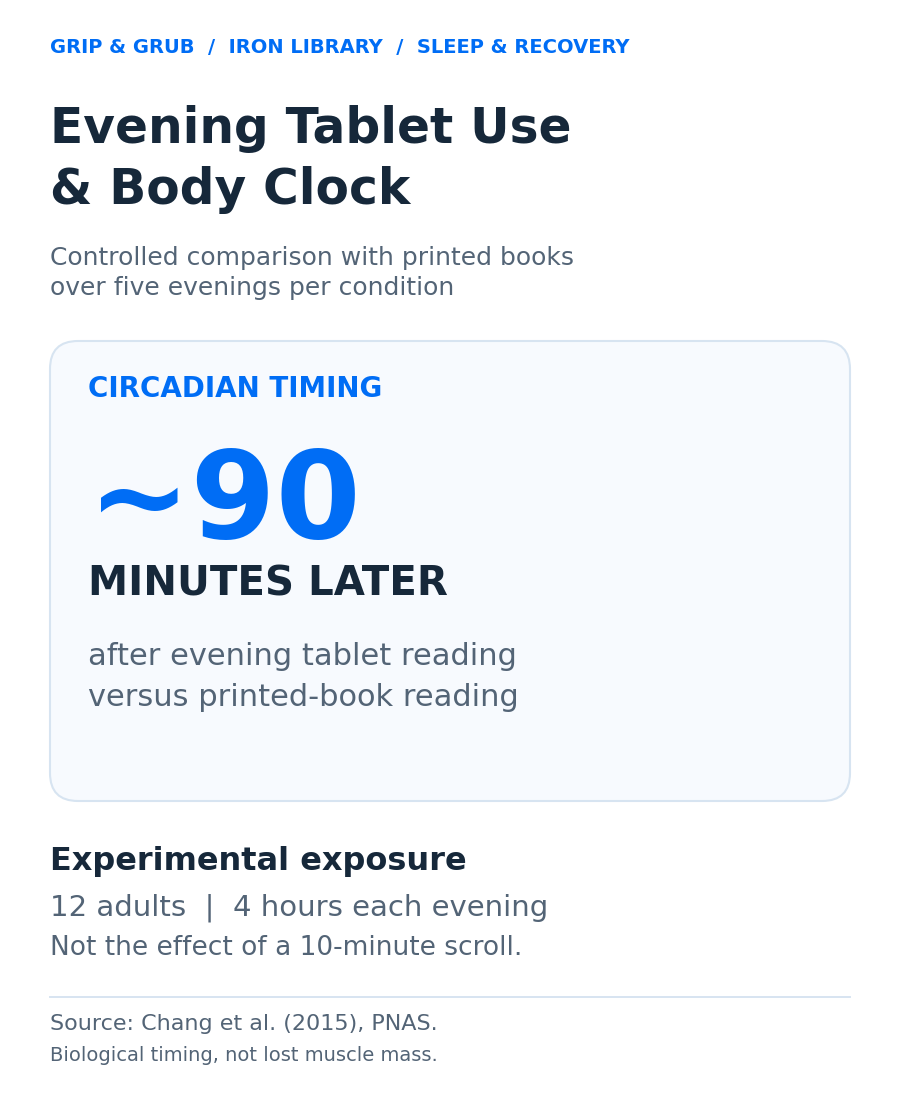
In a 2015 controlled experiment, 12 adults spent four hours before bed reading on a light-emitting tablet or reading a printed book over separate five-evening conditions. Tablet reading delayed circadian timing by about 90 minutes compared with the printed-book condition.
That's worth paying attention to. But don't twist it into "five minutes on Instagram costs you 90 minutes of recovery." The researchers tested four hours of evening exposure, not a quick text message.
Read the graphic in text
Chang et al. (2015): a controlled crossover study in 12 adults compared four hours of light-emitting tablet reading before bedtime with printed-book reading, over five evenings per condition. Circadian timing after tablet reading was about 90 minutes later than after print reading. The desktop scale begins at zero and extends to 120 minutes.
This is a body-clock timing result after prolonged exposure, not the effect of a brief phone check, 90 minutes of sleep lost or a measured change in muscle growth.
The Bigger Problem Might Be the Endless Scroll
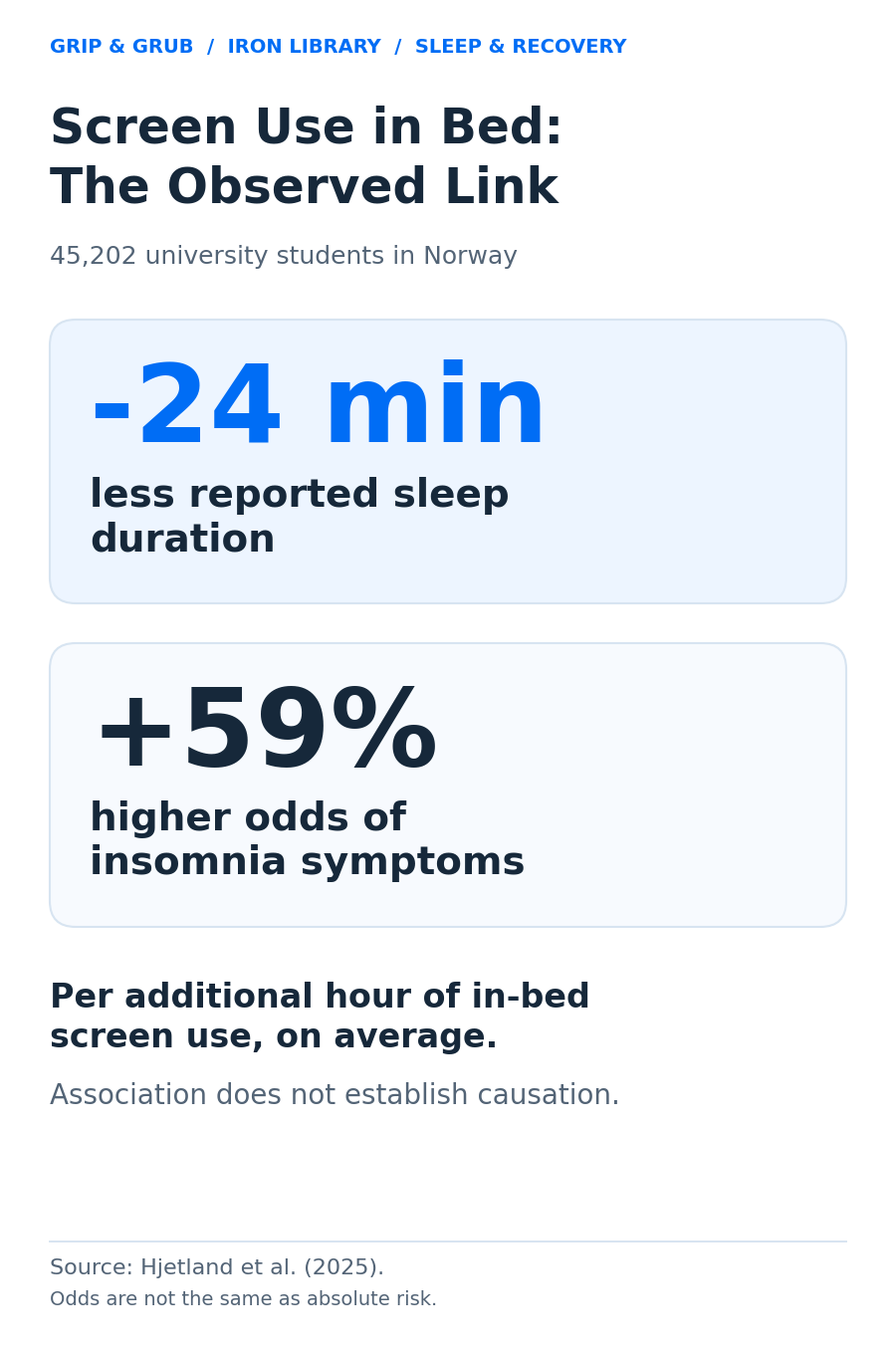
A 2025 survey of 45,202 university students found that every additional hour of screen use after getting into bed was associated with approximately 24 fewer minutes of reported sleep and 59% higher odds of insomnia symptoms.
That's an association, not proof that the phone caused the problem. People who already can't sleep might also reach for their phones more often.
But think about your own routine. You planned to sleep at 10:30. Then one lifting clip turns into an hour of videos, messages, and scrolling.
You don't need a sleep study to tell you that staying awake longer leaves less time for sleep.
Read the graphic in text
Hjetland et al. (2025): a cross-sectional, self-reported survey of 45,202 Norwegian university students. Each additional hour of screen use after getting into bed was associated with about 24 minutes shorter reported sleep duration and 59% higher odds of insomnia symptoms, on average.
The 59% value is a change in odds, not an absolute risk, an individual prediction or a measured loss of recovery. The survey cannot establish whether screen use caused insomnia or whether difficulty sleeping led to more screen use. These are student data, not a strength-athlete experiment.
Will Night Shift or Blue-Light Glasses Fix It?
Not necessarily.
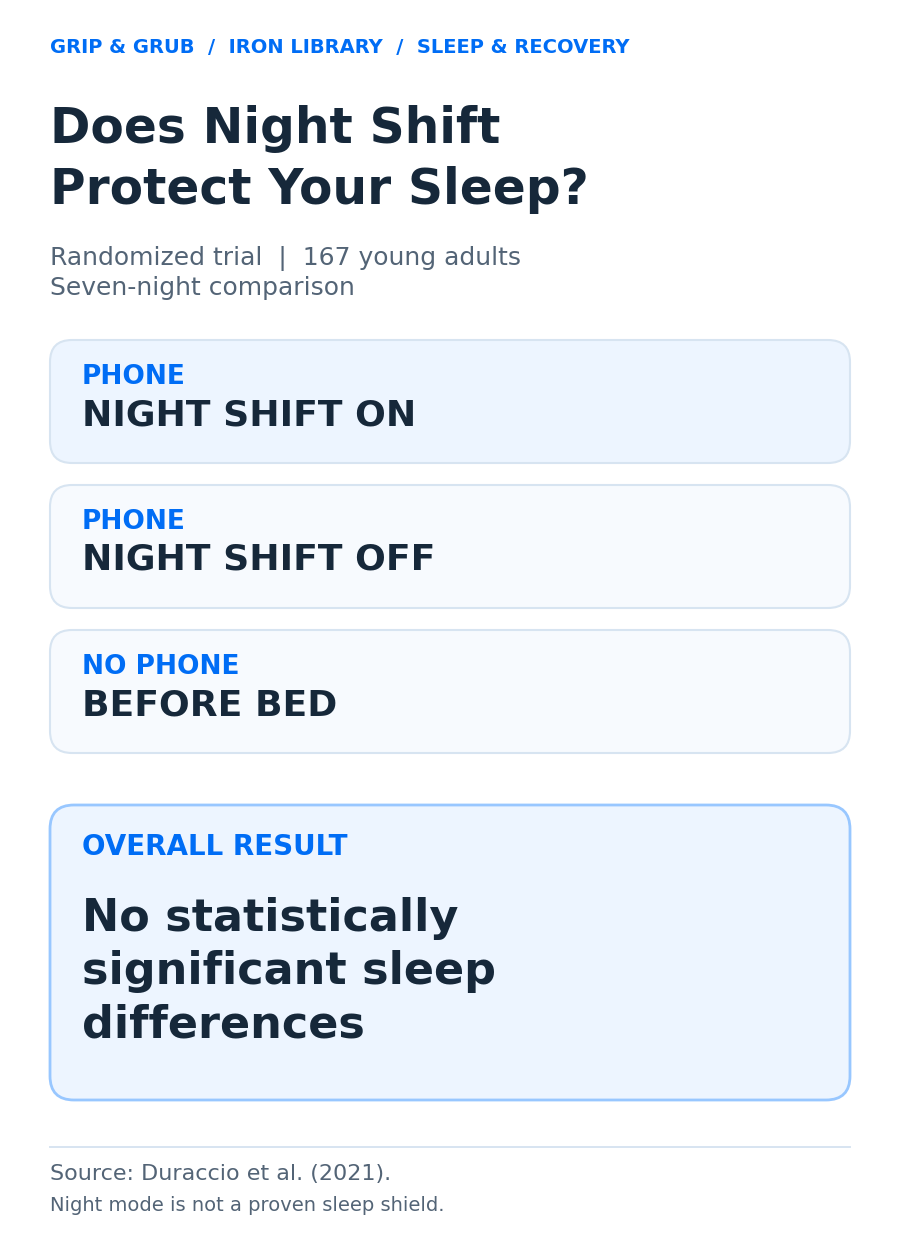
A 2021 randomized experiment followed 167 young adults for seven nights, comparing iPhone use with Night Shift on, Night Shift off, or no phone use before bed. There were no statistically significant sleep differences between the three groups overall.
Research on blue-light-blocking glasses is mixed, too. Some small studies report subjective improvements, but reviews haven't consistently found better objectively measured sleep.
A warmer screen or amber glasses might be comfortable. Neither one gives you a free pass to scroll until 2 a.m.
Read the graphic in text
Duraccio et al. (2021): 167 young adults were randomly assigned for seven nights to phone use with Night Shift on, phone use with Night Shift off, or no phone use during the hour before bedtime.
The overall comparison found no statistically significant sleep differences between the three conditions. This does not establish that screens never affect sleep, that all uses or exposures are equivalent, or that night mode is a proven sleep shield.
What About Strength and Muscle Growth?
A small 2026 experiment involving 16 elite soccer players found poorer reported sleep and changes in selected performance tests after repeated evenings of prolonged tablet exposure.
Interesting? Absolutely. Proof that phone light makes you lose muscle? Not even close. It was a small athlete study, the evening activity involved videos, and it didn't measure long-term strength or hypertrophy.
We have evidence that sleep matters for recovery and that evening light and screen habits can interfere with sleep. We don't have good trials showing that blocking blue light adds 20 pounds to your deadlift.
My Athlete Screen & Sleep Protocol
Here's what I'd do before spending money on another recovery gadget:
- Get some daylight after waking. Your body clock benefits from bright light during the day.
- Turn down the lights at night. Start dimming bright overhead lighting during the last one to three hours before bed when practical.
- Experiment with 30–60 minutes off recreational screens. This is a practical test, not a scientifically proven cutoff.
- If you need your phone, make it less disruptive. Lower the brightness, silence notifications, and avoid the stuff that keeps your brain fired up.
- Keep the phone out of bed when you can. Don't let your planned bedtime turn into another hour of lifting videos.
- Judge the results in real life. Track when you actually fall asleep, how rested you feel, and whether your training performance changes. Don't obsess over one wearable deep-sleep score.
The Bottom Line
I'm not saying you need to throw your phone in the trash or wear orange glasses every night.
But if you're training your ass off, doing everything you can for recovery, then sacrificing an hour of sleep to watch somebody else's PR, you might want to rethink that routine.
Blue light matters. So does brightness, mental stimulation, and the time you're losing to your screen.
Train hard. Put the damn phone down. Get your sleep.
Your muscles don't need another hour of scrolling.
Research & References
- Chang et al. (2015) — Evening Tablet Reading and Circadian Timing
- Gooley et al. (2011) — Evening Room Light and Melatonin
- Hjetland et al. (2025) — Bedtime Screen Use and Sleep in University Students
- Duraccio et al. (2021) — iPhone Night Shift and Sleep
- Brown et al. (2022) — Recommendations for Daytime, Evening and Nighttime Light
- Dridi et al. (2026) — Evening Tablet Exposure and Athletic Performance
- Singh et al. (2023) — Cochrane Review of Blue-Light-Filtering Spectacle Lenses
General education for athletes, not individualized medical advice.