Training & Recovery
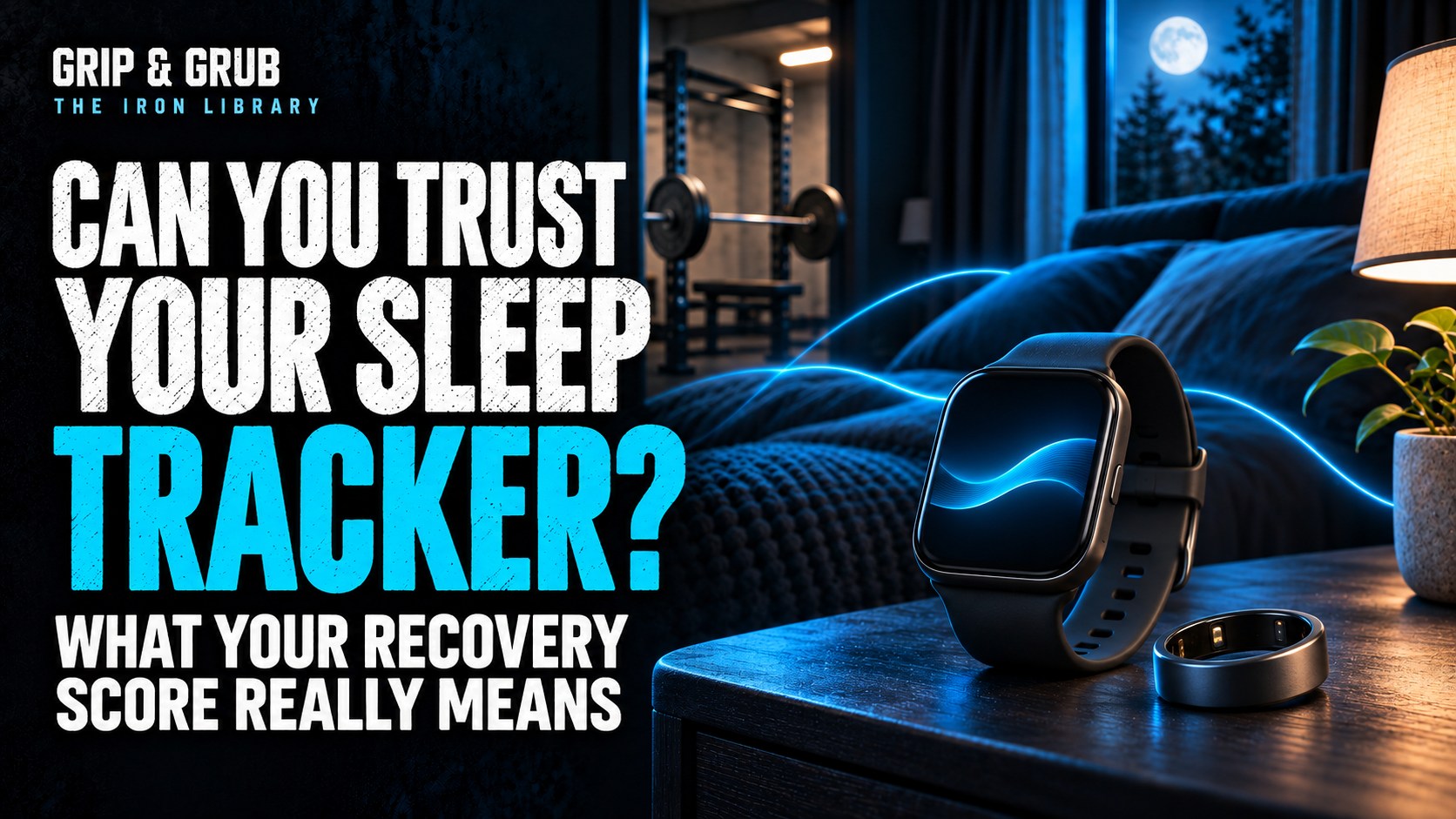
Can You Trust Your Sleep Tracker?
WHOOP, Oura, Apple Watch & Garmin — What Your Recovery Score Really Means
The practical take.
- What it may help with
- Wearables can help spot trends in sleep habits and nighttime heart-rate measures over time. A single low score cannot tell you how much muscle has recovered.
- What the evidence supports
- Validation depends on the device, software and metric tested. Sleep stages are estimates, and HRV measurement accuracy does not validate a proprietary recovery score.
- Joel’s approach
- Joel compares trends with his own baseline, then checks warm-ups, technique, RPE, fatigue and his training log before adjusting a session.
You wake up, check your watch, and it says you're 38% recovered.
Great. Now you're staring at a heavy deadlift day wondering if your body is falling apart.
We've got watches and rings measuring sleep, heart rate, HRV, recovery, and everything else. Some of that information is genuinely useful.
But here's the question: does a low recovery score actually mean you're not recovered enough to lift?
Not necessarily. And the science gets pretty interesting.
Your Tracker Isn't a Sleep Lab
A proper sleep study measures brain activity, eye movements, muscle activity, and more. Your watch or ring mostly uses movement and optical sensors to estimate what's happening.
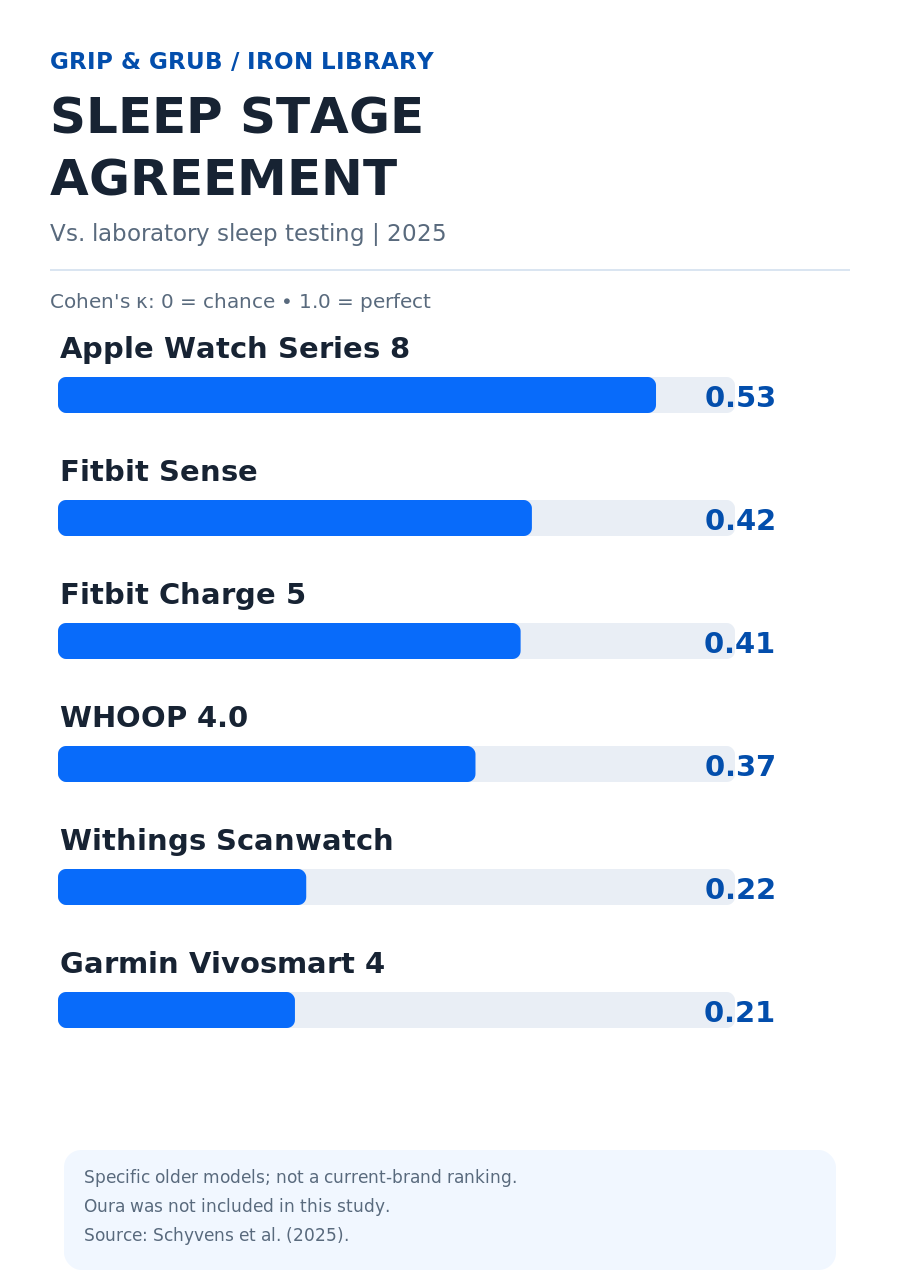
A 2025 study compared six wearables with laboratory sleep testing in 62 adults. The devices identified more than 90% of actual sleep periods, but correctly recognized only about 29–52% of awake periods.
Basically, they were much better at recognizing sleep than detecting when somebody was awake but lying still.
And the numbers for distinguishing different sleep stages were a lot less impressive.
Read the graphic in text
Schyvens et al. (2025) compared six specific wrist-worn models with laboratory polysomnography in 62 adults over one night. Participants wore two to four devices; the sample differed by model.
Chance-adjusted multistate agreement (Cohen’s kappa): Apple Watch Series 8, 0.53 (n=20); Fitbit Sense, 0.42 (n=37); Fitbit Charge 5, 0.41 (n=39); WHOOP 4.0, 0.37 (n=40); Withings Scanwatch, 0.22 (n=41); Garmin Vivosmart 4, 0.21 (n=25).
Kappa is not percentage accuracy: zero indicates chance-level agreement and one indicates perfect agreement. These findings concern the tested older models and software, not current product lines. Oura was not included.
Your Deep Sleep Number Isn't a Muscle Biopsy
Your watch might say you got 42 minutes of deep sleep one night and 90 the next.
That doesn't mean you built twice as much muscle on the second night.
Sleep stages matter. But a consumer wearable estimates them rather than measuring brain waves directly.
Don't let one ugly deep-sleep number convince you your recovery is shot.
HRV: Useful Data, Not a Crystal Ball
HRV—heart-rate variability—looks at the changing time between heartbeats. It can help show how your body is responding to training, sleep, illness, alcohol, and other stress.
And some devices measure nighttime HRV surprisingly well.
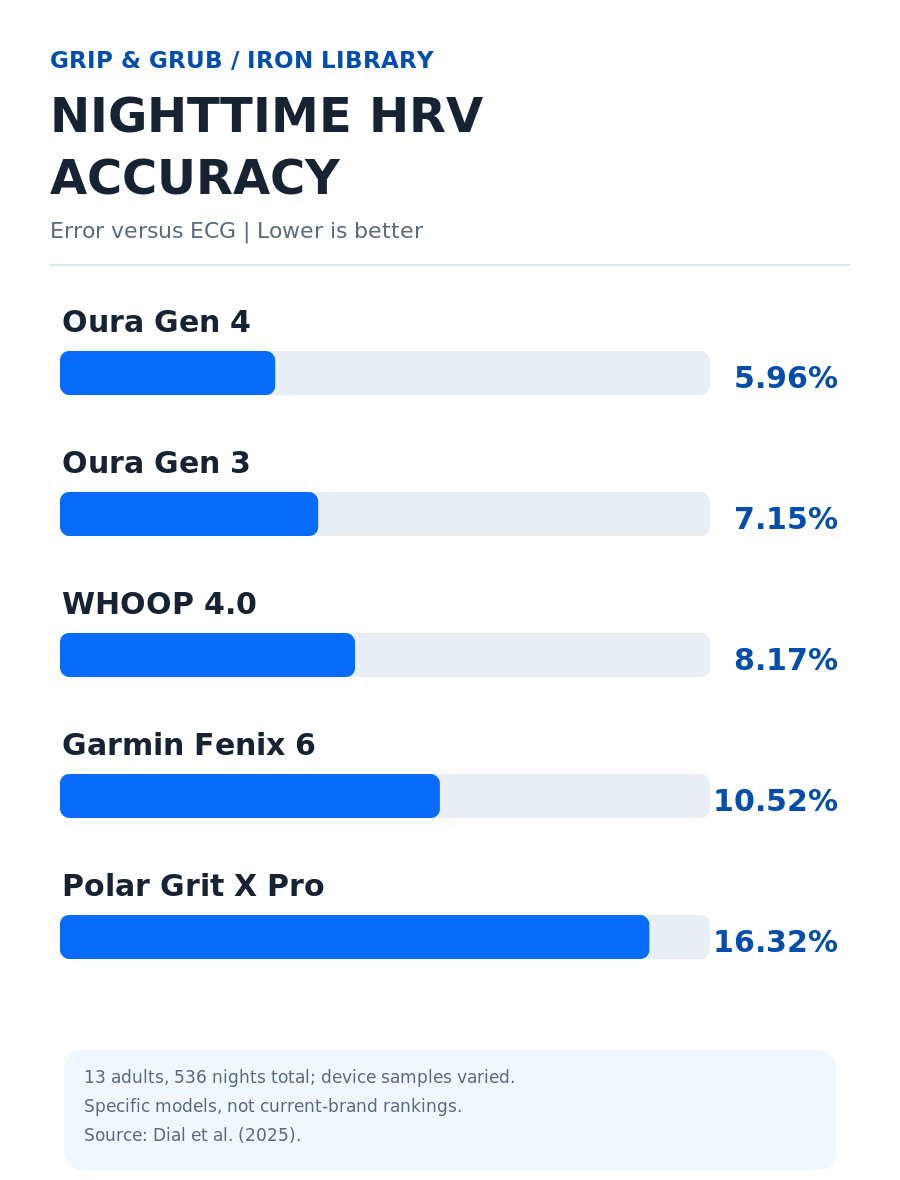
A 2025 study compared five wearables with ECG measurements across 536 nights from 13 adults. Oura Gen 4 and Gen 3 showed relatively low average HRV errors, with WHOOP 4.0 and Garmin Fenix 6 showing somewhat larger errors in that particular experiment.
Read the graphic in text
Dial et al. (2025) compared nighttime HRV with an ECG reference in 13 healthy adults across 536 reference-recorded nights. The chart reports mean absolute percentage error (MAPE); lower error is better.
Oura Gen 4: 5.96% (139 device nights); Oura Gen 3: 7.15% (470); WHOOP 4.0: 8.17% (289); Garmin Fenix 6: 10.52% (150); Polar Grit X Pro: 16.32% (206).
Device-night counts overlap because multiple devices could be worn on the same night; they must not be added as unique nights. Variability around each mean is omitted from the graphic. Apple Watch was not tested. These are model-specific HRV measurement errors, not validation of recovery scores or a ranking of current devices.
But there's a catch.
HRV doesn't directly measure muscle damage, muscle protein synthesis, or whether you're going to squat 600 pounds today.
And comparing your HRV with somebody else's—or switching brands and expecting the numbers to match—doesn't tell you much. Different devices can use different measurement methods and time windows.
Your own baseline matters more.
What Does a Recovery Score Actually Measure?
WHOOP calls it Recovery. Oura has Readiness. Garmin has Training Readiness and Body Battery. They all package sleep and physiological information into something easy to understand.
That's convenient. But it's still an algorithm, not a direct measurement of how much your muscles have repaired.
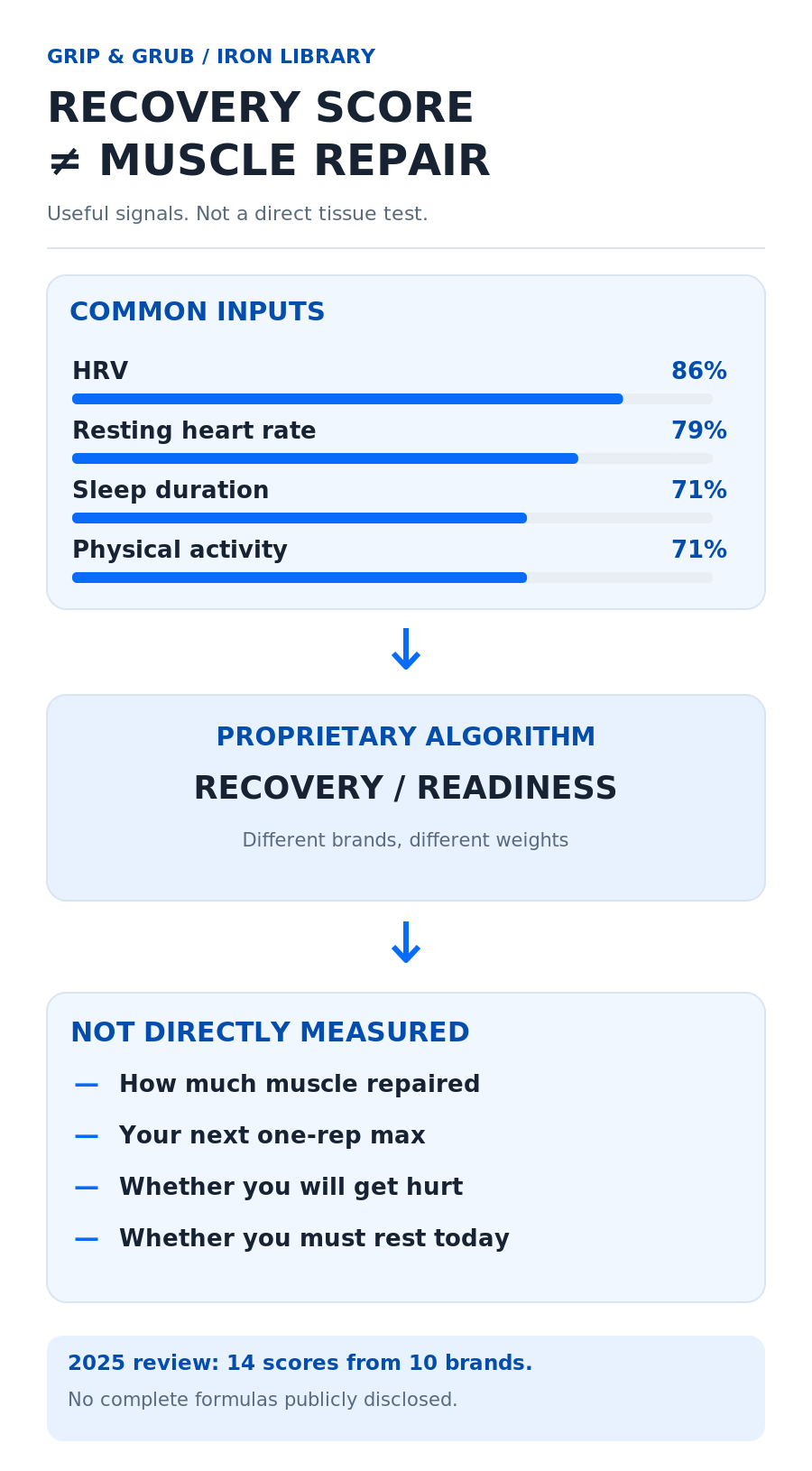
A 2025 review examined 14 composite health scores from 10 wearable manufacturers. HRV appeared in 86% of them, resting heart rate in 79%, and sleep duration in 71%. The companies did not publicly disclose the full scoring formulas.
Read the graphic in text
Doherty et al. (2025) reviewed public documentation for 14 composite health scores from 10 manufacturers. Inputs included HRV in 86% of scores, resting heart rate in 79%, sleep duration in 71% and physical activity in 71%.
These percentages describe the prevalence of inputs across score designs. They do not measure weighting, prediction accuracy or how recovered an athlete is. The reviewed manufacturers did not disclose complete scoring formulas.
Signals are combined through proprietary algorithms with differing inputs, weights and collection windows. A recovery or readiness score does not directly establish muscle repair, a one-rep max, injury risk or whether an athlete must skip training.
A 92% recovery score doesn't mean your muscles are 92% repaired. And a 35% score doesn't automatically mean you need to skip training.
Should You Change Your Workout Because Your Score Is Low?
I'd use the score as another piece of information, not as my coach.
If your tracker says recovery is low but you feel good, you've slept reasonably well, and the warm-up weights are moving great, there's no strong evidence that you must abandon your workout.
But if your score looks fantastic and you're sick, exhausted, or your technique is falling apart, don't use a green screen as permission to max out.
For strength athletes, bar speed, technique, RPE, fatigue, soreness, and the training log still matter.
My Athlete Tracking Protocol
Here's how I'd use one of these devices without becoming a slave to it:
- Watch trends, not one night. Look at sleep duration and consistency across several weeks.
- Compare HRV and resting heart rate with your own baseline. Don't chase someone else's number.
- Track what happens under the bar. Warm-up speed, RPE, training volume, and technique tell you things a ring can't.
- Use recovery scores as a conversation starter. A strange score should make you look at the bigger picture, not panic.
- Don't ignore real symptoms. Persistent exhaustion, breathing problems during sleep, or feeling unwell deserve attention regardless of what the app says.
And quit obsessing over whether you got 61 or 72 minutes of deep sleep. That kind of precision is often more confidence than the technology deserves.
The Bottom Line
I like data. If a watch helps you identify poor sleep habits, catch trends, or make smarter recovery decisions, that's a win.
But there's a big difference between measuring heartbeats and measuring muscle recovery.
These trackers are tools. They're not a crystal ball, and they're definitely not your strength coach.
Use the data. Trust your training log. Pay attention to your body.
And don't let a number on your wrist decide how strong you are before you've even touched the bar.
Research & References
- Schyvens et al. (2025) — Six Wearable Sleep Trackers vs. Polysomnography
- Dial et al. (2025) — Nighttime HRV and Resting Heart Rate Validation
- Doherty et al. (2025) — Recovery, Readiness, and Strain Score Evaluation
- Robbins et al. (2024) — Oura, Apple Watch, and Fitbit Sleep Validation
- Walsh et al. (2021) — Sleep and the Athlete: Expert Consensus
General education for adult athletes, not individualized medical advice.