
Nutrition & Supplements
Beetroot Juice & Dietary Nitrates: More Reps, Better Conditioning, or Just Hype?
Can beetroot juice actually help lifters get more reps or stronger conditioning? We separate the research from the marketing and show why the real nitrate dose matters.
The practical take.
- What it may help with
- Potentially support selected endurance and conditioning efforts; benefits for maximal strength and long-term muscle growth are not established.
- What the evidence supports
- Findings vary by population and outcome. The 2025 umbrella review had quality limitations; the 2026 athlete review found no significant pooled effect in its six analyzed outcomes.
- Joel’s approach
- Verify actual nitrate content, test cautiously in comparable training, and keep the blood-pressure and prescribed dental-care cautions in view.
Read full guide & sources
Can a shot of beet juice actually help you perform better, or is this just another pre-workout marketing trick?
I've taken plenty of supplements over the years, but drinking beet juice before a workout still sounds like something that started as a dare at a salad bar.
Turns out there's real science behind it. Beetroot is rich in dietary nitrate, which your body can turn into nitric oxide. The big question is whether that means more reps, better strongman conditioning, or just more expensive red pee.
I dug into the newest human studies, and here's what I found.
What's Beetroot Actually Doing?
Your body can convert dietary nitrate into nitrite, then nitric oxide. Nitric oxide is involved in blood-vessel signaling and how your muscles respond to exercise. Even bacteria in your mouth help with that conversion.
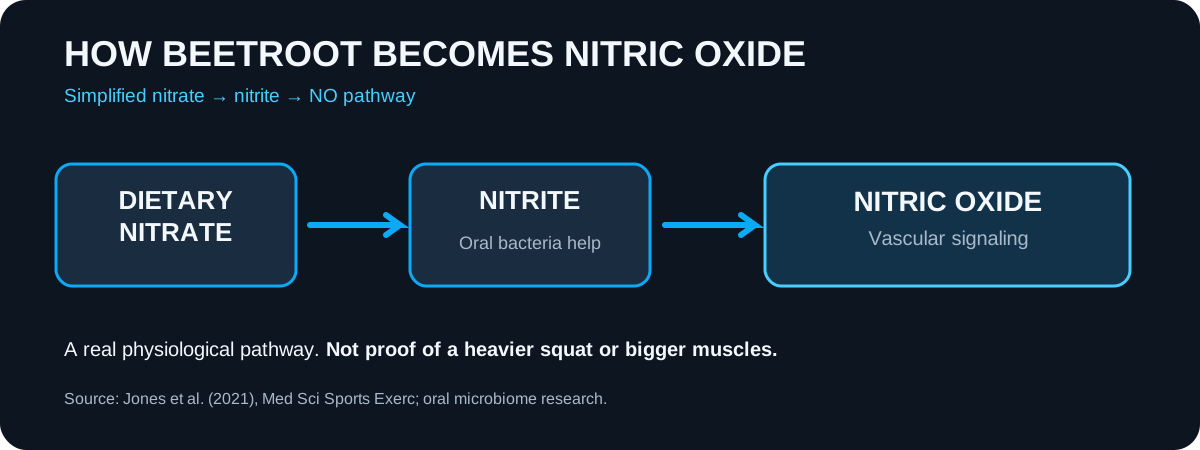
Better nitric-oxide availability doesn't automatically mean a bigger bench press. A real biological mechanism is just the starting point. The gym performance still has to show up in the research.
Does It Help You Perform Better?
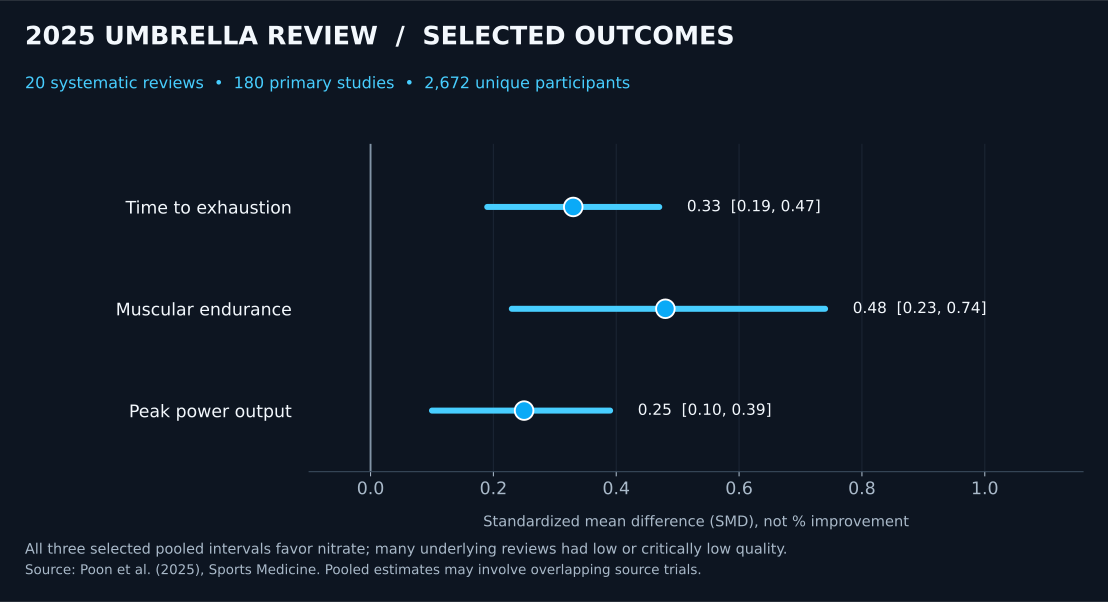
A 2025 umbrella review pooled results across 20 systematic reviews. It found encouraging signals for time to exhaustion, muscular endurance, and some power outcomes. But many of the underlying reviews were rated low or critically low quality. [1]
Then an October 2026 review of 45 randomized trials involving 659 athletes found no statistically significant pooled improvement in six measured outcomes, including peak power and mean power. Importantly, that review wasn't a direct test of every possible lifting or strongman outcome. [2]
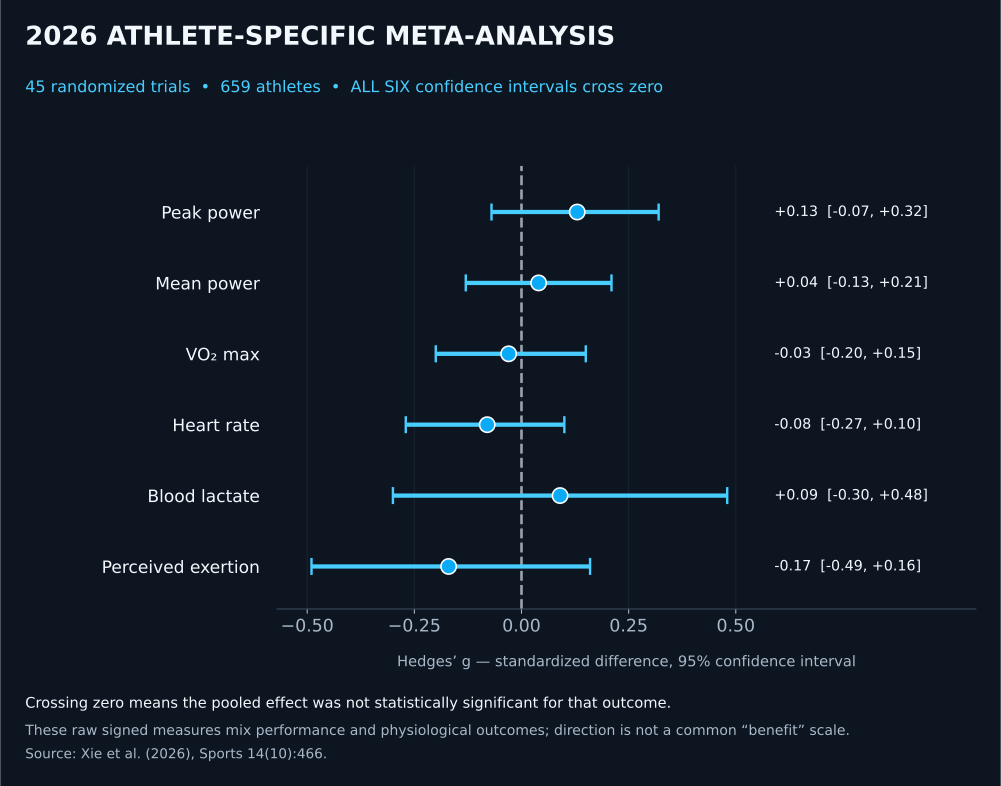
My translation: There might be a small benefit in some situations, but don't expect beet juice to add 50 pounds to your squat.
What About Actual Lifting?
One small 2020 study found more total reps after beetroot juice, mainly during squats. That's interesting. [3]
But a 2025 trial in 18 trained men tested 6, 12, and 24 mmol of nitrate and found no meaningful improvement in the tested squat, bench, or jump performances. [4]
A 2026 study in 16 trained women also found no significant advantage in bench-press or leg-press reps after nitrate-rich beetroot juice. [5]
As for building bigger muscles, we still don't have convincing evidence that beetroot supplementation improves long-term hypertrophy beyond good training.
For strongman, I'm more interested in longer loading medleys, repeated carries, and demanding conditioning than a single max deadlift. That's a plausible use—not a proven strongman advantage. We need actual competition-focused trials.
Beetroot vs. L-Citrulline
We've already covered citrulline in the Iron Library. Both can influence nitric-oxide availability, but they use different pathways.
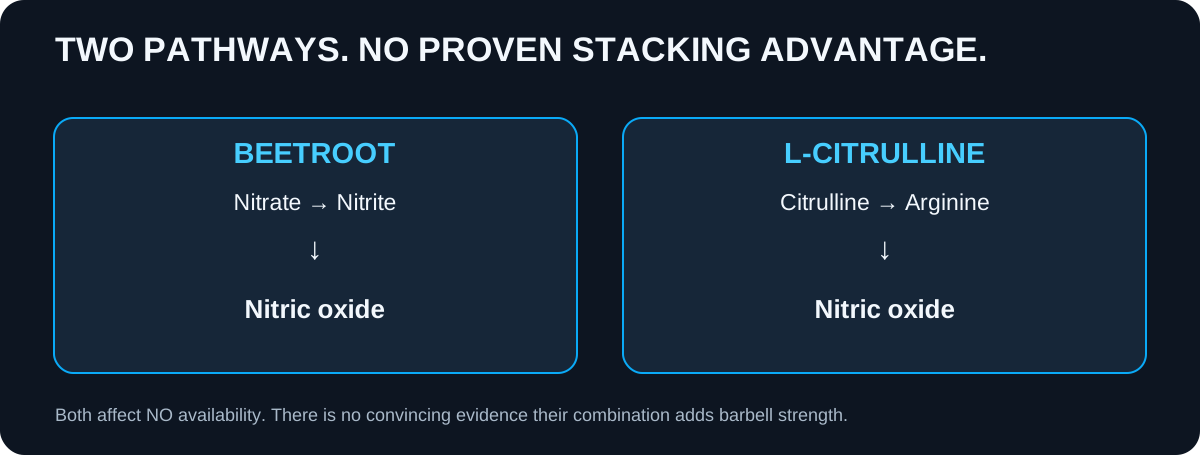
Different pathways don't guarantee some magical pre-workout stack. We don't have convincing evidence that combining both reliably improves maximal strength or muscle growth.
The Label Is Where Things Get Sketchy
Here's a detail I think every lifter should understand: 5 grams of beetroot powder is not the same as 5 grams of nitrate.
A laboratory analysis of 24 commercial products found a roughly 50-fold difference in nitrate content between products. Only 5 of 24 consistently supplied at least 5 mmol per tested serving. The samples were bought in 2017–2018, so this isn't a survey of today's products, but the quality-control lesson still matters. [6]
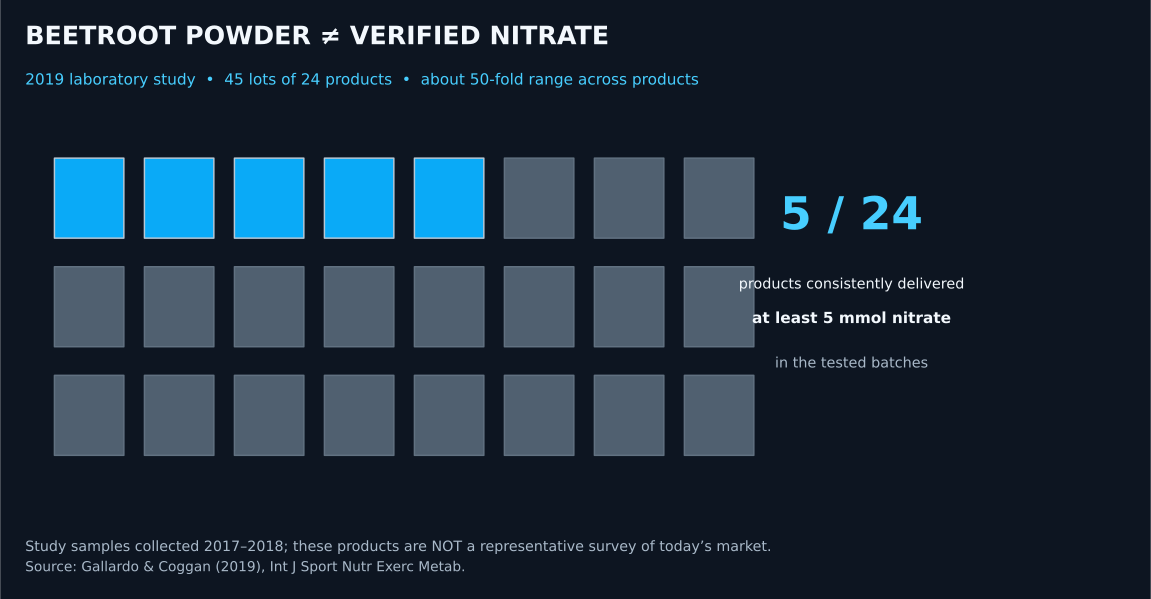
If a company can't tell you how much actual nitrate is in a serving, the fancy label isn't doing much for me.
Athlete Action Plan: Dose, Timing & Safety
Here's what the Australian Institute of Sport describes as a commonly studied nitrate protocol for selected endurance and conditioning situations—not a guarantee for lifters. [7]
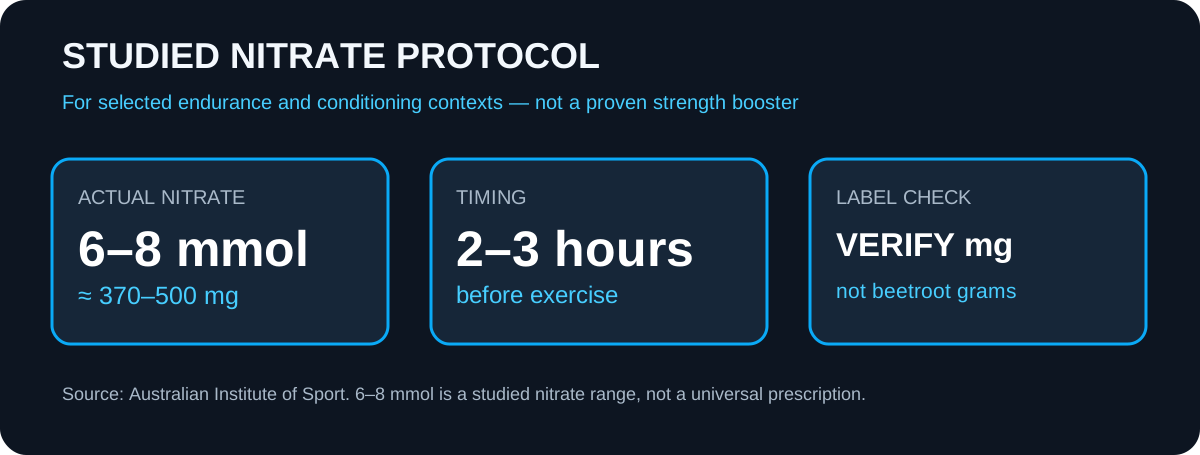
- Dose: About 6–8 mmol of actual nitrate, roughly 370–500 mg, has been studied. Look for verified nitrate content, not just grams of powder.
- Timing: Typically 2–3 hours before exercise. Some studies used several days of supplementation, but year-round use for lifters isn't established.
- Best fit: Potentially longer conditioning efforts; less convincing for maximal singles.
- Mouthwash: Strong antibacterial mouthwash can reduce nitrate-to-nitrite conversion. Don't stop prescribed dental care to chase a supplement benefit. [8]
- Track it: Compare event times or reps in comparable workouts. A bigger pump or red-colored shaker isn't proof it works.
- Safety: Concentrated beetroot may cause stomach discomfort and temporarily pink or red urine/stool. It can lower blood pressure; get professional guidance if you have low blood pressure, take blood-pressure medication, or have a history of calcium-oxalate stones.
And remember: more nitrate isn't automatically better. The study in trained men didn't find performance benefits even at its highest tested dose. [4]
My Take
I think beetroot juice is one of the more interesting non-stimulant performance supplements—especially for endurance and conditioning.
But for pure maximal strength? The research isn't convincing. And for strongman, we need better direct studies before promising anything.
If your training, calories, protein, creatine, and sleep aren't handled, a shot of beet juice probably isn't the missing piece.
The barbell doesn't care how impressive your supplement label looks.
Train hard. Recover harder. Let the science do the talking.
— Joel
Research & References
- Poon et al. (2025). Dietary nitrate and exercise performance: umbrella review of 20 systematic reviews. https://pubmed.ncbi.nlm.nih.gov/40085422/
- Xie et al. (2026). Meta-analysis of 45 randomized trials in athletes. https://pubmed.ncbi.nlm.nih.gov/42931603/
- 2020 randomized crossover lifting trial. Beetroot juice, squat and bench endurance. https://pubmed.ncbi.nlm.nih.gov/32605284/
- Egiazarian et al. (2025). Nitrate dose-response and resistance-exercise performance in trained men. https://pubmed.ncbi.nlm.nih.gov/40274664/
- Teodoro et al. (2026). Bench-press and leg-press endurance in trained women. https://pubmed.ncbi.nlm.nih.gov/42864982/
- Gallardo & Coggan (2019). Lab analysis of nitrate content in 24 beetroot products. https://pubmed.ncbi.nlm.nih.gov/30299195/
- Australian Institute of Sport. Dietary nitrate/beetroot supplement framework. https://www.ausport.gov.au/ais/nutrition/supplements/group_a/performance-supplements2/beetroot-juicenitrate
- Oral microbiome review (2022). Nitrate conversion and antiseptic mouthwash. https://pubmed.ncbi.nlm.nih.gov/35636654/
- Huberman Lab / Andy Galpin (2023). Optimal Nutrition & Supplementation for Fitness, 1:31:20. https://www.hubermanlab.com/episode/dr-andy-galpin-optimal-nutrition-and-supplementation-for-fitness
Educational content only; not individualized medical advice.