Training & Recovery
Alcohol & Muscle Recovery: Are You Drinking Away Your Gains?
What Drinking After Training Really Does to Sleep, Strength & Recovery
The practical take.
- Why it matters
- Heavy drinking after training can work against muscle protein synthesis, sleep and overnight recovery habits.
- What the evidence supports
- The 24% figure is from a short-term high-dose experiment in eight men, not a measured loss of long-term muscle gains. Wearable findings describe associations.
- Joel’s approach
- Joel protects sleep and training priorities, keeps alcohol from replacing recovery food and fluids, and treats tracker scores as context.
You train your ass off, hit your protein, take your creatine, and spend money on all kinds of recovery gadgets. Then you finish a competition or a brutal training week and knock back a bunch of drinks.
So are you drinking away your gains?
One beer isn't going to erase your workout. But getting hammered after training isn't exactly a recovery hack, either. And the science is worth looking at.
Alcohol and Muscle Growth: What the Study Actually Found
In a 2014 study, eight physically active men completed resistance training and hard cycling, then researchers compared different recovery drinks.
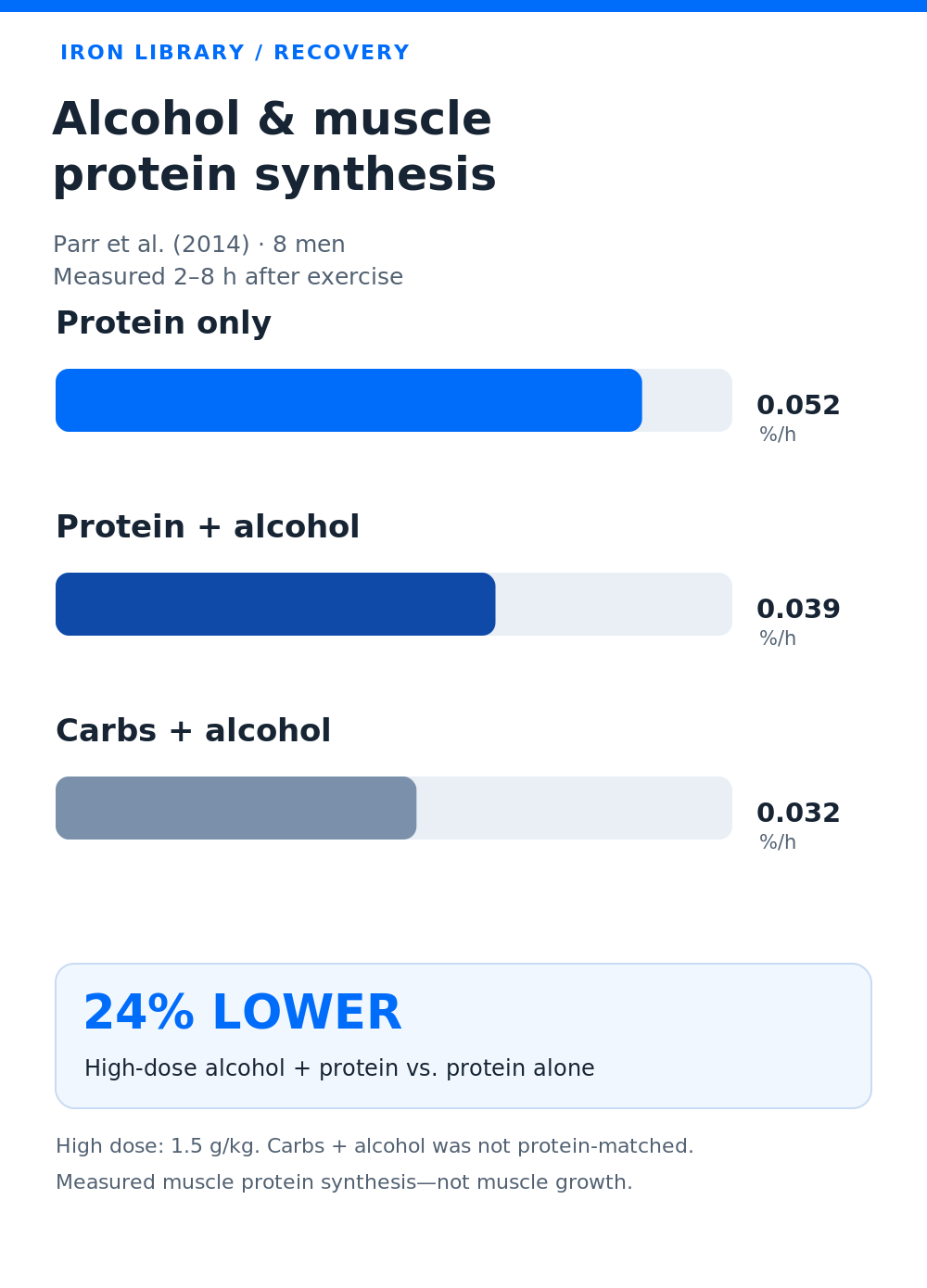
When they consumed a very large dose of alcohol along with protein, their post-exercise muscle protein synthesis was about 24% lower than when they consumed protein without alcohol.
Muscle protein synthesis is part of the process your body uses to repair and build muscle after training.
But don't twist the numbers. The study measured a short-term process over several hours. It did not show that drinking costs you 24% of your actual muscle gains over a training program.
Read the graphic in text
Parr et al. (2014): eight physically active men completed resistance and cycling exercise. Mean myofibrillar fractional synthesis rates were measured during hours 2–8 of recovery.
Protein only: 0.052% per hour; protein plus alcohol: 0.039% per hour; carbohydrate plus alcohol: 0.032% per hour. Means are shown without error bars. The alcohol dose was 1.5 g per kg of body weight.
The protein-and-alcohol condition had about 24% lower synthesis than protein alone. The carbohydrate-and-alcohol condition did not receive the same protein. These short-term rates do not establish a percentage loss of long-term muscle growth.
We're Not Talking About One Beer
Here's the detail that gets lost when people quote that study.
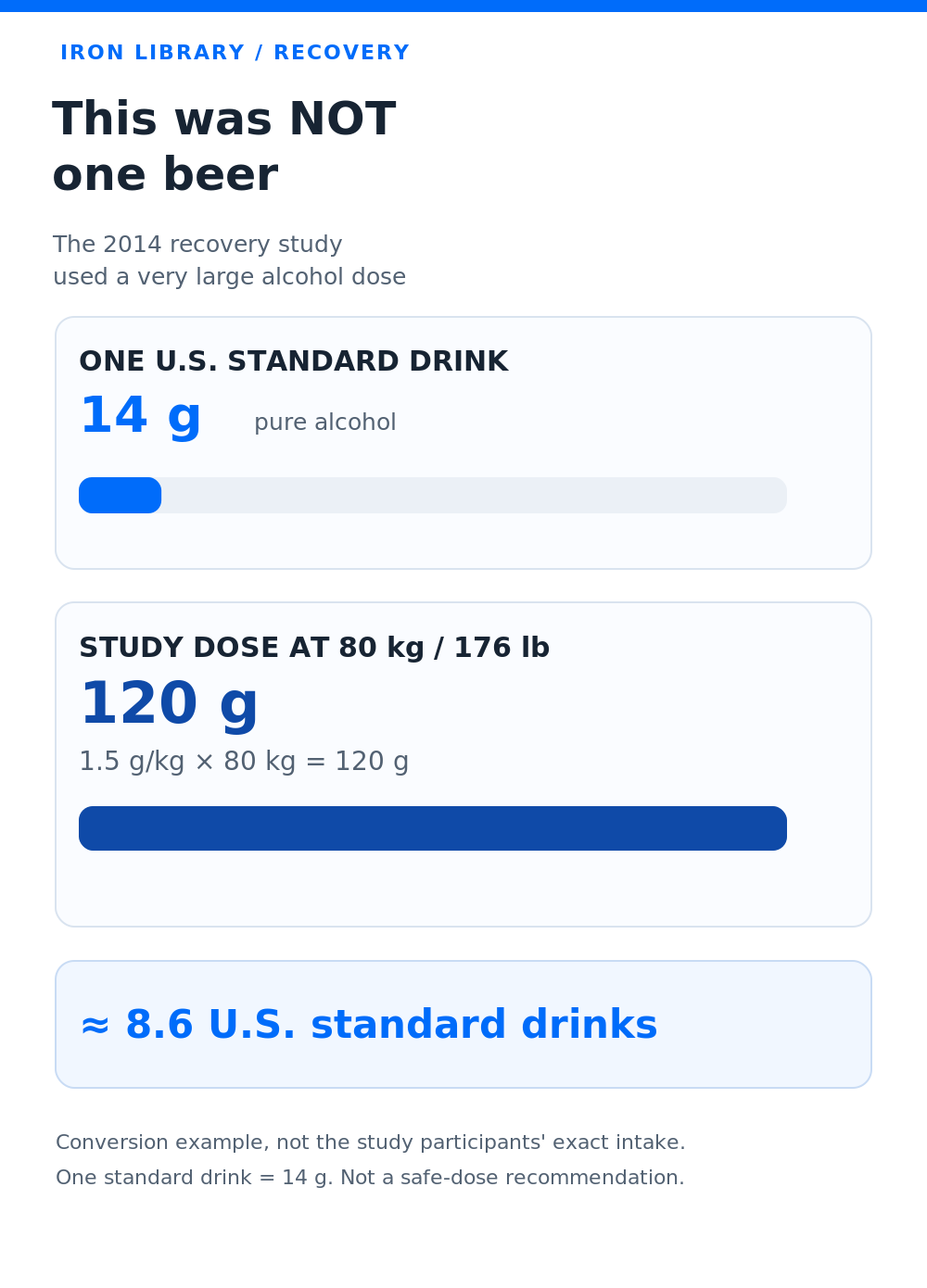
The alcohol dose was 1.5 grams per kilogram of body weight. For a 176-pound (80 kg) athlete, that's roughly 8.6 U.S. standard drinks. That's heavy drinking—not a beer with dinner.
Smaller-dose studies haven't consistently found the same losses in measured muscle-force recovery. But that doesn't prove smaller amounts are harmless, especially for sleep.
Read the graphic in text
One U.S. standard drink contains about 14 g of pure alcohol. The amount depends on both drink volume and alcohol percentage.
The study protocol used 1.5 g of alcohol per kg of body weight. For an illustrative 80 kg (176 lb) athlete: 1.5 × 80 = 120 g; 120 ÷ 14 is about 8.6 U.S. standard drinks.
This is a conversion example for a very large experimental dose, not the exact intake of every study participant, a typical serving or a drinking recommendation.
Alcohol Might Make You Sleepy. That Doesn't Mean You Sleep Better.
This is probably the biggest recovery issue for most athletes.
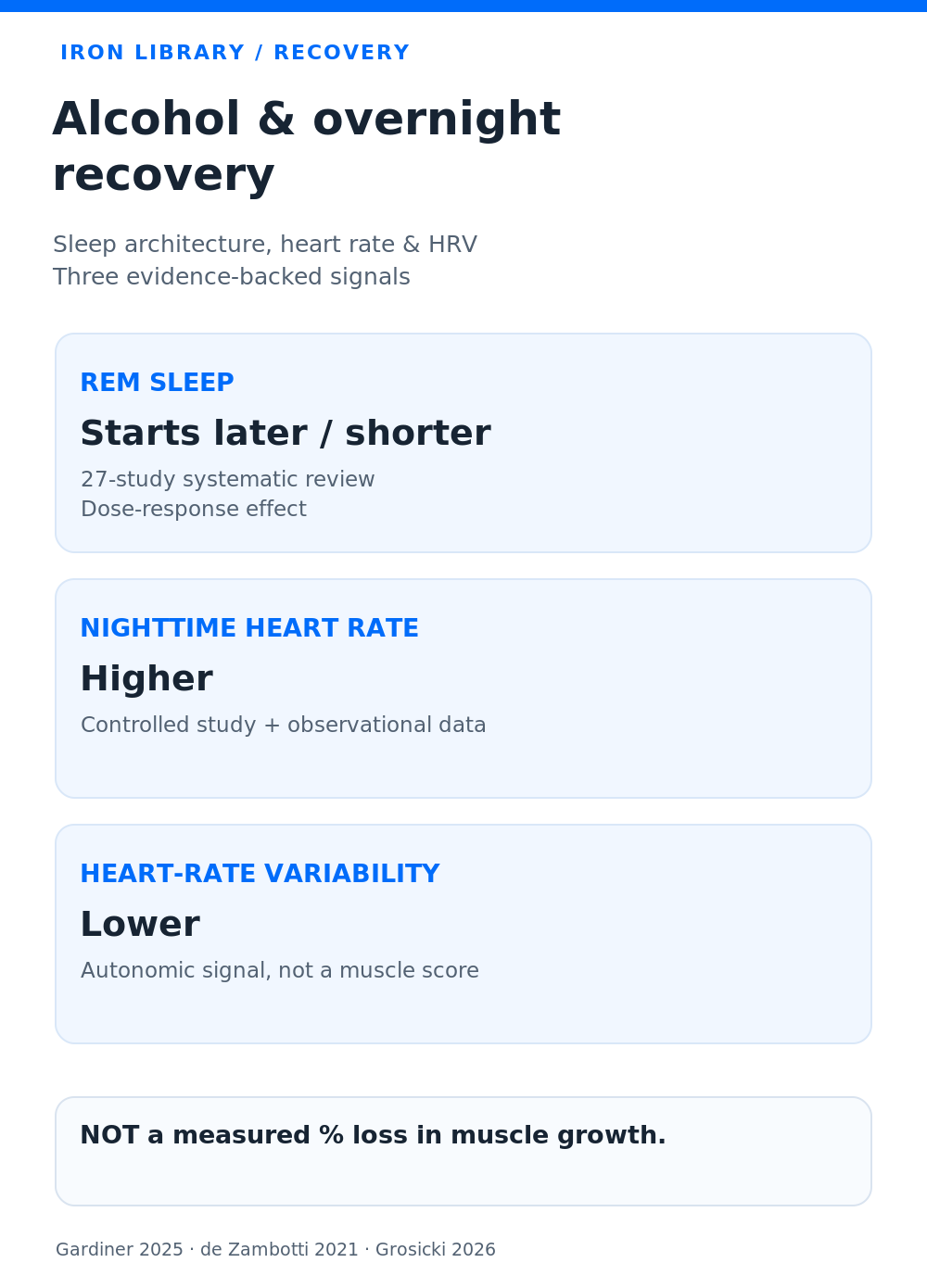
A 2025 systematic review covering 27 studies found that alcohol delayed REM sleep and reduced how much REM sleep people got. The effects showed up even at lower studied doses and generally became worse with more alcohol.
High doses sometimes helped people fall asleep faster. But passing out faster isn't the same as getting better-quality sleep.
REM sleep matters for normal brain function. That doesn't mean we can calculate lost muscle growth from lost REM minutes—but it does mean alcohol isn't a great bedtime recovery tool.
Read the graphic in text
Gardiner et al. (2025) reviewed 27 sleep studies. Alcohol delayed REM onset and reduced REM duration, with greater disruption as dose increased. This graphic does not assign an individual effect size.
Controlled laboratory research by de Zambotti et al. (2021) found higher nighttime heart rate and lower HRV after alcohol. Grosicki et al. (2026) analyzed 5,109,185 person-days from 20,968 WHOOP users and reported dose-related associations with higher resting heart rate, lower HRV, shorter sleep and lower next-day activity.
The wearable cohort is observational, not a randomized causal experiment. HRV is an autonomic signal, not a muscle-repair score. None of these results measures a percentage loss of muscle growth.
What About HRV and Recovery Scores?
This one should sound familiar if you use WHOOP, Oura, Garmin, or another tracker.
Controlled sleep-lab research has found higher nighttime heart rate and lower HRV after alcohol. And a 2026 study analyzing more than 5 million person-days of WHOOP data found similar dose-related associations, along with shorter sleep and lower next-day activity.
But remember what we covered in the sleep-tracker article: a lousy HRV score isn't a direct measurement of muscle damage. It can be a useful warning sign, not a muscle biopsy.
Alcohol can also worsen nighttime breathing problems in people with sleep apnea, which is another reason bigger lifters shouldn't brush off heavy snoring or gasping during sleep.
My Athlete Recovery Protocol
Here's how I'd approach alcohol if strength and recovery are the priority:
- Don't make heavy drinking your post-workout routine. The strongest direct muscle-protein evidence involves substantial alcohol intake after exercise.
- Keep it away from important lifting and competition days. You don't need to handicap tomorrow's session for tonight's buzz.
- Protect your sleep. Less alcohol—and not drinking close to bedtime—is a more sensible strategy than chasing a magical cutoff time.
- Eat and hydrate properly. Don't let drinks replace your post-training protein, food, water, or electrolytes.
- Use recovery data with some common sense. If your resting heart rate is elevated and HRV is down after drinking, look at the pattern. Don't pretend a single score tells you exactly how much muscle recovered.
And if alcohol use is frequent or hard to control, that's worth getting help with rather than trying to out-supplement it. Heavy daily drinking can also require medical guidance when cutting back.
The Bottom Line
I'm not saying you can't enjoy a drink and make gains. Plenty of people do.
But if you're training your ass off, obsessing over recovery, and regularly getting hammered afterward, you're working against some of the very things you're trying to improve.
The science doesn't tell us exactly how much a casual drink affects long-term muscle growth. It does tell us that heavy post-exercise drinking can blunt muscle protein synthesis, and alcohol can disrupt REM sleep and nighttime physiology.
Train hard. Eat your protein. Get your damn sleep. And don't let the booze do your recovery dirty.
Research & References
- Parr et al. (2014) — Alcohol and post-exercise muscle protein synthesis
- Gardiner et al. (2025) — Alcohol and sleep: systematic review of 27 studies
- de Zambotti et al. (2021) — Alcohol and nighttime cardiovascular physiology
- Grosicki et al. (2026) — Alcohol, heart rate, HRV, sleep, and activity
- Lakićević (2019) — Alcohol after resistance exercise: systematic review
- Kolla et al. (2018) — Alcohol and sleep apnea: meta-analysis
- NIAAA — What Is a Standard Drink?
General education for adult athletes, not individualized medical advice.