Training & Recovery
Sleep Supplements: What Actually Works—and What's Just Expensive Bedtime Bro Science?
Magnesium, Melatonin, Glycine, L-Theanine, Tart Cherry & the Truth About Recovery
The practical take.
- What it may help with
- Some supplements may help selected sleep problems. Feeling sleepy is not the same as better sleep or improved muscle recovery.
- What the evidence supports
- Benefits are modest, mixed or specific to the sleep problem. Research doses and wearable results do not establish a muscle-building stack.
- Joel’s approach
- Joel starts with sleep habits, identifies the actual problem and checks suitability and interactions before considering one change.
You get done training, eat your last meal, and look at your nightstand. Magnesium. Melatonin. Glycine. L-theanine. Maybe some tart cherry and another fancy “recovery” blend.
At some point, your bedtime routine starts looking like a supplement store.
I'm all for something that actually works. But feeling sleepy isn't the same as getting better sleep, and better sleep doesn't automatically mean bigger muscles. So let's see what the research actually says.
Melatonin: A Body-Clock Tool, Not a Knockout Pill
Melatonin helps signal when it's nighttime. It's most useful for certain problems with sleep timing, like jet lag or a delayed body clock—not as a mandatory nightly recovery supplement.
In one controlled study of people with delayed sleep-wake timing, 0.5 mg taken with a scheduled bedtime routine moved sleep onset about 34 minutes earlier than placebo. That's useful, but it doesn't mean every lifter needs melatonin or that bigger doses build more muscle.
My take: Fix the timing problem first. Don't assume melatonin is the answer to every bad night's sleep.
Magnesium: Some Promise, Not Magic
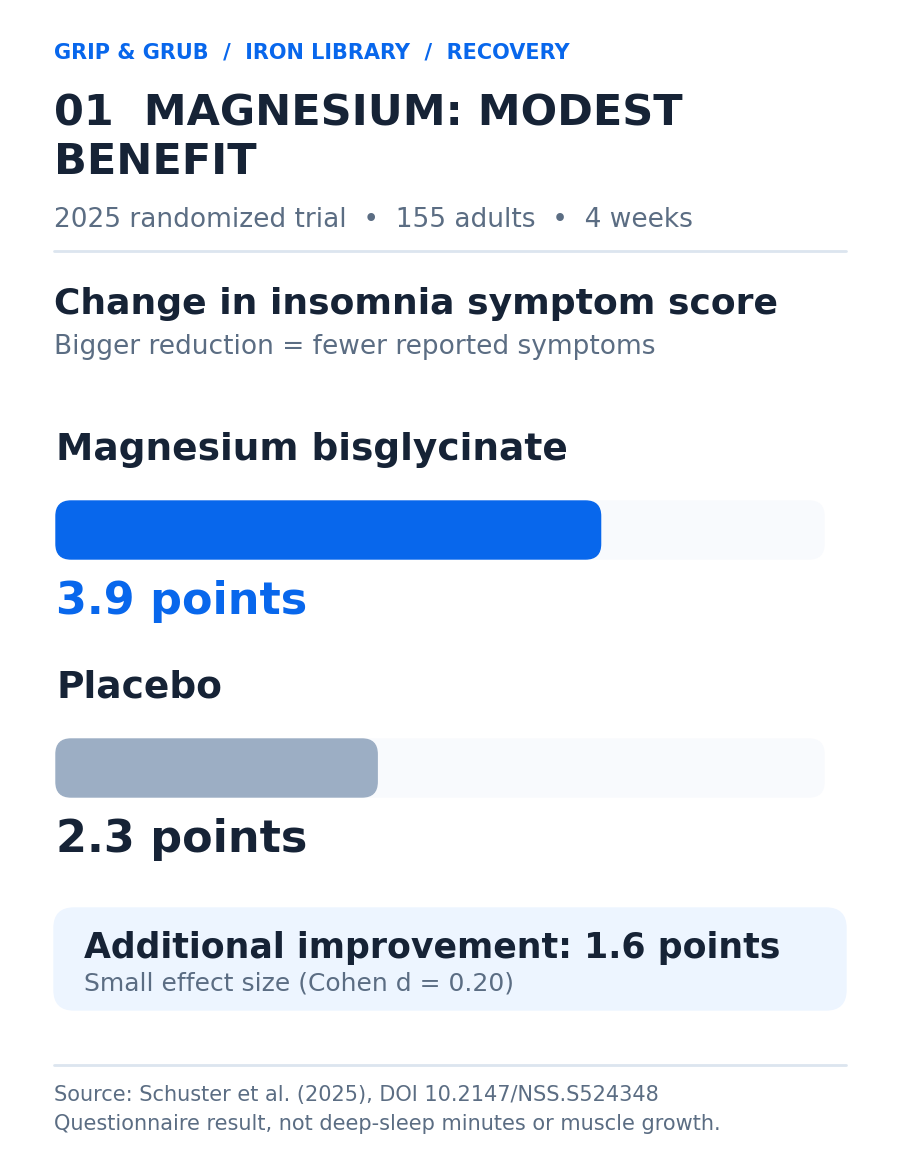
A 2025 study involving 155 adults tested 250 mg of elemental magnesium as bisglycinate for four weeks. Insomnia symptom scores improved by 3.9 points versus 2.3 with placebo—a statistically significant but small additional benefit.
And that was a questionnaire result, not proof of more deep sleep or faster muscle repair.
Magnesium L-threonate gets a lot of hype, too. A 2026 trial found some improvements in self-reported outcomes, but no significant differences in wearable-measured sleep outcomes. There's no convincing head-to-head proof that threonate beats glycinate for sleep.
Read the graphic in text
In Schuster et al. (2025), 155 adults reporting poor sleep were randomized to magnesium bisglycinate or placebo for four weeks. The studied dose supplied 250 mg elemental magnesium daily.
Baseline-adjusted Insomnia Severity Index reductions were 3.9 points with magnesium (95% CI 2.0–5.8) and 2.3 points with placebo (95% CI 0.4–4.1): an additional 1.6 points, with a small effect size (Cohen’s d = 0.20; p = 0.049).
These are questionnaire scores, not sleep minutes, deep-sleep measurements, strength gains or muscle repair. Larger reductions indicate fewer reported insomnia symptoms.
Glycine & L-Theanine: Interesting, but Don't Get Carried Away
Glycine has been studied at around 3 grams before bed, with some encouraging sleep and fatigue findings. But a 2026 review identified only three trials specifically testing supplemental glycine for sleep outcomes. That's preliminary, not a slam dunk.
L-theanine has a larger evidence base. A 2025 review covering 19 articles and 897 participants found improvements in several self-reported sleep measures. But many studies combined it with other ingredients, making it harder to know exactly what theanine accomplished on its own.
Neither one is proven to boost your one-rep max or muscle growth.
Tart Cherry: Don't Buy the 84-Minute Hype
You may have seen claims that tart cherry gives you an extra 84 minutes of sleep. That headline came from a tiny study with eight older adults with insomnia.
A much broader 2026 analysis of 10 trials and 294 participants found no statistically significant overall improvement in sleep quality. Certain insomnia subgroups looked promising, but the evidence was limited.
It might help some people. It isn't a guaranteed extra hour of recovery.
What About Apigenin and the Popular Sleep Stack?
Here's a study I wish more people talked about.
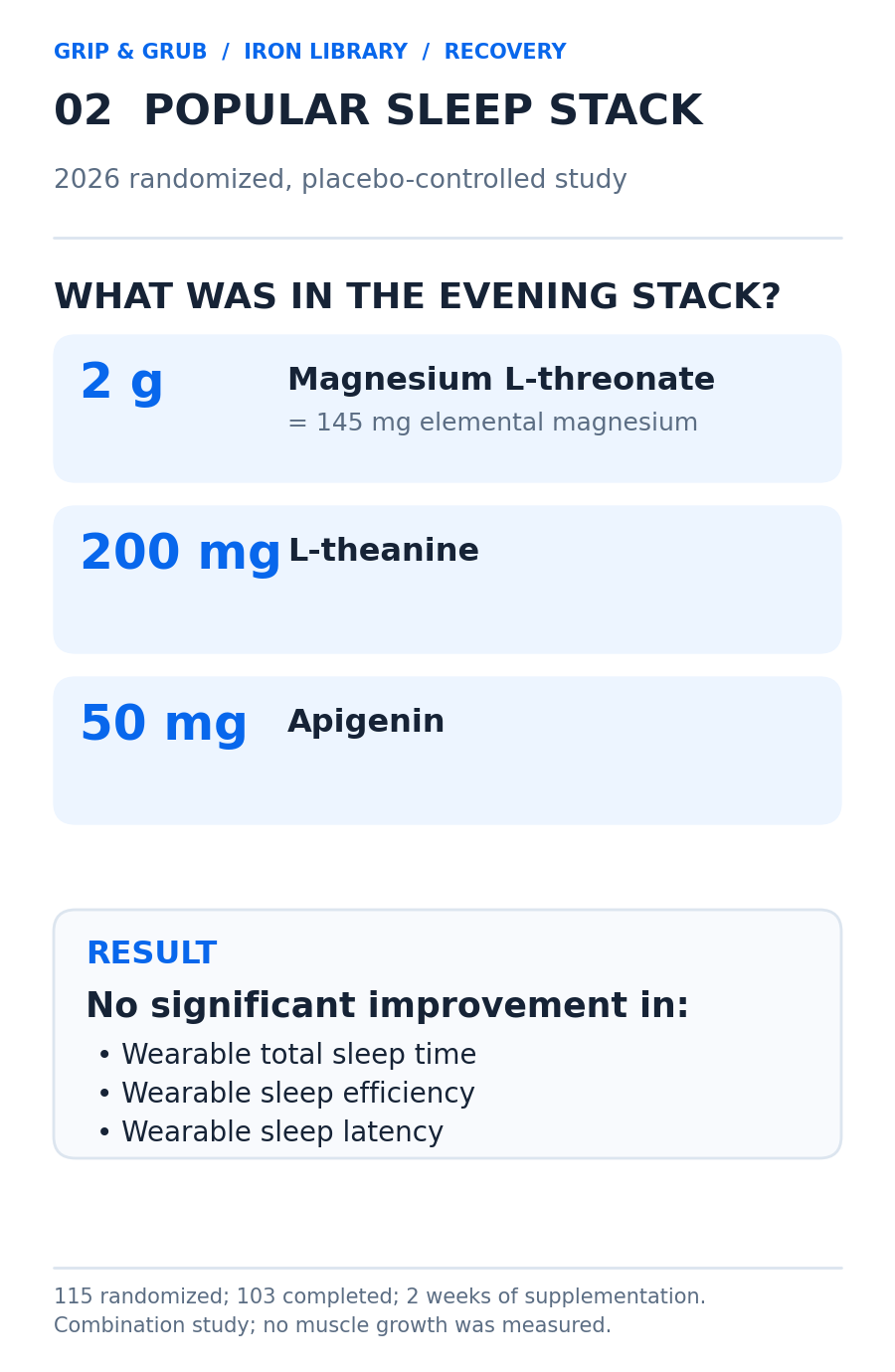
A 2026 randomized trial examined an evening combination containing 2 g magnesium L-threonate (145 mg elemental magnesium), 200 mg L-theanine, and 50 mg apigenin. Of 115 people randomized, 103 physically active adults completed the study.
After two weeks of supplementation, the evening stack did not significantly improve wearable-measured total sleep time, sleep efficiency, or sleep latency.
That doesn't prove every ingredient is useless. It does mean a popular stack hasn't earned the reputation some people give it—and apigenin alone still lacks convincing human sleep evidence.
Read the graphic in text
The 2026 four-arm study randomized 115 people, with 103 physically active adults completing the study. The active supplement period lasted two weeks, within a four-week study including baseline and washout.
The evening combination contained 2 g magnesium L-threonate supplying 145 mg elemental magnesium, 200 mg L-theanine and 50 mg apigenin. These are research doses, not a recommendation to use or combine them.
The evening stack did not significantly improve wearable-measured total sleep time, sleep efficiency or sleep latency. A combination study does not establish the effect of isolated apigenin or the other ingredients. Muscle growth and strength recovery were not measured.
Ashwagandha: Not for Everyone
Ashwagandha has some encouraging trials for stress and sleep, but it isn't risk-free. Extracts vary, and there are concerns involving the thyroid, liver, and medication interactions.
This isn't something I'd tell every strength athlete to toss into a bedtime stack without checking whether it's appropriate.
My Athlete Sleep-Supplement Protocol
Here's how I'd approach it before dropping another $100 on pills and powders:
- Get the basics right. Enough time asleep, a consistent schedule, a cool dark room, and smarter caffeine timing come first.
- Figure out the actual problem. Trouble shifting your sleep schedule isn't the same as insomnia, stress, or waking up gasping for air.
- Don't start five things at once. If you and your healthcare professional decide a supplement is reasonable, change one variable and see what actually happens.
- Check the label and interactions. Elemental magnesium isn't the same as the weight of a magnesium compound. Product quality and medications matter.
- Track real results. Falling asleep, staying asleep, waking refreshed, and training quality matter more than chasing a wearable's deep-sleep score.
Read the graphic in text
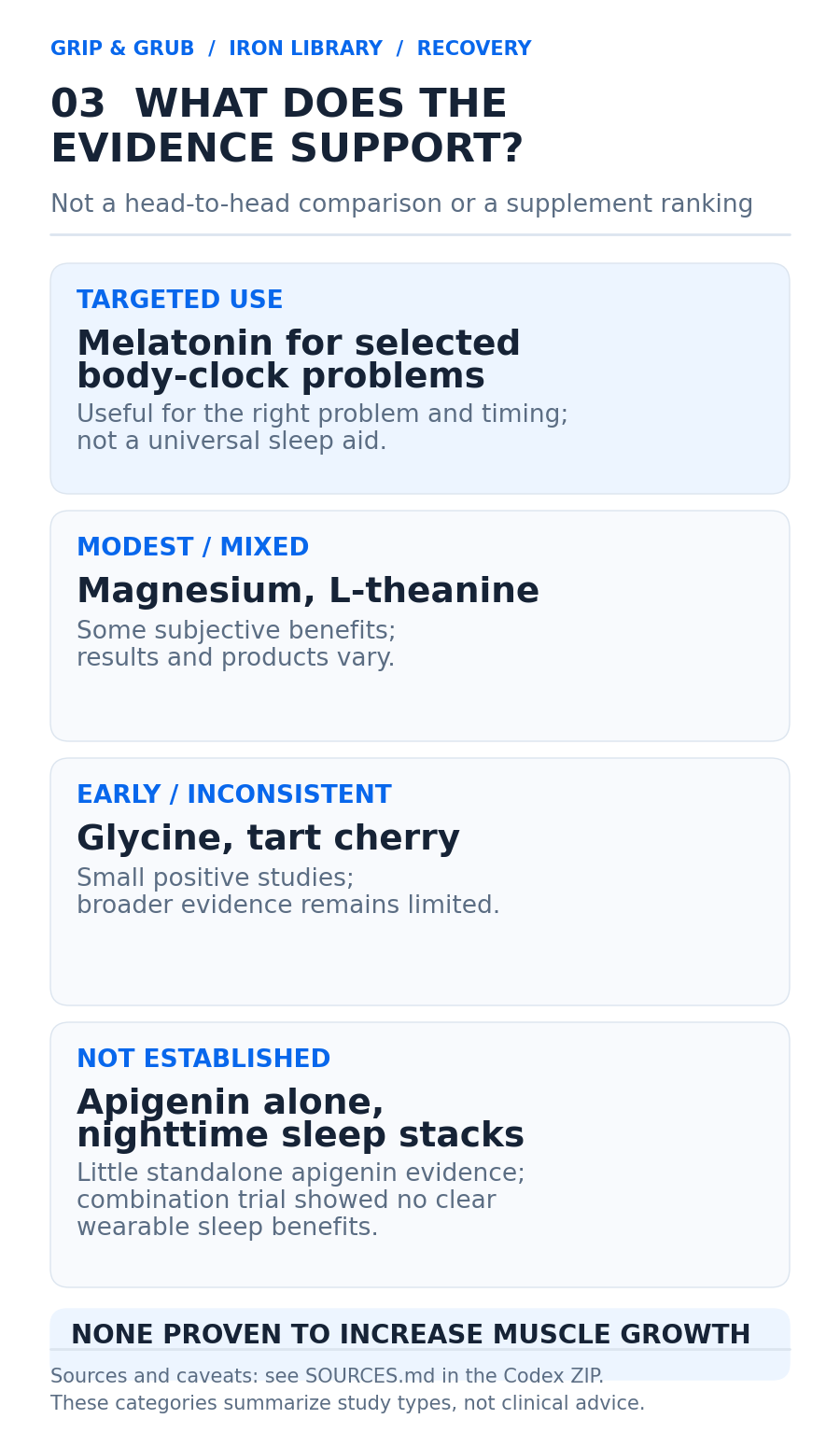
Targeted use: melatonin can help selected body-clock problems when the problem and timing fit; it is not a universal sleep aid.
Modest or mixed findings: magnesium and L-theanine have some self-reported benefits, with variable results.
Early or inconsistent evidence: glycine and tart cherry have some small positive studies; the broader evidence remains limited or mixed.
Not established: isolated apigenin and nighttime sleep stacks lack convincing standalone evidence; the cited combination trial found no clear wearable sleep benefit.
This is an editorial summary of research types, not a quantified efficacy score, a head-to-head ranking or a recommendation to combine supplements. No sleep-focused supplement stack discussed here has been proven to increase muscle growth.
And if you're dealing with ongoing insomnia or signs of sleep apnea, get that evaluated instead of trying to supplement your way around it.
The Bottom Line
I'm not anti-supplement. I'm anti-spending money on something just because the label says deep sleep, anabolic, or recovery.
Some ingredients have a purpose. Melatonin can help with certain timing problems. Magnesium and L-theanine may help some people, but effects are modest or inconsistent. The rest need better research.
None of these stacks has been proven to build more muscle just because you take it before bed.
Train hard. Fix your sleep habits. Use supplements when they actually make sense.
You don't need a pharmacy on your nightstand to recover like an athlete.
Research & References
- Schuster et al. (2025) — Magnesium Bisglycinate and Insomnia Symptoms
- Lopresti & Smith (2026) — Magnesium L-Threonate, Cognition and Sleep
- L-Theanine Sleep Outcomes: Systematic Review and Meta-Analysis (2025)
- Fan et al. (2026) — Glycine and Sleep: Scoping Review
- Tart Cherry Sleep Systematic Review and Meta-Analysis (2026)
- Multi-Compound Sleep Supplement Randomized Trial (2026)
- Sletten et al. (2018) — Melatonin for Delayed Sleep Timing
- NCCIH — Ashwagandha: Safety and Evidence
- Cohen et al. (2023) — Melatonin Gummy Label Accuracy
General education for adult athletes, not individualized medical advice.