Training & Recovery
Protein Before Bed: Are You Building Muscle While You Sleep?
Casein vs. Whey, How Much to Take, and Whether Timing Actually Matters

The practical take.
- What it may help with
- A pre-sleep protein serving can support overnight muscle protein synthesis, especially when it helps you meet your daily intake.
- What the evidence supports
- The growth trial also added protein and calories; it did not isolate bedtime timing. A single-night endurance study found no significant whey-versus-casein difference.
- Joel’s approach
- Joel prioritizes total daily protein, considers an optional 30–40 g evening serving when useful, and moves it earlier if it disrupts sleep.
We've all heard the old bodybuilding rule: drink a casein shake before bed or your muscles are going to starve all night.
But do you really need a special nighttime protein powder? Or is this another way to sell us one more tub of supplements?
Turns out, there's actual science behind eating protein before sleep. The catch is that supporting muscle repair overnight isn't the same as proving bedtime is the best time to eat it.
Your Muscles Don't Stop Working When You Sleep
Your body is still breaking down and rebuilding muscle proteins while you're asleep. And yes, it can digest a protein shake during that time.
In a 2012 study, 16 young men completed evening resistance exercise. Those who consumed 40 grams of casein about 30 minutes before bed had better overnight protein balance than those who received a placebo. The casein was digested and its amino acids were available during sleep.
So the nighttime shake isn't useless. Your body can absolutely put that protein to work.
Does Bedtime Protein Actually Build More Muscle?
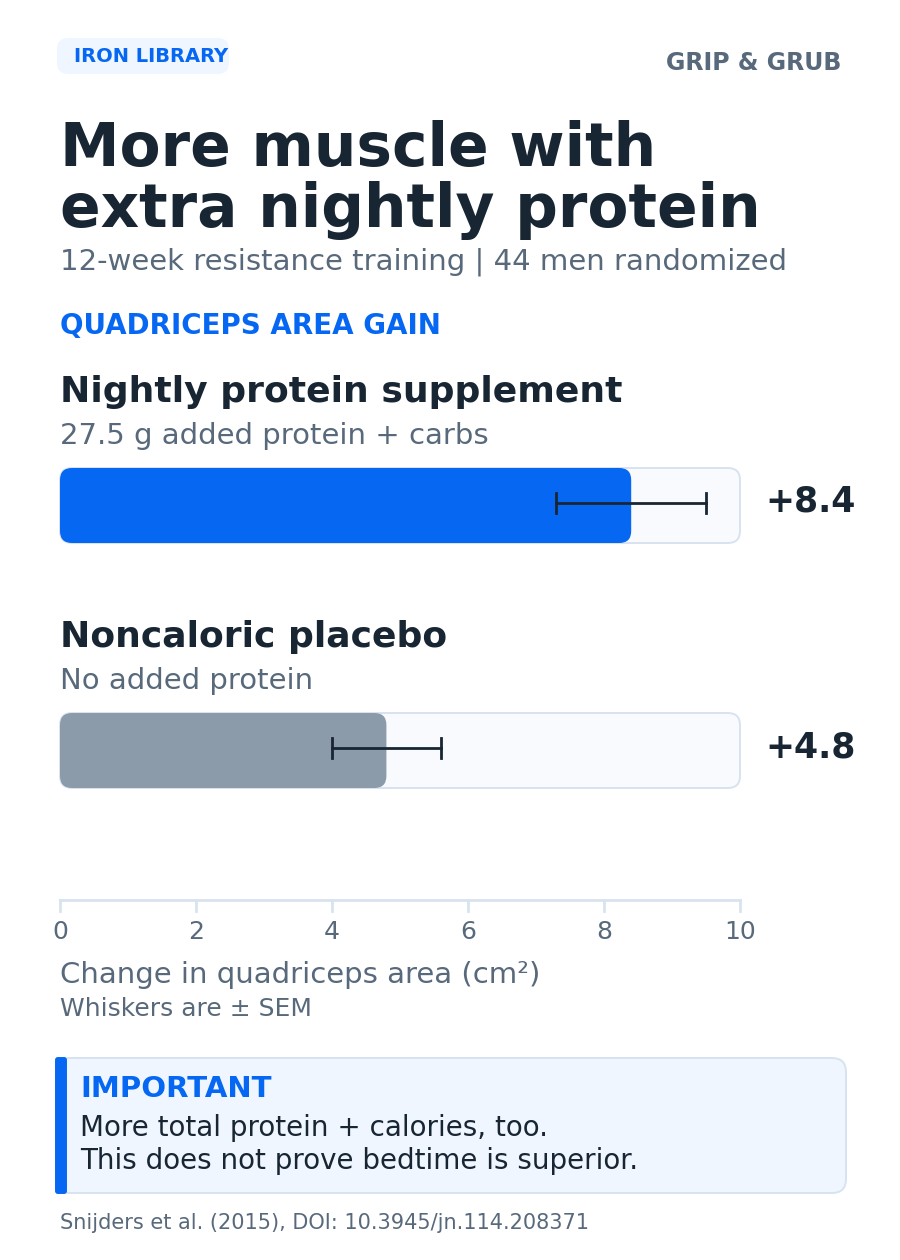
A 2015 study followed 44 young men through 12 weeks of resistance training. The group taking a nightly supplement gained more quadriceps muscle cross-sectional area: 8.4 cm² versus 4.8 cm² in the placebo group.
That's a pretty impressive difference.
But here's the catch. The bedtime group also consumed an additional 27.5 grams of protein and 15 grams of carbohydrates every night.
And that's the part I want people to understand.
Was it the timing—or just the extra protein? This study can't separate the two.
Read the graphic in text
Study design: 44 young men randomized to 12 weeks of resistance training; quadriceps cross-sectional-area analyses included 20 protein-group and 19 placebo-group participants.
The bedtime group received 27.5 g protein plus 15 g carbohydrate; the placebo was noncaloric.
Quadriceps area gains were 8.4 ± 1.1 cm² versus 4.8 ± 0.8 cm² (means ± SEM). Extra total protein and calories mean this study does not isolate a bedtime-timing advantage.
Casein vs. Whey: Which One Wins?
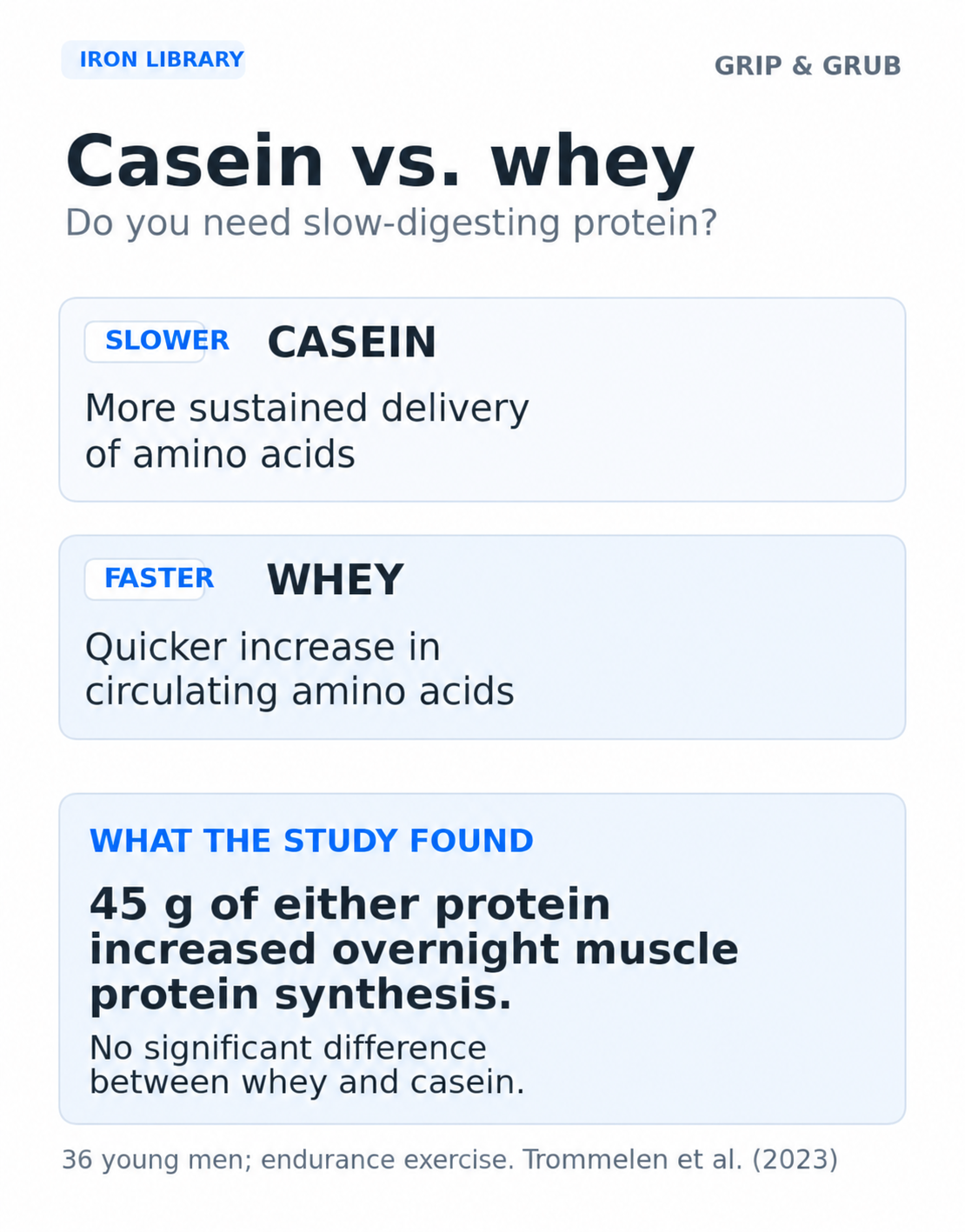
Casein digests more slowly. Whey digests faster. Both contain the essential amino acids your muscles need.
In a 2023 study, 36 young men consumed 45 grams of whey, 45 grams of casein, or placebo before sleep after evening endurance exercise.
Both protein groups supported overnight muscle protein synthesis, with no statistically significant difference between whey and casein.
Don't run out and buy casein just because somebody told you whey stops working when you fall asleep.
If whey works for your diet and digestion, use it.
Read the graphic in text
Casein delivers amino acids more slowly; whey produces a quicker rise.
Trommelen et al. (2023) studied 36 young men after evening endurance exercise: 45 g casein, 45 g whey, or noncaloric placebo before sleep.
Both protein groups increased overnight muscle protein synthesis compared with placebo, with no statistically significant difference between the proteins. This was not a long-term hypertrophy comparison or proof of equivalence in all settings.
What If You're Already Eating Enough Protein?
This is the biggest question.
A small 2018 study gave 13 men 35 grams of casein either during the day or before bed while keeping daily protein intake similar.
After 10 weeks of lifting, both groups gained strength and muscle size, without a significant difference between timing groups.
It's a small study, so it doesn't settle the debate. But it backs up how I look at this:
Your total daily protein matters more than chasing some magical 10 p.m. anabolic window.
Research-based recommendations generally fall around 1.4–2.0 grams of protein per kilogram of body weight per day for most exercising adults, although individual needs vary.
How Much Should You Eat Before Bed?
If a nighttime serving helps you meet your goal, 30–40 grams of high-quality protein is a practical starting point.
It's not a mandatory dose or some special absorption limit.
You can use whey, casein, Greek yogurt, cottage cheese, or a regular protein-containing meal.
One more thing: don't wreck your sleep trying to optimize recovery.
A small 2026 study suggested that pre-sleep whey might improve some sleep measures compared with carbohydrate, but it involved only nine resistance-trained adults. That's not enough to call whey a proven sleep aid.
If a late shake causes reflux, bloating, or nighttime waking, eat it earlier.
My Athlete Protein Protocol
Here's how I'd approach nighttime protein for strength athletes.
- Hit your daily protein first. That's the priority.
- Consider 30–40 grams in the evening if you trained late or are still short of your protein goal.
- Whey or casein? Pick whichever you tolerate, like, and can afford.
- Don't chase an exact bedtime deadline. Many studies used protein about 30 minutes before sleep, but that isn't a proven magic window.
- Protect your actual sleep. A good night's rest beats forcing down a shake you don't need.
Read the graphic in text
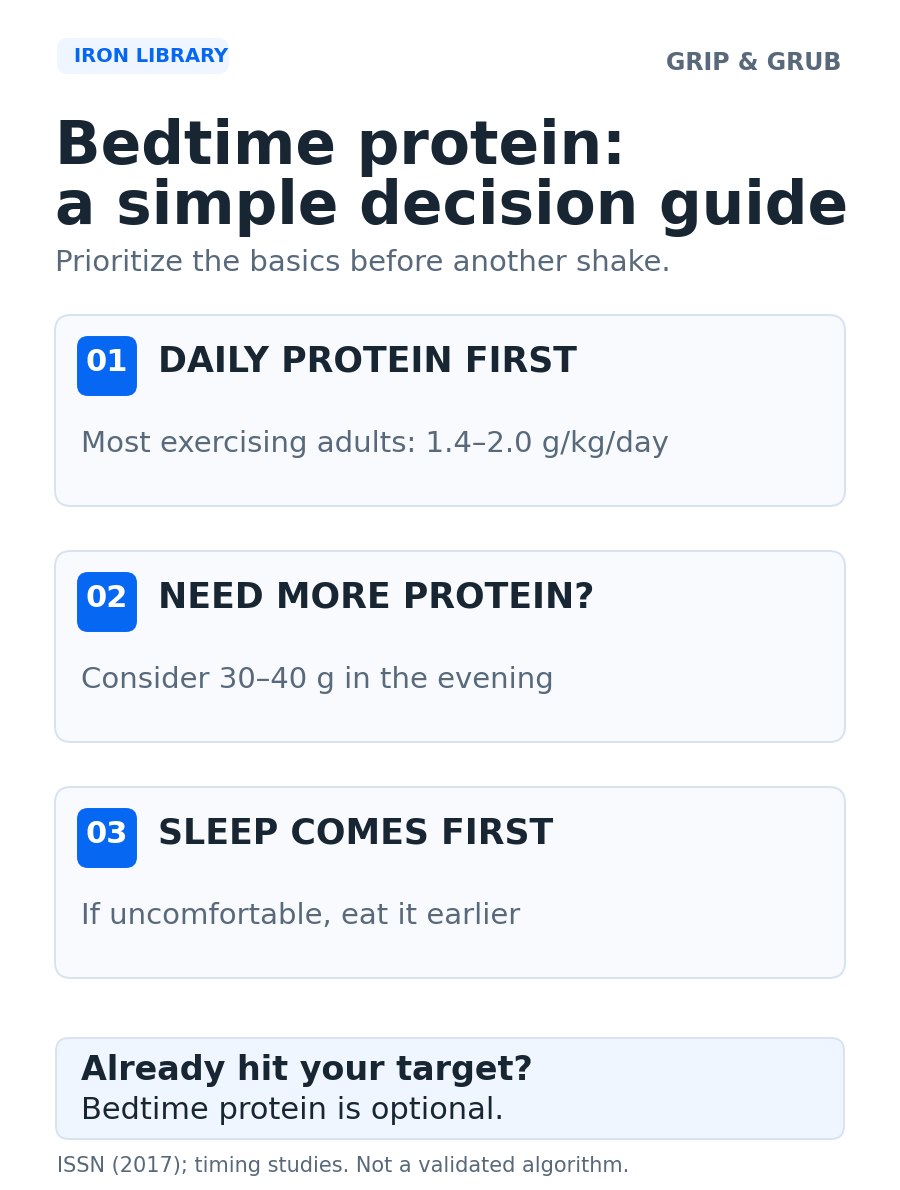
Prioritize total daily protein: the ISSN position stand describes about 1.4–2.0 g/kg/day as sufficient for most exercising adults; individual needs vary.
If you need another serving, consider about 30–40 g in the evening from whey, casein, yogurt or food. This is an optional practical strategy, not a mandatory dose or deadline.
If a late serving causes discomfort or disrupts sleep, move it earlier. A bedtime serving is optional if you already meet your daily target. This guide is not a validated muscle-growth algorithm.
The Bottom Line
Can protein before bed support overnight muscle-building processes? Absolutely.
Is it required to build muscle? No. And we don't have convincing evidence that bedtime protein builds more muscle than an equal amount eaten earlier when total daily intake is already sufficient.
We already spend enough money on recovery gadgets and supplements. You don't need another overpriced nighttime formula just because the label says anabolic.
Train hard. Hit your protein. Get your damn sleep.
Your muscles don't own a clock.
Research & References
- Res et al. (2012) — Protein Before Sleep and Overnight Recovery
- Snijders et al. (2015) — Bedtime Protein and Muscle Growth
- Trommelen et al. (2023) — Casein vs. Whey Overnight
- Joy et al. (2018) — Daytime vs. Nighttime Casein
- Jäger et al. (2017) — ISSN Position Stand: Protein
- Aussieker et al. (2026) — Pre-Sleep Protein and Sleep Quality
General education for adult athletes, not individualized medical advice.